
The reopening of the Suez Canal after the Yom Kippur War was far more than a technical achievement or a diplomatic milestone. It was a moment when geography, politics, economics, and human resilience collided and ultimately converged into one of the most significant post-war transformations of the Middle East. The canal has always been more than a trench carved through sand and seawater; it is a living artery of world commerce, a geopolitical pressure point, and a mirror reflecting the ambitions, fears, and resolve of nations. When it reopened in 1975 after eight long years of closure, rust, mines, and conflict, it didn’t just allow ships to pass again—it symbolized the prospect of a new regional order. For Egypt, for Israel, and for the world, the canal’s rebirth marked both the end of a tumultuous chapter and the beginning of a new and uncertain future.
The story begins in the aftermath of the 1967 Six-Day War, when Israel’s sudden occupation of the Sinai Peninsula transformed the Suez Canal from a world crossroads into the front line of a cold, tense, and dangerous standoff. The channel became a no-man’s-land, stretching from Port Said to Suez City, bristling with artillery positions, observation posts, and the constant threat of engagement. The great waterway that once carried tankers and cargo vessels from Europe to Asia now carried only floating mines, silt, and the wreckage of abandoned ships. For Egypt, the closure was both a humiliation and an economic catastrophe. For Israel, it was a buffer zone and a line of defense. For the world, it was a reminder that a single chokepoint could shape the fate of continents.
When the Yom Kippur War erupted in October 1973, the canal became the scene of drama, daring, and devastation. Egypt launched a surprise attack on Yom Kippur, crossing the canal in a meticulously planned amphibious operation that stunned Israel and briefly reshaped the regional battlefield. Israeli forces counterattacked and pushed into western banks. The canal’s waters, already stagnant from years of closure, now swallowed tanks, pontoon bridges, and the wreckage of battle. The war ended with both sides exhausted and the world shaken. The conflict had seen superpowers nearly step into direct confrontation, energy markets explode into crisis, and the Middle East thrown into its most precarious moment since 1948. Yet out of this storm emerged something unexpected: the first glimmer of real political possibility.
The United States, under Secretary of State Henry Kissinger’s shuttle diplomacy, maneuvered to bring Egypt and Israel from the brink of perpetual war to a fragile, but real, disengagement agreement. The canal, once a symbol of bitter rivalry, became the centerpiece of de-escalation. Egypt reclaimed its position along the east bank; Israel pulled back deeper into the Sinai. For Egyptian President Anwar Sadat, reopening the canal was not just a practical necessity—it was a national imperative, a powerful symbol of reclaiming sovereignty and charting a new course for his country.
Restoring the canal was a monumental undertaking, requiring international cooperation on an unprecedented scale. Engineers, divers, and specialists from the United States, Britain, France, and Japan joined Egyptian teams in a sweeping mission to clear wrecks, mines, unexploded ordnance, and debris that had accumulated over nearly a decade of war. It was dangerous work. Mines were unpredictable, shifting silently beneath the water’s surface. Sunken ships had twisted hulls and jagged steel that could trap divers. Some of the munitions were unstable relics from earlier conflicts. Yet the effort became a rallying point—a sign that Egypt was not merely repairing infrastructure but rebuilding its sense of purpose.
For Egyptians living along the canal’s banks, the restoration effort was emotional. Cities like Ismailia, Port Said, and Suez—once elegant hubs of shipping and cosmopolitan life—had become ghostly, scarred by artillery duels and emptied of their former vitality. Families had been displaced. Businesses were shuttered. Buildings bore the wounds of shrapnel. To see teams clearing the waterway and repairing docks felt like watching a battered but determined patient take their first steps after a long recovery. The canal was coming back to life, and with it, so were the communities that depended on it.
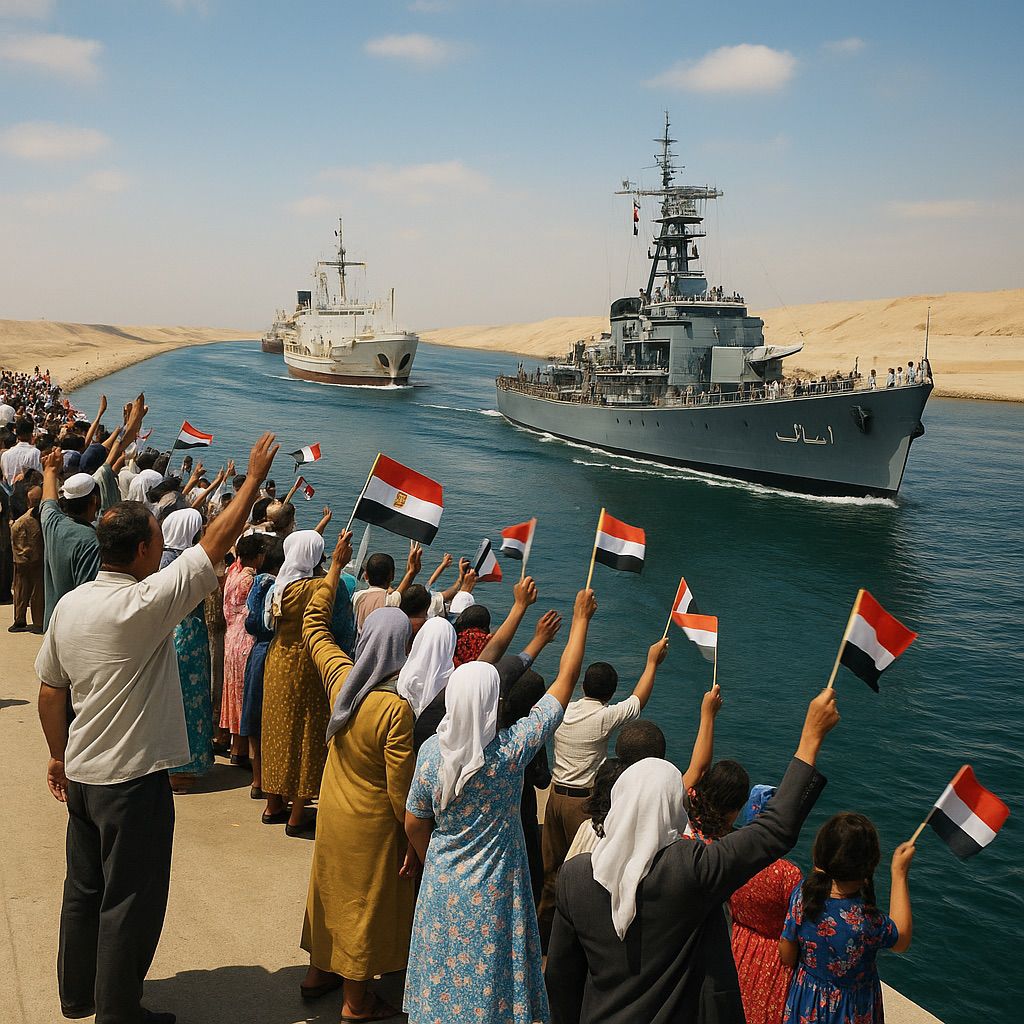
When the Suez Canal finally reopened on June 5, 1975, the moment was celebrated not just in Egypt but around the world. The first convoy of ships to pass through was led by the Egyptian destroyer El Nasser, followed by a symbolic assortment of vessels representing many nations. Crowds gathered along the banks, waving flags, cheering, and celebrating a triumph that was as much psychological as it was economic or political. The reopening signaled that Egypt was ready to step back into its role as a regional leader and partner in global maritime trade.
Economically, the impact was immediate and dramatic. The canal restored the shortest sea link between Europe and Asia, cutting thousands of miles off shipping routes that had been forced to detour around the Cape of Good Hope. Oil tankers, cargo carriers, and container ships once again flowed through the artery that connected the Mediterranean to the Red Sea. Revenue poured back into Egypt, providing billions in foreign currency and giving Sadat the breathing room he needed to pursue domestic reforms. For Europe and Japan, the reopening helped stabilize energy supplies still reeling from the 1973 oil shock. For global trade networks, it marked the return of a critical pressure valve in a system that had strained under the canal’s prolonged absence.
Diplomatically, the canal’s reopening helped accelerate a political transformation in the Middle East. Sadat, emboldened by the positive momentum and the strategic partnership emerging with Washington, became the first Arab leader to openly break with the Soviet Union’s orbit and seek a negotiated peace with Israel. The canal’s rebirth was proof that diplomacy could yield tangible results. Sadat used that credibility to take bold steps that few would have predicted just a few years earlier. His 1977 visit to Jerusalem—an act that shocked the Arab world—and the subsequent Camp David Accords were shaped in no small part by the environment of cautious optimism created by the reopening of the Suez Canal.
For Israel, the reopening of the canal was both a strategic adjustment and a window into a possible new era. The Yom Kippur War had revealed vulnerabilities and miscalculations, prompting Israeli leaders to reconsider assumptions that had governed their foreign policy since 1967. The canal’s return to Egyptian control was a reminder that occupation carried costs, risks, and limits. As disengagement lines solidified and hostilities cooled, the canal became a practical and symbolic boundary—one that encouraged Israeli leadership to think beyond short-term security and toward longer-term solutions. Though peace was still distant and fragile, the reopening helped create the conditions for dialogue.
On the world stage, the Suez Canal’s rebirth marked a recalibration of power dynamics. It reinforced the United States’ role as a mediator and stabilizing presence in the region, while diminishing Soviet influence. It strengthened Egypt’s economic leverage and enhanced its geopolitical relevance. It also cemented the canal’s status as one of the most important choke points in modern commerce—a reminder to the global community that stability in the Middle East was not just a regional concern but a worldwide necessity.
But beyond governments, policies, and economics, the canal’s reopening carried a deeply human dimension. Workers, sailors, engineers, and families had endured decades of uncertainty and conflict. For them, seeing ships glide once again through waters that had witnessed so much pain was profoundly emotional. The canal was not just a passageway; it was a testament to endurance. Local fishermen returned to work. Children played along the water’s edge, watching foreign sailors wave from passing decks. Homes and shops reopened. Streets once marked by craters were slowly repaired. It was as though the flow of water had brought with it a flow of life back into the region.
In many ways, the reopening of the Suez Canal stands today as a reminder that even in the aftermath of war, reconstruction is possible—not just of infrastructure, but of relationships, identity, and hope. The canal’s rebirth contributed to reshaping the geopolitical landscape, revitalizing local communities, and reintegrating Egypt into global trade. It symbolized the triumph of cooperation over confrontation and served as a rare moment when the world could collectively exhale after years of tension.
The canal continues to be vital to the global economy, carrying a significant percentage of the world’s trade and energy supplies. It remains a strategic fulcrum, a place where the ambitions of nations intersect with the everyday lives of workers and sailors. Yet the lesson of its reopening in 1975 still resonates today: even in a region marked by conflict, there are moments when the tides of history shift toward progress.
Ultimately, the reopening of the Suez Canal after the Yom Kippur War was far more than the resumption of maritime traffic. It was a declaration of renewal—one that rippled across Egypt, the Middle East, and the world. It reflected a rare convergence of diplomacy, determination, and collective effort. It offered a glimpse of what the region could be when nations chose rebuilding over battle, and dialogue over destruction. And it remains a testament to the enduring human capacity to repair what war breaks, to reopen what conflict closes, and to reclaim hope from the ashes of the past.