
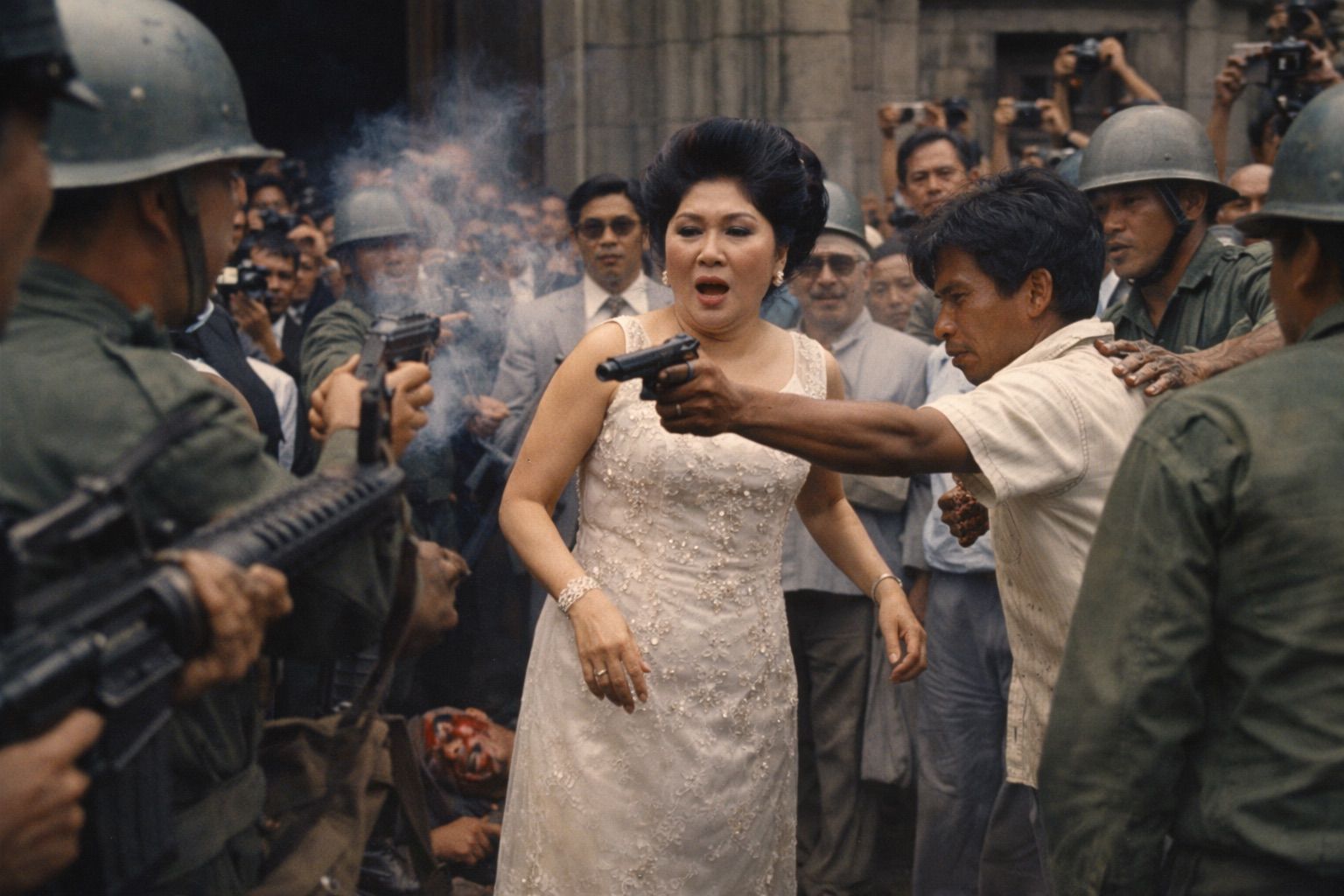
It was the early morning of August 31, 1972, and Imelda Marcos, the wife of Philippine President Ferdinand Marcos, had just finished attending a mass at the Manila Cathedral. As she stepped out into the bright sunlight, a crowd of well-wishers waited to greet her, their faces beaming with admiration for the woman who was widely regarded as one of the most beautiful and fashionable women in the world.
But amidst the chaos of flashing cameras and shouting voices, Imelda’s security detail suddenly sprang into action. A figure emerged from the crowd, his eyes fixed intently on the presidential couple. It was a young man named Danilo Salvador, a former soldier who had grown increasingly disillusioned with the Marcos regime’s corruption and abuses.
As Salvador drew closer to the President and his wife, Imelda’s guards quickly closed in around them, forming a tight cordon of steel helmets and machine guns. But it was too late – Salvador had already pulled out a pistol from beneath his shirt and was raising it towards Imelda.
The scene that unfolded next would become one of the most infamous moments in Philippine history: as Salvador fired his first shot, Imelda’s guards returned fire almost instantly, sending Salvador flying to the ground. But remarkably, despite being hit by multiple bullets, Salvador managed to struggle back to his feet and continue firing his pistol, sending chaos erupting through the crowded streets.
The attempted assassination of Imelda Marcos was a shocking and unprecedented attack on the regime that had held power in the Philippines for nearly two decades. The Marcoses were known for their ruthless suppression of opposition, and Imelda’s own reputation as a symbol of extravagance and corruption only seemed to fuel further resentment among the country’s growing anti-Marcos movement.
As news of the assassination attempt spread like wildfire through Manila, panic set in among the city’s residents. Soldiers sealed off major roads and buildings, while rumors swirled that Salvador was not acting alone – that he was part of a larger conspiracy to overthrow the Marcos regime once and for all.
Meanwhile, Imelda herself seemed almost detached from the mayhem unfolding around her. Despite being just inches away from death, she appeared remarkably composed, her designer heels still gleaming with dew as she moved through the crowds with an air of detachment that bordered on disdain.
The aftermath of the attempt was a blur of medical checks and frantic debriefings, as Imelda’s handlers scurried to contain the fallout. But beneath the surface, whispers began to circulate about the true nature of Salvador’s attack – whether it had been a genuine assassination attempt or simply a publicity stunt orchestrated by anti-Marcos forces.
Some claimed that Salvador was nothing more than a patsy, a mere pawn in a larger game of deception and disinformation designed to discredit the Marcos regime once and for all. Others pointed out that Salvador’s gun had somehow magically disappeared into thin air, leaving behind only a faint smudge of powder on Imelda’s dress.
The incident marked a turning point in the increasingly volatile politics of the Philippines. As anti-Marcos sentiment continued to simmer beneath the surface, the attempted assassination attempt served as a stark reminder of the regime’s brutal resolve to maintain its grip on power at any cost.
In the years that followed, Imelda would emerge as one of the most polarizing figures in Philippine history – a symbol of excess and corruption who seemed to embody everything that was wrong with the country’s corrupt elite. And yet, despite the numerous assassination attempts and plots against her life, she somehow managed to survive, her resilience and cunning earning her a reputation as one of the most formidable women in Southeast Asian politics.
Her eventual downfall would come more than two decades later, when her husband Ferdinand Marcos was finally forced from power by the People Power Revolution of 1986. As she fled Manila with a cache of stolen jewels and artworks, Imelda would leave behind a legacy that was as complicated as it was far-reaching – a testament to the darker side of Philippine politics and the enduring power of beauty, fashion, and charm.
As the days turned into weeks, the attempted assassination attempt became a national obsession. The Filipino media devoured every detail, speculating about Salvador’s motives and connections to anti-Marcos groups. Imelda herself seemed unfazed by the commotion, instead choosing to focus on her official duties as First Lady.
Behind the scenes, however, the Marcos regime was in disarray. Ferdinand Marcos, already growing increasingly paranoid and isolated, became convinced that Salvador was part of a larger conspiracy to overthrow him. He dispatched his trusted advisors to investigate, but it soon became clear that they were more interested in finding scapegoats than uncovering the truth.
The investigation into Salvador’s attack was marked by gross irregularities. Imelda’s guards claimed that Salvador had been acting alone, but some eyewitnesses contradicted this account, suggesting that there may have been multiple shooters involved. Others questioned why Salvador’s gun seemed to vanish into thin air, leaving behind only a faint smudge of powder on Imelda’s dress.
Meanwhile, the Marcos regime continued its campaign of intimidation and suppression against anti-Marcos groups. Protesters were beaten, arrested, and sometimes killed, while opposition leaders were forced into hiding or exile. The country was gripped by fear and uncertainty, with many Filipinos wondering if they would ever be able to express themselves freely without facing reprisals.
Imelda’s reputation as a symbol of extravagance and corruption only continued to grow during this period. Her love of designer clothing and jewelry was matched only by her passion for building grandiose monuments and infrastructure projects that served no practical purpose but to showcase the regime’s power and wealth. The Marcoses’ ill-gotten gains were embezzled, laundered, and hidden away in secret bank accounts and offshore safe havens.
Despite the mounting criticism, Imelda remained defiant, using her charm and wit to deflect attention from the regime’s misdeeds. She charmed foreign dignitaries with her fashion sense and graciousness, while at home she promoted herself as a champion of women’s rights and social justice. It was a facade that few believed, but one that allowed her to maintain her status as a global celebrity.
The attempted assassination attempt had also sparked a renewed focus on Imelda’s personal life. Rumors began circulating about her supposed obsession with beauty and youth, with some speculating that she had undergone extensive plastic surgery to maintain her stunning appearance. Others claimed that she was an expert manipulator who used her charm and beauty to get what she wanted from powerful men.
It is worth noting that these claims were often based on half-truths or outright fabrications. While Imelda’s obsession with fashion and beauty was certainly well-documented, it was unlikely that she had undergone as much surgery as claimed. Moreover, while she may have used her charm to influence others, this was largely a product of her background as a socialite and politician’s wife.
The reality was more complex, reflecting the contradictions and paradoxes at the heart of Imelda’s character. She was both a symbol of beauty and excess, yet also a shrewd operator who had mastered the art of politics through sheer force of will. Her story was one of self-invention and reinvention, as she adapted to changing circumstances and transformed herself into a global celebrity.
In many ways, Imelda’s life was a microcosm of the Philippines itself – a country torn apart by conflicting forces and ideologies. The attempts on her life reflected the broader struggle for power and control that had defined the nation since its independence from Spain in 1898. It was a story of colonialism, corruption, and revolution, with Imelda herself embodying both the glamour and decay of a dying regime.
The years following the attempted assassination attempt saw Imelda become increasingly entrenched as First Lady. Her reputation as a master manipulator only grew, as she skillfully navigated the complex web of alliances and rivalries within the Marcos court. She continued to charm foreign dignitaries and celebrities, using her beauty and wit to build support for the regime.
But beneath the surface, tensions were brewing. Anti-Marcos sentiment was growing more vocal and widespread, with opposition groups like the Moro National Liberation Front (MNLF) and the Communist Party of the Philippines (CPP) gaining strength in the countryside. The Philippines was sliding towards chaos, with Ferdinand Marcos’s increasingly authoritarian rule sparking widespread protests and violence.
In this climate of fear and uncertainty, Imelda’s role as First Lady became more critical than ever. As a unifying figure, she helped to paper over the cracks in the regime’s facade, using her charm and charisma to reassure allies and distract from the growing unrest.
But beneath the surface, she was acutely aware of the threat to her own survival – and that of her husband’s regime. She knew that as long as Ferdinand remained in power, she would continue to be a target for anti-Marcos activists and opposition groups. And so, with characteristic cunning and determination, Imelda set about securing her future, using every trick in the book to protect herself and her loved ones from the forces of change.
The fate of the Marcos regime was already sealed, however. The seeds of its downfall had been sown years earlier, as corruption, abuse, and incompetence had gradually eroded public trust in the government. It would take one final push – the People Power Revolution of 1986 – to finally topple Ferdinand from power.
As Imelda watched her husband flee Manila with a cache of stolen jewels and artworks, she knew that her own legacy was at stake. Would she be remembered as a symbol of excess and corruption, or as a shrewd operator who had adapted to changing circumstances? The answer would depend on how history chose to remember her – but for now, Imelda Marcos remained an enigma, a testament to the enduring power of beauty, fashion, and charm in shaping the course of human events.