
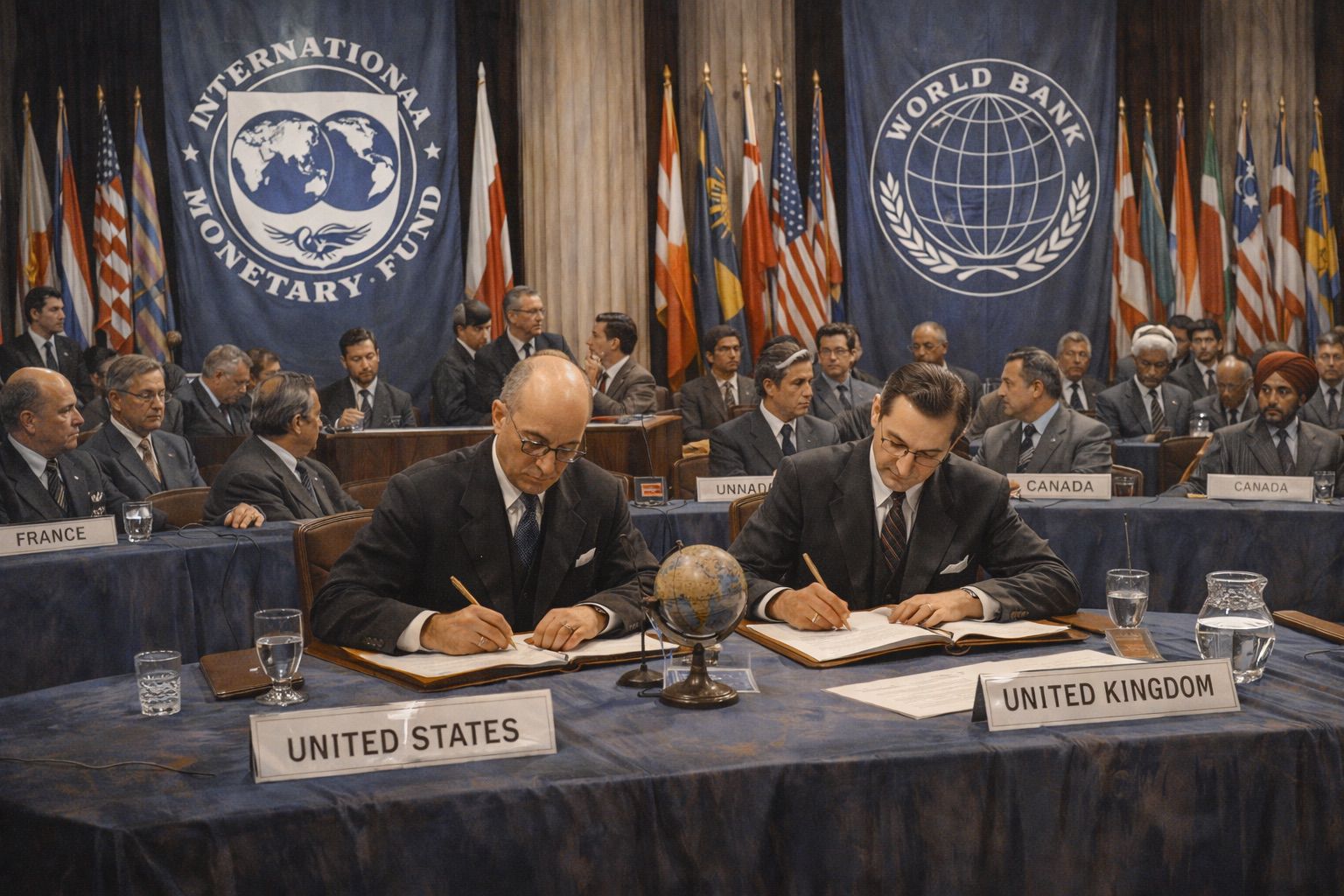
In the aftermath of World War II, the international community was faced with the daunting task of rebuilding and restructuring the global economy. The devastation caused by the war had left many countries in shambles, and the Bretton Woods Conference held in 1944 brought together representatives from 44 nations to discuss the creation of a new international monetary order. The conference resulted in the establishment of two key institutions: the International Monetary Fund (IMF) and the World Bank.
The IMF was established with the primary goal of promoting international economic cooperation and stability, particularly in the areas of exchange rates and balance of payments. The fund’s initial resources were provided by its member countries, which contributed a portion of their foreign exchange holdings to create a pool of liquidity that could be drawn upon in times of need. The IMF was also tasked with promoting trade and investment, as well as providing technical assistance and capacity-building programs for developing countries.
The World Bank, on the other hand, was established to provide financing for development projects and policies in developing countries. Its primary goal was to reduce poverty and promote economic growth through the provision of loans, guarantees, and advisory services. The bank’s initial capitalization came from its 45 founding member countries, which contributed a total of $10 billion to create a fund that could be used to finance development projects.
The IMF and World Bank were designed to work together in tandem, with the IMF focused on macroeconomic stabilization and the World Bank focused on structural transformation. This division of labor was intentional, as it allowed both institutions to leverage their comparative advantages and complement each other’s efforts. The IMF was seen as a more rapid response institution, able to provide emergency financing and technical assistance in times of crisis. In contrast, the World Bank was viewed as a longer-term development institution, focused on promoting sustainable economic growth through targeted investments.
In its early years, the IMF played a crucial role in stabilizing exchange rates and preventing competitive devaluations that had plagued the international economy in the 1930s. The fund’s innovative approach to currency stabilization, which involved setting adjustable pegs between currencies rather than fixed pegs, helped to reduce the risk of speculative attacks on currencies and stabilize exchange rates. This approach also gave countries more flexibility to adjust their economic policies in response to changing economic conditions.
The IMF’s early years were marked by significant challenges, particularly with regards to its lending policies. The fund’s initial rules required that loans be repaid within a specified timeframe, which often placed an excessive burden on borrowing countries. Additionally, the IMF’s conditionality clause, which tied loan disbursements to policy reforms and structural adjustments, was criticized for imposing overly stringent requirements on borrower countries.
Despite these challenges, the IMF played a key role in stabilizing exchange rates and promoting economic growth in the post-war period. Its innovative approach to currency stabilization, combined with its provision of emergency financing and technical assistance, helped to reduce the risk of economic instability and promote international cooperation.
The World Bank’s early years were marked by significant successes, particularly in the areas of infrastructure development and poverty reduction. The bank’s initial focus on large-scale infrastructure projects, such as dams and highways, was seen as a key driver of economic growth and development. However, the bank soon recognized that its lending policies needed to be more nuanced and country-specific.
In response to these needs, the World Bank began to shift towards a more flexible and adaptive approach to lending. This involved working closely with borrowing countries to develop customized project proposals that met their unique needs and priorities. The bank also placed greater emphasis on poverty reduction and social development, recognizing that economic growth was not an end in itself but rather a means to improve the lives of citizens.
Throughout its early years, the IMF and World Bank were criticized for their perceived biases towards Western-style capitalism and free market principles. Developing countries often felt that these institutions were imposing overly stringent conditions on loan disbursements, which limited their ability to implement policies tailored to their unique needs and circumstances.
Despite these criticisms, both institutions continued to play a key role in promoting international economic cooperation and stability. Their innovative approaches to macroeconomic stabilization and structural transformation helped to reduce the risk of economic instability and promote sustainable economic growth.
As the years passed, the IMF and World Bank underwent significant reforms designed to address some of the criticisms leveled against them. The IMF introduced a new lending policy that placed greater emphasis on country ownership and flexibility, allowing countries to tailor their loan agreements to meet their specific needs. The bank also adopted more nuanced approaches to poverty reduction and social development, recognizing the importance of these factors in driving economic growth.
Today, both institutions continue to play critical roles in promoting international economic cooperation and stability. Their innovative approaches to macroeconomic stabilization and structural transformation have helped to reduce the risk of economic instability and promote sustainable economic growth.
The IMF’s early years were marked by significant challenges, particularly with regards to its lending policies. The fund’s initial rules required that loans be repaid within a specified timeframe, which often placed an excessive burden on borrowing countries. Additionally, the IMF’s conditionality clause, which tied loan disbursements to policy reforms and structural adjustments, was criticized for imposing overly stringent requirements on borrower countries.
One of the earliest criticisms of the IMF came from the United States, which had initially been a strong supporter of the fund. In 1947, U.S. Treasury Secretary John W. Snyder expressed concerns that the IMF’s lending policies were too restrictive and would limit the ability of countries to implement policies tailored to their unique needs and circumstances.
Despite these criticisms, the IMF continued to play a key role in stabilizing exchange rates and promoting economic growth in the post-war period. Its innovative approach to currency stabilization, combined with its provision of emergency financing and technical assistance, helped to reduce the risk of economic instability and promote international cooperation.
In the 1950s and 1960s, the IMF began to expand its membership and lending activities. The fund’s initial resources had been provided by its member countries, which contributed a portion of their foreign exchange holdings to create a pool of liquidity that could be drawn upon in times of need. However, as the global economy continued to grow and develop, the IMF recognized the need for additional resources to meet the increasing demands for financing.
To address this issue, the IMF implemented several reforms aimed at expanding its lending capacity. In 1952, the fund introduced a new lending policy that allowed it to provide longer-term loans with more flexible repayment terms. This change was designed to reduce the burden on borrowing countries and make it easier for them to access IMF financing.
The World Bank’s early years were marked by significant successes, particularly in the areas of infrastructure development and poverty reduction. The bank’s initial focus on large-scale infrastructure projects, such as dams and highways, was seen as a key driver of economic growth and development. However, the bank soon recognized that its lending policies needed to be more nuanced and country-specific.
In response to these needs, the World Bank began to shift towards a more flexible and adaptive approach to lending. This involved working closely with borrowing countries to develop customized project proposals that met their unique needs and priorities. The bank also placed greater emphasis on poverty reduction and social development, recognizing that economic growth was not an end in itself but rather a means to improve the lives of citizens.
One notable example of the World Bank’s early successes was its involvement in the development of the Aswan Dam in Egypt. Completed in 1964, the dam was one of the largest hydroelectric projects in the world at the time and provided electricity for millions of people in Egypt. The project also helped to reduce poverty and improve living standards in rural areas.
Throughout its early years, the IMF and World Bank were criticized for their perceived biases towards Western-style capitalism and free market principles. Developing countries often felt that these institutions were imposing overly stringent conditions on loan disbursements, which limited their ability to implement policies tailored to their unique needs and circumstances.
In response to these criticisms, both institutions continued to evolve and adapt to changing global economic conditions. The IMF introduced a new lending policy that placed greater emphasis on country ownership and flexibility, allowing countries to tailor their loan agreements to meet their specific needs. The bank also adopted more nuanced approaches to poverty reduction and social development, recognizing the importance of these factors in driving economic growth.
Today, both institutions continue to play critical roles in promoting international economic cooperation and stability. Their innovative approaches to macroeconomic stabilization and structural transformation have helped to reduce the risk of economic instability and promote sustainable economic growth.
However, there is still much work to be done. Many developing countries continue to face significant challenges in terms of poverty reduction, inequality, and access to basic services such as healthcare and education. The IMF and World Bank must continue to evolve and adapt to meet these changing needs and ensure that their policies are effective in promoting sustainable economic growth and reducing poverty.
In recent years, both institutions have made significant efforts to address some of the criticisms leveled against them. The IMF has introduced a new approach to lending that emphasizes country ownership and flexibility, while the bank has placed greater emphasis on poverty reduction and social development.
Despite these efforts, there is still much debate about the effectiveness of the IMF and World Bank in promoting sustainable economic growth and reducing poverty. Some critics argue that these institutions are too focused on macroeconomic stabilization and not enough on poverty reduction and social development.
Others have criticized the IMF’s lending policies for being overly restrictive and limiting the ability of countries to implement policies tailored to their unique needs and circumstances. The bank has also faced criticism for its handling of large-scale infrastructure projects, which have often been marred by corruption and inefficiency.
In response to these criticisms, both institutions must continue to evolve and adapt to changing global economic conditions. They must prioritize poverty reduction and social development, while also ensuring that their policies are effective in promoting sustainable economic growth.
The future of the IMF and World Bank will depend on their ability to respond to these challenges and ensure that they remain relevant and effective in promoting international economic cooperation and stability. As the global economy continues to evolve and change, it is essential that these institutions continue to adapt and innovate to meet the needs of developing countries.
In conclusion, the IMF and World Bank have played critical roles in promoting international economic cooperation and stability since their establishment in 1944. While both institutions have faced significant challenges and criticisms over the years, they have continued to evolve and adapt to changing global economic conditions.
Their innovative approaches to macroeconomic stabilization and structural transformation have helped to reduce the risk of economic instability and promote sustainable economic growth. However, there is still much work to be done, particularly in terms of poverty reduction and social development.
As the IMF and World Bank look towards the future, they must prioritize country ownership and flexibility, while also ensuring that their policies are effective in promoting sustainable economic growth and reducing poverty. By continuing to evolve and adapt to changing global economic conditions, these institutions can remain relevant and effective in promoting international economic cooperation and stability.