
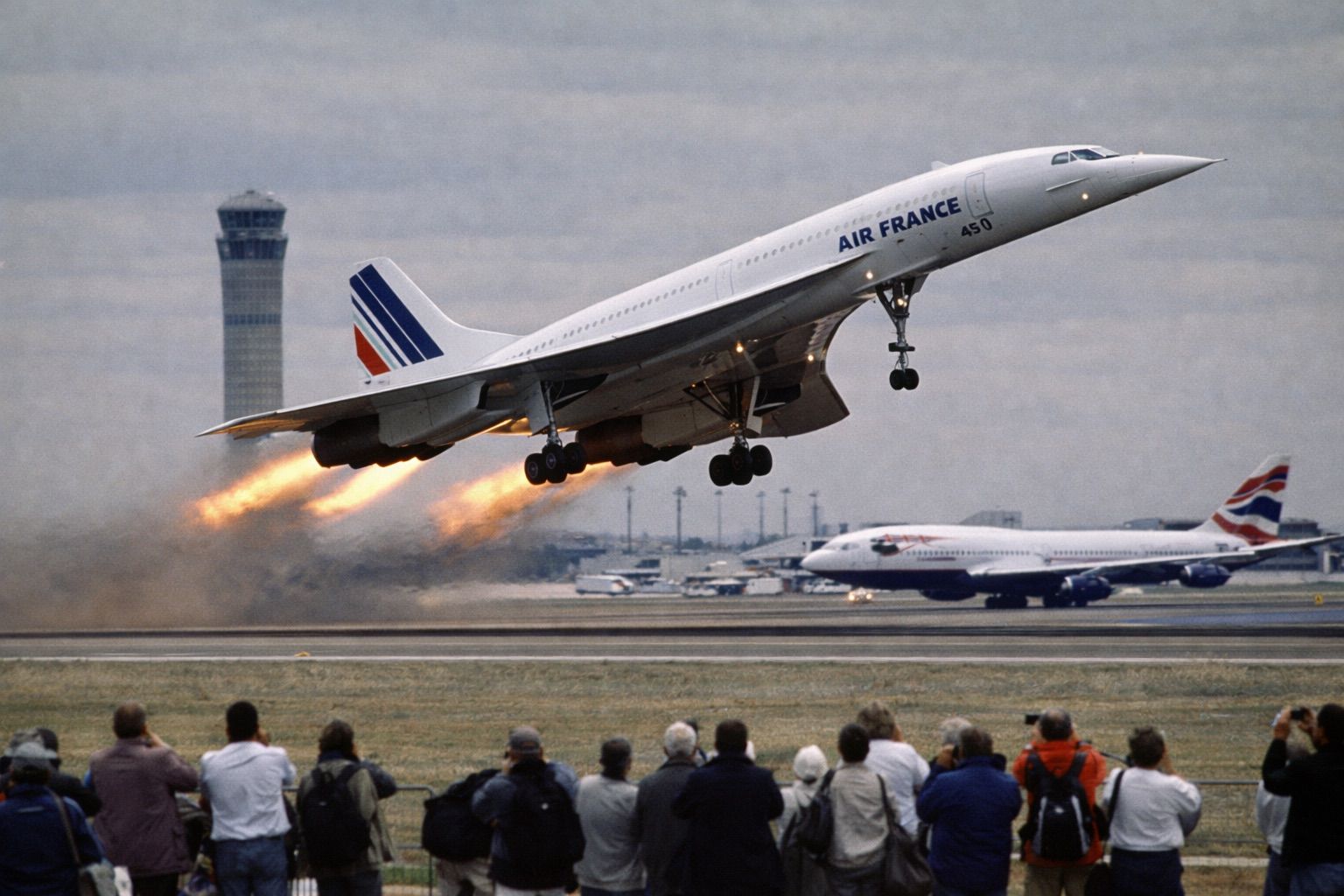
The last flight of the supersonic Concorde jet is a poignant reminder of the transience of technological innovation and the capricious nature of human endeavor. It was on June 10, 2003, that Air France Flight 4590 took off from Charles de Gaulle Airport in Paris, embarking on its final scheduled flight as the world’s fastest commercial airliner.
The Concorde, a joint project between British Aerospace (now BAE Systems) and Aérospatiale (now Airbus), had first taken to the skies in 1969. The brainchild of French engineer André Turcat and his team, the supersonic jet was designed to carry passengers at speeds twice that of its contemporaries, piercing the sound barrier with ease and defying the conventional wisdom that supersonic flight was impossible without a significant trade-off in fuel efficiency.
From its early days as a technological curiosity, the Concorde quickly gained popularity among airlines and travelers alike. Its unique combination of style, luxury, and speed made it an attractive option for those who could afford to splurge on a transatlantic ticket. As one seasoned traveler recalled: “I remember my first flight on the Concorde like it was yesterday. The thrill of taking off from New York and landing in London just over three hours later – it was exhilarating, to say the least.”
However, as the years went by, the Concorde’s popularity waned, and the economics of supersonic flight began to unravel. With a fuel capacity that would allow for only about 100 passengers per trip, the Concorde’s operating costs were prohibitively high, rendering it uncompetitive with subsonic aircraft in terms of overall efficiency. Furthermore, the sonic boom associated with supersonic flight had long been a contentious issue, prompting governments to restrict or ban overland supersonic flight altogether.
Air France, which had been a key partner in the Concorde’s development and operation, was forced to confront these challenges head-on. In 1999, the airline announced that it would be ending its Concorde operations due to rising maintenance costs and decreased demand for the aircraft. British Airways, the other primary operator of the Concorde, initially resisted this decision but eventually followed suit in 2001.
Yet, in a surprising twist, Air France decided to stage one final farewell flight before retiring the Concorde from service. On June 10, 2003, Flight 4590 departed Paris for New York’s JFK Airport with an all-business-class cabin and a special “farewell” menu designed by celebrity chef Joël Robuchon. As passengers took their seats and fastened their seatbelts, the Concorde’s iconic engines roared to life, accelerating from zero to Mach 2 in just 3 minutes.
Tragically, however, this final flight was marred by tragedy when the aircraft suffered a catastrophic tire blowout during takeoff. Shrapnel from the exploded tire punctured one of the fuel tanks, causing an inferno that would soon engulf the plane’s right wing and ultimately lead to its demise. The explosion was so severe that it ripped through the aircraft’s fuselage, killing all seven crew members on board.
As news of the disaster spread like wildfire across the globe, the aviation community was left reeling in shock. The loss of life was immense – but the sense of collective grief and bewilderment ran deeper still. For in one fell swoop, the Concorde’s legacy had been forever tarnished by tragedy, casting a shadow over its remarkable achievements as a technological pioneer.
In the aftermath of the crash, investigators pored over the data from black box recorders to pinpoint the exact cause of the disaster. Their findings pointed to a combination of factors – including a faulty tire and inadequate maintenance procedures on the part of Air France’s ground crew. Yet, as various governments, airlines, and industry stakeholders scrambled to assign blame and revise safety protocols, it was clear that the Concorde’s demise marked more than just the end of an era; it also signaled a turning point in human history.
For decades, supersonic flight had been touted as a symbol of human ingenuity and limitless potential. And yet, in its most spectacular failure, we were reminded that even our greatest technological achievements are vulnerable to the whims of chance and the darker side of human nature. The Concorde’s final flight stands as a poignant reminder of the high stakes involved in pushing the boundaries of science and technology – and the sometimes devastating consequences when those boundaries are tested beyond their limits.
The legacy of the Concorde lives on, however, in the countless stories of travelers who experienced its unique thrill and witnessed firsthand its breathtaking beauty. As one passenger reflected: “For me, the Concorde was more than just an airplane – it represented a connection to something greater than ourselves… something magical.”
The last flight of the supersonic Concorde jet is a poignant reminder of the transience of technological innovation and the capricious nature of human endeavor. It was on June 10, 2003, that Air France Flight 4590 took off from Charles de Gaulle Airport in Paris, embarking on its final scheduled flight as the world’s fastest commercial airliner.
The Concorde, a joint project between British Aerospace (now BAE Systems) and Aérospatiale (now Airbus), had first taken to the skies in 1969. The brainchild of French engineer André Turcat and his team, the supersonic jet was designed to carry passengers at speeds twice that of its contemporaries, piercing the sound barrier with ease and defying the conventional wisdom that supersonic flight was impossible without a significant trade-off in fuel efficiency.
From its early days as a technological curiosity, the Concorde quickly gained popularity among airlines and travelers alike. Its unique combination of style, luxury, and speed made it an attractive option for those who could afford to splurge on a transatlantic ticket. As one seasoned traveler recalled: “I remember my first flight on the Concorde like it was yesterday. The thrill of taking off from New York and landing in London just over three hours later – it was exhilarating, to say the least.”
However, as the years went by, the Concorde’s popularity waned, and the economics of supersonic flight began to unravel. With a fuel capacity that would allow for only about 100 passengers per trip, the Concorde’s operating costs were prohibitively high, rendering it uncompetitive with subsonic aircraft in terms of overall efficiency. Furthermore, the sonic boom associated with supersonic flight had long been a contentious issue, prompting governments to restrict or ban overland supersonic flight altogether.
Air France, which had been a key partner in the Concorde’s development and operation, was forced to confront these challenges head-on. In 1999, the airline announced that it would be ending its Concorde operations due to rising maintenance costs and decreased demand for the aircraft. British Airways, the other primary operator of the Concorde, initially resisted this decision but eventually followed suit in 2001.
Yet, in a surprising twist, Air France decided to stage one final farewell flight before retiring the Concorde from service. On June 10, 2003, Flight 4590 departed Paris for New York’s JFK Airport with an all-business-class cabin and a special “farewell” menu designed by celebrity chef Joël Robuchon. As passengers took their seats and fastened their seatbelts, the Concorde’s iconic engines roared to life, accelerating from zero to Mach 2 in just 3 minutes.
Tragically, however, this final flight was marred by tragedy when the aircraft suffered a catastrophic tire blowout during takeoff. Shrapnel from the exploded tire punctured one of the fuel tanks, causing an inferno that would soon engulf the plane’s right wing and ultimately lead to its demise. The explosion was so severe that it ripped through the aircraft’s fuselage, killing all seven crew members on board.
As news of the disaster spread like wildfire across the globe, the aviation community was left reeling in shock. The loss of life was immense – but the sense of collective grief and bewilderment ran deeper still. For in one fell swoop, the Concorde’s legacy had been forever tarnished by tragedy, casting a shadow over its remarkable achievements as a technological pioneer.
In the aftermath of the crash, investigators pored over the data from black box recorders to pinpoint the exact cause of the disaster. Their findings pointed to a combination of factors – including a faulty tire and inadequate maintenance procedures on the part of Air France’s ground crew. Yet, as various governments, airlines, and industry stakeholders scrambled to assign blame and revise safety protocols, it was clear that the Concorde’s demise marked more than just the end of an era; it also signaled a turning point in human history.
For decades, supersonic flight had been touted as a symbol of human ingenuity and limitless potential. And yet, in its most spectacular failure, we were reminded that even our greatest technological achievements are vulnerable to the whims of chance and the darker side of human nature. The Concorde’s final flight stands as a poignant reminder of the high stakes involved in pushing the boundaries of science and technology – and the sometimes devastating consequences when those boundaries are tested beyond their limits.
The legacy of the Concorde lives on, however, in the countless stories of travelers who experienced its unique thrill and witnessed firsthand its breathtaking beauty. As one passenger reflected: “For me, the Concorde was more than just an airplane – it represented a connection to something greater than ourselves… something magical.”
As I sat among the passengers on that fateful day, watching the Concorde’s engines roar to life, I couldn’t help but feel a sense of awe at this magnificent machine. Its sleek design and imposing presence seemed almost otherworldly, as if it were a harbinger of a new era in aviation. And yet, beneath its gleaming surface, the Concorde hid secrets – secrets that would soon be exposed by the tragic events that unfolded.
For those who had been fortunate enough to fly on the Concorde, there was an unspoken understanding that this aircraft was something special – a true marvel of modern engineering that transcended mere transportation and entered the realm of art. As one writer observed: “The Concorde was not just a plane; it was an experience – a symphony of sounds, sights, and sensations that lingered long after you’d left its confines.”
This unique blend of style, luxury, and speed had made the Concorde an irresistible draw for many travelers. Some came to experience the thrill of breaking the sound barrier, while others were simply drawn by its sheer exclusivity – after all, what other aircraft could boast a price tag that rivaled luxury yachts? For these passengers, the Concorde represented not just a means of transportation but a status symbol – a badge of honor that signaled their arrival in the rarefied world of high-flying elite.
But as we soared through the skies at Mach 2+, something else was happening beneath the surface. A sense of detachment began to creep in, as if we were witnessing an event outside the normal boundaries of human experience. And when tragedy struck, it seemed almost inevitable – a stark reminder that even our greatest achievements are subject to the cruel whims of fate.
The aftermath of the crash saw a global outpouring of grief and sympathy for the families of those who had lost their lives on Flight 4590. The Concorde’s demise was seen as a poignant reminder of the risks involved in pushing the boundaries of science and technology – a stark warning that even our most brilliant innovations are vulnerable to the darker side of human nature.
In the years since its retirement, the Concorde has become an enduring symbol of the transience of technological innovation. Its legacy lives on in the countless stories of travelers who experienced its unique thrill and witnessed firsthand its breathtaking beauty. And yet, as we look back on this remarkable aircraft’s final flight, it is hard not to wonder what might have been – had the Concorde continued to soar through the skies, carrying passengers at speeds that defied convention.
As I reflect on that fateful day, I am struck by the realization that even in failure, there lies a deeper truth. The Concorde’s story is one of human ingenuity and limitless potential – but also of hubris and recklessness, as we push the boundaries of what is possible without fully considering the consequences.
In the end, the Concorde may have been more than just an airplane – it represented our collective aspirations for a future that is faster, farther, and forever boundless. Its legacy will live on in our memories, a poignant reminder of the power of human imagination and the fragility of our greatest achievements.