In December 1989, the United States launched Operation Just Cause, a military invasion of Panama that aimed to overthrow dictator Manuel Noriega’s regime and restore democracy to the Central American nation. The intervention marked one of the most significant military actions undertaken by the US in Latin America since the Bay of Pigs debacle in Cuba three decades earlier.
The roots of the crisis lay in Noriega’s increasingly authoritarian rule, which had been tolerated if not encouraged by successive US administrations. Noriega, a former Panamanian general and close ally of Washington during the Cold War, had risen to power in 1983 after ousting President Ricardo de la Espriella through a bloodless coup. However, his presidency was marked by widespread corruption, repression, and human rights abuses. The regime’s security forces killed or disappeared hundreds of opponents, including students, journalists, and ordinary citizens who dared to challenge Noriega’s rule.
The US government initially ignored these abuses, continuing to provide military aid and economic assistance to Panama in the name of counterinsurgency against leftist movements in Central America. However, as Noriega’s regime became increasingly repressive and isolated, Washington began to reassess its policy. In 1988, Congress passed a law prohibiting US military aid to Panama due to human rights concerns, which effectively terminated the funding that had sustained Noriega’s regime for so long.
The turning point came in 1989 when Panamanian opposition leader Guillermo Endara won the presidential election, but Noriega refused to accept the results. The regime responded with violence, burning buildings and attacking civilians who dared to protest. On December 16, 1989, US President George H.W. Bush authorized Operation Just Cause, a comprehensive military plan that aimed to neutralize Noriega’s forces and secure Endara’s inauguration.
The invasion began at midnight on December 20, when US troops from the Southern Command in Panama City launched a surprise attack on key targets, including the presidential palace, the military headquarters, and major military installations. The initial assault was swift and devastating, with US Marines quickly overrunning Noriega’s forces and securing key infrastructure.
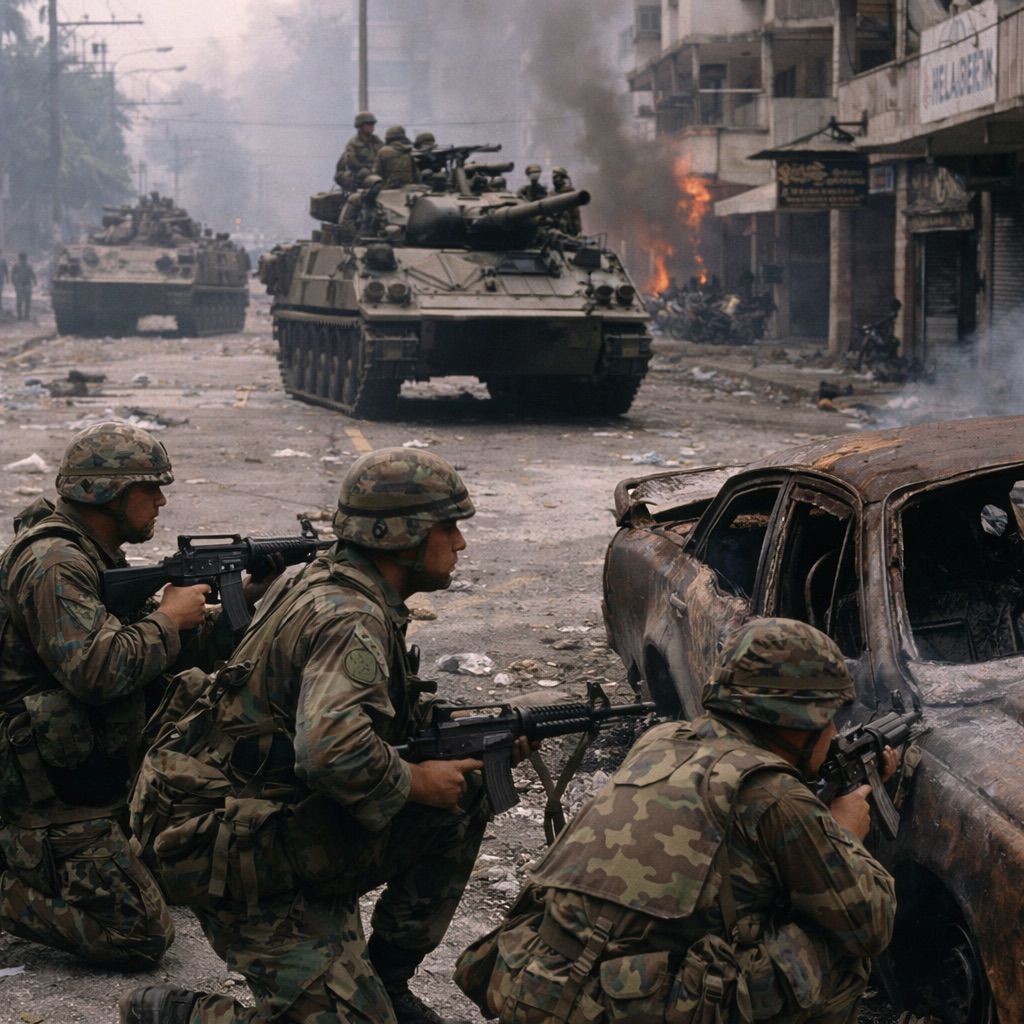
However, the operation soon turned into a complex battle as Panamanian resistance fighters, known as Dignity Battalions, began to engage American troops in urban warfare. US forces faced fierce resistance from Dignity Battalions, who had prepared for an invasion by digging trenches, laying mines, and conducting ambushes against the invaders.
Over the next few days, US military units engaged in house-to-house searches and raids to root out Noriega’s loyalists. Despite initial successes, American forces soon found themselves bogged down in a long and bloody fight for control of Panama City. The urban warfare tactics employed by Dignity Battalions made it difficult for the US military to dislodge them from their entrenched positions.
Meanwhile, Noriega himself remained at large, refusing to surrender even as his regime collapsed around him. On December 25, he was spotted in a hotel room in Panama City, where he was reportedly using a satellite phone to coordinate resistance efforts with Cuban officials.
As the battle raged on, Washington faced intense international criticism for its actions. Leaders from Mexico to Argentina condemned the invasion as a flagrant disregard for sovereignty and self-determination. In response, US officials argued that Operation Just Cause was justified by Noriega’s brutal repression of opposition and his alleged ties to drug cartels.
Despite these claims, evidence suggests that Washington’s primary motivation for invading Panama lay in its desire to secure strategic military bases and protect American business interests in the region. The US had long been interested in expanding its presence in Panama, which provided a crucial location for deploying troops and equipment in Latin America.
As Operation Just Cause finally drew to a close on January 3, 1990, Noriega was forced to flee to the Vatican Embassy, where he took refuge along with his closest advisors. After a two-week siege by US forces, Noriega surrendered on January 31, marking the end of a brutal regime that had terrorized Panama for over a decade.
The aftermath of the invasion saw Endara inaugurated as president, backed by a caretaker government established by the US military. However, many Panamanians questioned the legitimacy of this new government and resented Washington’s perceived attempts to impose its will on their nation. The experience left deep scars in Panama, where anti-American sentiment remains strong to this day.
The invasion also sparked controversy within the United States, with some lawmakers questioning the constitutionality of Bush’s actions. Critics argued that Operation Just Cause was an impeachable offense for violating Congressional authority over foreign policy and disregarding international law. Others praised the operation as a necessary intervention in support of democracy and human rights.
In the end, the legacy of Operation Just Cause remains complex and contested. While it marked a significant departure from Washington’s earlier tolerance of authoritarian rule in Panama, it also demonstrated the willingness of US leaders to disregard sovereignty and due process when deemed necessary. As the world continues to grapple with questions of interventionism and human rights, the US invasion of Panama serves as a cautionary tale about the dangers of unchecked executive power and the importance of respecting national sovereignty.
Operation Just Cause also marked a turning point in US-Latin American relations, highlighting the deepening rift between Washington’s commitment to democracy and its pursuit of strategic interests. As the 1990s unfolded, US policymakers increasingly turned their attention to the complexities of globalization and multilateralism, recognizing that military intervention alone could no longer guarantee stability or security in a rapidly changing world.
As the dust settled on Panama City, the full extent of Operation Just Cause’s destruction became clear. Entire neighborhoods lay in ruins, with buildings reduced to rubble and streets littered with debris. The once-thriving metropolis was now a war zone, its people traumatized by the violence they had endured.
The US military’s actions sparked widespread outrage across Latin America, where leaders from Mexico to Argentina condemned the invasion as an affront to regional sovereignty. In Panama itself, anti-American sentiment surged, with many citizens viewing the US intervention as a betrayal of their nation’s independence.
As Washington grappled with international criticism, internal debates raged within the United States about the constitutionality and legitimacy of Operation Just Cause. Some lawmakers argued that Bush had overstepped his authority by launching a military invasion without Congressional approval, while others defended the operation as a necessary measure to protect American interests and restore democracy in Panama.
The controversy surrounding Operation Just Cause was not limited to the halls of Congress or the corridors of international diplomacy. Within Panama itself, tensions ran high between supporters and opponents of the US intervention. Many Panamanians saw the invasion as an opportunity for their country to break free from Noriega’s authoritarian rule and embark on a new era of democratic governance.
Others, however, viewed the US presence with suspicion and resentment. They remembered the long history of American interference in Panama, dating back to the construction of the canal at the turn of the 20th century. Many saw Operation Just Cause as just another example of US imperialism, where Washington imposed its will on a sovereign nation for the benefit of its own interests.
As the months passed following Noriega’s ouster, Panamanian society struggled to come to terms with the trauma inflicted by the invasion. The aftermath of Operation Just Cause left deep scars that would take years to heal. Many civilians continued to live in makeshift refugee camps, while others returned to their homes only to find them damaged or destroyed.
In the midst of this chaos, US policymakers began to reassess the long-term implications of Operation Just Cause. They recognized that the invasion had marked a significant shift in Washington’s approach to Latin America, one that prioritized strategic interests over traditional notions of sovereignty and non-interference.
This new paradigm was driven by a growing recognition within the US government that globalization and multilateralism were transforming the regional security landscape. As trade agreements and international institutions gained prominence, policymakers began to view military intervention as an increasingly inadequate tool for maintaining stability in Latin America.
Instead, Washington turned its attention to more nuanced forms of engagement, including diplomatic efforts to promote democratic governance and economic development. This shift was exemplified by the Clinton administration’s push for the Free Trade Agreement of the Americas (FTAA), a comprehensive trade pact aimed at integrating Western Hemisphere economies under a single framework.
The aftermath of Operation Just Cause also saw a growing recognition within the US government that human rights abuses were not confined to Panama, but rather were endemic in many Latin American nations. This realization led to increased emphasis on supporting civil society and promoting democratic institutions throughout the region.
In Panama itself, this newfound focus on human rights helped facilitate a national dialogue about the country’s dark past. In 1992, President Endara established an independent commission to investigate Noriega-era atrocities and provide reparations to victims’ families. The commission’s report, released in 1994, exposed widespread human rights abuses committed by Noriega’s regime, including forced disappearances, torture, and summary executions.
The report’s findings sparked widespread outrage within Panama, with many citizens demanding justice for the regime’s victims. In response, the Panamanian government implemented a series of reforms aimed at strengthening accountability and promoting human rights protections.
However, this newfound commitment to accountability was not without its challenges. Many Panamanians continued to question the legitimacy of their country’s new democratic institutions, which had been imposed by Washington through Operation Just Cause. This skepticism was fueled by ongoing US military presence in Panama, including a significant American base at Howard Air Force Base.
As the years passed following Operation Just Cause, Panamanian society grappled with the complexities of rebuilding and reconciliation. The experience left deep scars that would take decades to heal, but also created an opportunity for Panama to forge its own path towards democratic governance and human rights.
The legacy of Operation Just Cause serves as a cautionary tale about the dangers of unchecked executive power and the importance of respecting national sovereignty. As policymakers continue to navigate the complex landscape of international relations, they would do well to remember the lessons of this forgotten war: that military intervention can have far-reaching consequences, and that the most effective forms of engagement often lie in promoting democratic governance and human rights through diplomacy rather than force.
Today, as the United States grapples with its own identity crisis in Latin America, Operation Just Cause stands as a reminder of the complex and contested history between these two hemispheres. As we move forward into an uncertain future, it is essential to acknowledge the legacy of this forgotten war and the profound impact it has had on our understanding of international relations, human rights, and democracy itself.