Panama’s declaration of independence from Spain on November 28, 1821, stands as one of the most fascinating and understated independence movements in Latin American history. Unlike the sweeping battles that defined the struggles of nations like Mexico, Peru, and Colombia, Panama’s liberation was—incredibly—accomplished without bloodshed. It was a revolution of planning, persuasion, diplomacy, and sheer collective will. That peaceful triumph, achieved in a world engulfed in wars of liberation, tells a unique story about Panama’s identity, its strategic importance, and the wisdom of a people who understood that freedom could be won through unity rather than violence.
To understand the significance of Panama’s independence, you have to first imagine the world in which the isthmus found itself in the early 19th century. Panama was not simply a small, remote colonial holding; it was the beating heart of Spain’s empire in the Americas. The Isthmus of Panama was the narrow hinge connecting the vast wealth of South America with the rest of the world. Gold, silver, goods, and people passed through Panama’s ports and overland routes, making it a critical artery for Spanish power. But this value came at a cost: Panama bore the burden of decades of economic exploitation, heavy taxation, trade restrictions, and neglect.
By the time the independence movements swept through Latin America, the people of Panama watched their neighbors fight battles that consumed entire regions. Simón Bolívar pushed northward through New Granada. José de San Martín liberated the southern cone. Revolutionary ideas flowed across the continent like wildfire. And although Panama did not erupt into war, it simmered with frustration, aspiration, and the dawning realization that the Spanish empire was growing weaker by the year.
The spark for Panama’s independence wasn’t loud or violent—it was calculated. The people of Panama spent months quietly preparing, building consensus across influential families, clergy, political leaders, and merchants who understood both the promise and the peril of fighting Spain. The Spanish military presence had weakened significantly, leaving fewer soldiers stationed in the region. Supplies were short. Morale was low. And news of Spain’s declining power circulated widely.
Panama’s leaders saw an opening that may never come again.
Rather than take up arms, they crafted a strategy built on diplomacy. They reached out to local Spanish authorities, gauging their sentiment. Many soldiers and officials, unpaid and disillusioned, were unwilling to die for an empire already collapsing. The independence movement realized they could succeed by ensuring that no group felt threatened or cornered. If they could persuade the Spanish garrison to step aside—and convince the population that independence would bring stability, not chaos—they could avoid the bloodshed that ravaged other nations.
What unfolded next was a masterclass in peaceful revolution. Meetings were held in private homes under candlelight. Letters were exchanged discreetly. Community leaders quietly took stock of who supported independence, who opposed it, and who could be convinced. Instead of stockpiling weapons, they stockpiled consensus.
Then came the decisive moment.
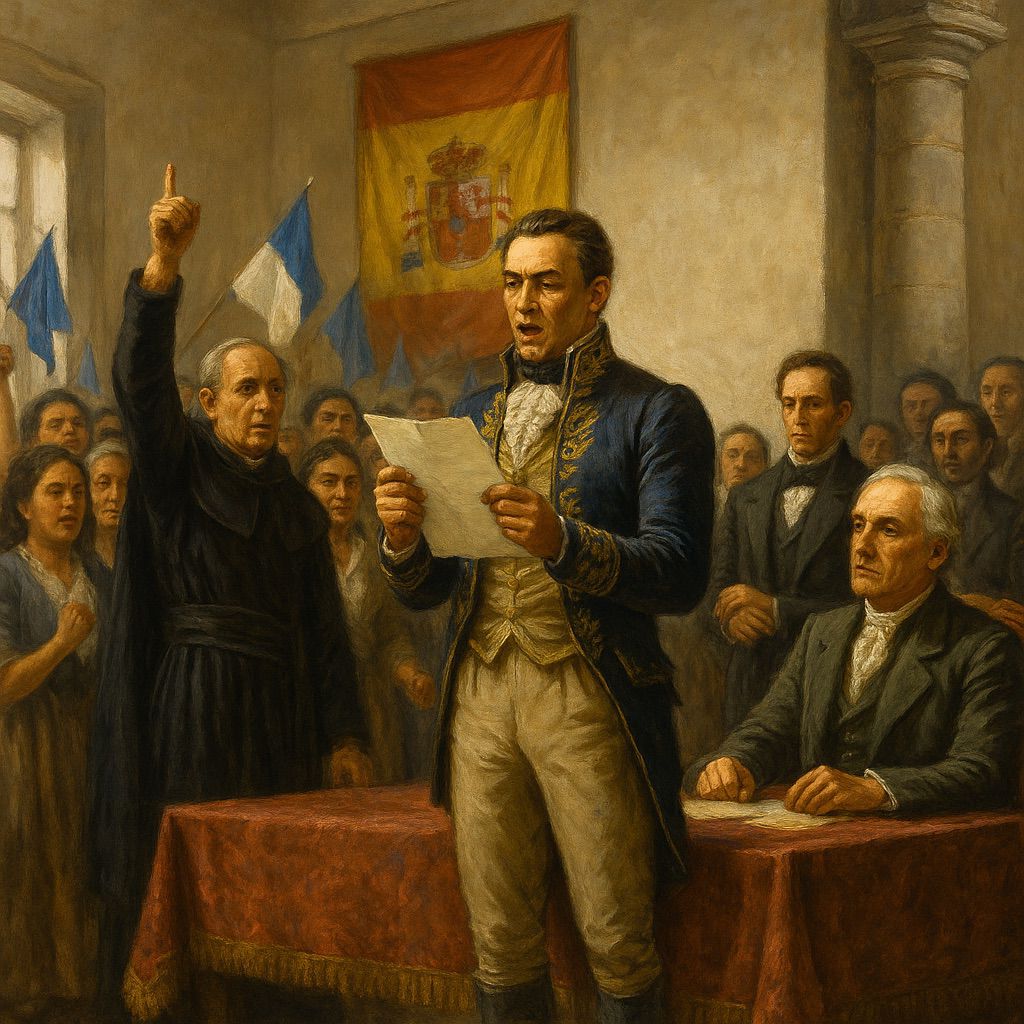
On November 28, 1821, Panama convened a historic gathering in the capital. A crowd of citizens filled the room—clergy, merchants, local elites, ordinary townspeople—all waiting to witness something they had only dared to imagine. The atmosphere was tense but filled with fragile hope. When the Act of Independence was read aloud, it declared, with clarity and resolve, that Panama was henceforth a free and sovereign entity. The announcement was met not with gunfire but with applause, tears, and a profound sense of relief. The Spanish forces, fully aware of their dwindling strength and seeing overwhelming local support for independence, surrendered peacefully.
It was a moment that rewrote the rules of revolution.
Panama’s leaders understood that independence alone would not secure their future. They faced a critical question that would shape the path of their young country: What next? Remaining entirely independent was one option. But with economic vulnerability, a small population, and the threat of re-occupation by Spain, Panama needed powerful allies. The most practical choice was immediate union with Gran Colombia—a republic under the leadership of Simón Bolívar that encompassed modern-day Colombia, Venezuela, Ecuador, and later Panama.
This decision was not an act of submission but of strategy. Panama’s geography made it one of the world’s most coveted regions. It was the key to global trade long before anyone imagined the canal. By aligning with Gran Colombia, Panama gained protection, stability, and the promise of shared progress. In Bolívar’s grand vision for Latin American unity, the isthmus played a central role. Bolívar famously believed Panama could one day become “the capital of the world,” a crossroads of commerce and diplomacy.
Panama’s peaceful independence became a source of pride that shaped generations. It proved that freedom could be won through reason rather than war. It showed that diplomacy, unity, and foresight could succeed where violence often failed. And it reinforced the idea that Panama’s destiny was tied not merely to its geography but to its ability to navigate political landscapes with intelligence and pragmatism.
For decades afterward, the legacy of this independence shaped Panama’s political identity. Even as it later separated from Gran Colombia in 1903—this time with the support of a rising global power, the United States—the memory of the tranquil independence of 1821 was preserved as a unique testament to the Panamanian spirit.
In many ways, the story of Panama’s independence mirrors its role in the world today: a nation defined by connection rather than conflict, by diplomacy rather than destruction, by a cultural richness shaped through centuries as a crossroads of the Americas. The independence of 1821 became the quiet foundation for the more dramatic transformations that would follow, including the creation of the Panama Canal, one of the most significant engineering achievements in human history.
But beyond politics, beyond treaties, beyond the shifting tides of empires, the moment that Panamanians declared themselves free was deeply human. Ordinary people—mothers, fathers, merchants, priests, and soldiers—chose hope over fear. They chose unity over division. They chose a future they would shape themselves rather than one imposed by a distant empire.
Standing in that crowded room on November 28, surrounded by the sound of voices rising in agreement, the people of Panama took control of their fate. The independence they claimed was more than a legal declaration; it was a collective heartbeat.
And in that heartbeat, a nation was born.