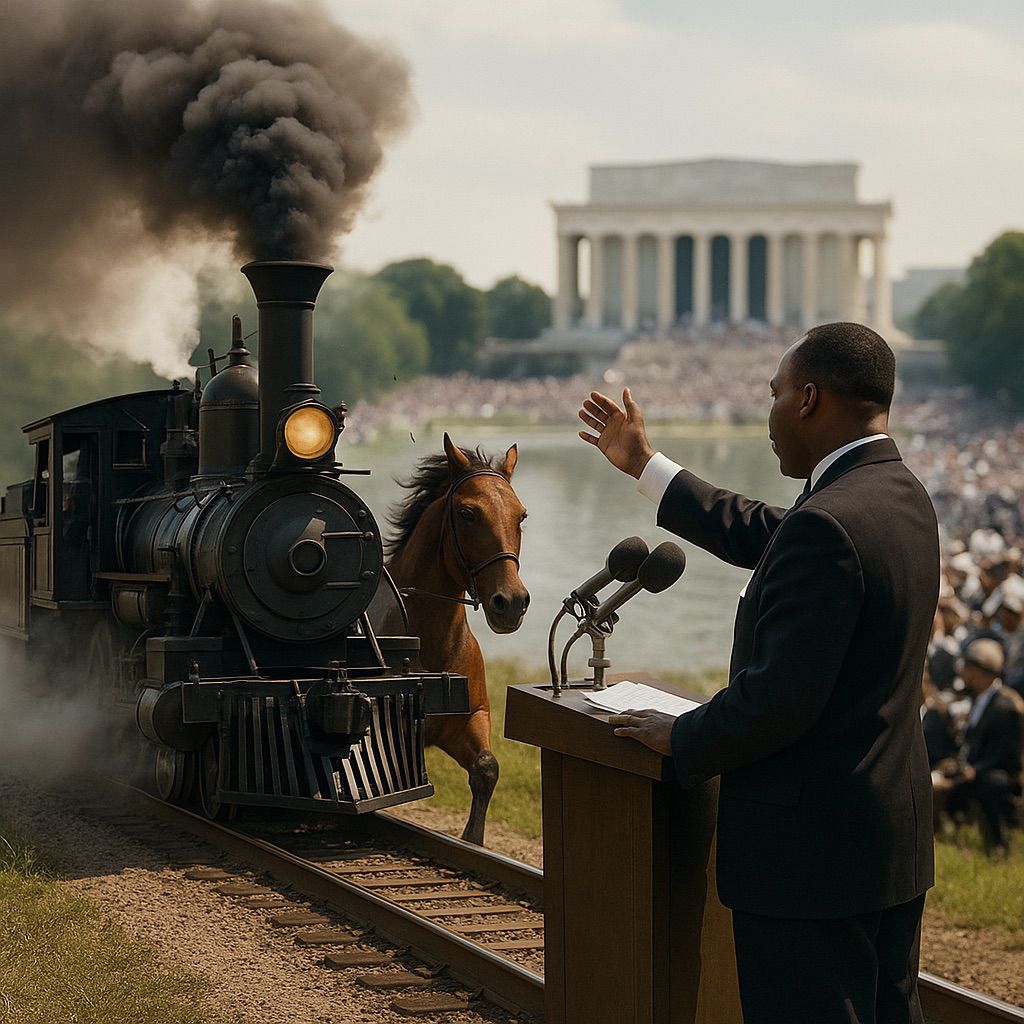
There are dates that look ordinary until you lean in and catch the hum beneath the ink. August 28 is one of those dates. On one August 28, in 1830, a tea-kettle of a locomotive nicknamed Tom Thumb lined up beside a horse on a short run of track outside Baltimore and lost a race it should have won. On another August 28, in 1963, a Baptist minister stood before a quarter of a million people at the Lincoln Memorial and gave voice to a dream so clear it still braids itself into the nation’s conscience every time we say the words. One story is comic in its immediacy—leather, steam, and a slipped belt. The other is solemn, musical, and nation-shaping. Together they tell us something about motion: how we move bodies and freight, and how we move hearts and law; how the future, when it first arrives, looks small and a little ridiculous; how justice, when it finally speaks plainly, sounds like something we had all been trying to say for generations. August 28 is a hinge. On one side, a sputtering engine challenges the familiar rhythm of hooves. On the other, a voice challenges the familiar rhythm of inequality. If the first is a fable about innovation, the second is a field manual for courage. Both are instruction.
It is late summer, 1830. The Baltimore & Ohio Railroad has laid only a few miles of iron, an audacious thread between skepticism and ambition. Peter Cooper, a self-taught inventor and businessman with a nose for the useful, has cobbled together a tiny locomotive as proof of concept. Tom Thumb is not majestic: it is a cylinder and boiler perched on a small frame, a little chimney, a hand-fed fire, and a blower that keeps the flame hungry. But when steam gathers, size is deceptive. To convince the B&O directors—men who have invested money and pride—Cooper proposes a public demonstration. A horse-drawn car pulls alongside. Wagers are whispered. The challenge is on, not because the horse is expected to win, but because spectacle is the grammar of persuasion in a young republic. The race starts. Tom Thumb coughs, hisses, and then takes the bit between its iron teeth. The crowd cheers as the car clatters forward, the horse stretching into a gallop; the engine gains, glides, and—astonishingly—leads. Then calamity of the most mundane sort: the blower belt slips. Without forced draft, the little boiler gasps; the pressure drops as if the future itself had caught a cold; the horse thunders past; the finish line arrives like a punchline. Laughter and jeers. The past appears to have triumphed. Yet anyone who has ever built something knows the private smile of proof. The point wasn’t the photo finish; it was the middle of the race—the moment when steam outran muscle and time compressed into a new shape. The B&O directors saw it and funded more track. Within a generation, locomotives stitched the mid-Atlantic to the Midwest, schedules replaced seasons, freight costs collapsed, and lives changed because a small machine, even in defeat, revealed a different possible world.
The lesson of Tom Thumb is compact but deep: failure, public and undeniable, can be the most persuasive form of success. An engine that loses can still win the argument. Ask any engineer: the first prototype’s job is to fail interestingly enough that the second prototype knows what not to be. The belt slip is almost allegorical. It suggests that the future is not foiled by big ideas so much as by small tolerances, unglamorous parts that connect power to purpose. The fix is tedious and technical, but it is also where courage lives. Progress is not a parade; it is an alignment, a sequence of refinements invisible to posterity but indispensable to it. And so the rails grow long. The whistle becomes a national sound. With every timetable printed and every bridge built, the lesson repeats: the way forward becomes common only after it has been ridiculous in public.
A different crowd gathers on a different August 28, this time in the humid capital of a country at once proud and haunted. It is 1963. The March on Washington for Jobs and Freedom did not materialize out of thin air; it was engineered by organizers who understood logistics, coalition, and risk. Bayard Rustin, precise and tireless, diagrams bus routes and restroom access, coordinates sound systems and marshals. A. Philip Randolph brings the moral voltage of decades of labor advocacy. Thousands of volunteers move like capillaries, carrying information and water through the body of the demonstration. The architecture of the day—permits, first-aid stations, food stalls—makes a city of conscience possible. And into that city walks Martin Luther King Jr., bearing a manuscript and a lifetime of sermons, marches, and cells. The stage is the Lincoln Memorial. The gaze of a stone emancipator rests on a living one. The reflecting pool holds the sky like a promise.
King’s speech climbs by steps, each phrase placed so carefully that it feels inevitable. He begins not with dream but with debt: a promissory note defaulted, a nation’s check returned “insufficient funds.” It is the language of a preacher conversant with banks and breadlines, poetry yoked to policy. He names the fierce urgency of now and refuses the narcotic of gradualism, the opiate that seduced so many well-meaning onlookers into the paradox of waiting for justice. When he says “now,” the crowd answers with its breathing. He speaks of thresholds: justice rolling down like waters, righteousness like a mighty stream. He speaks of specific places—Georgia’s red hills, Mississippi’s heat of oppression—binding abstract promise to concrete geography. Then the turn. Mahalia Jackson, friend and witness, calls from behind him: “Tell them about the dream, Martin!” He leaves the script and lands on a riff he has preached before, but never like this. The dream expands, stanza by stanza: a nation where children are judged by the content of their character, where Alabama becomes a place for little Black boys and Black girls to join hands with little white boys and white girls, where freedom rings from Lookout Mountain to Stone Mountain, from every mountainside. The repetition is hammer and lullaby. The crowd becomes the instrument. The marchers, many of whom have already been bloodied, hear not an escape but a blueprint. The dream is not a pillow; it is a set of coordinates.
The aftermath is policy and pushback, both swift. The Civil Rights Act of 1964 and the Voting Rights Act of 1965 do not fall from the sky; they are hauled by generations into law, pushed by funerals and filibusters, court orders and clipboards, training sessions and airless church basements where volunteers learn de-escalation and how to register voters in counties that require courage just to pronounce your own name at a counter. The machinery of oppression does not sit idle while statutes are signed; it reconfigures, reinventing obstacles with the slyness of a river that finds a new channel. Segregation’s signage comes down, then zoning maps do the same work with a patina of neutrality. Poll taxes and jelly-jar literacy tests retreat, then voter roll purges and precise ID rules and quietly shuttered precincts step forward. If the Tom Thumb taught us that a slipped belt can stall an engine, the years after 1965 teach that democracy has belts everywhere and saboteurs who prefer them loose. The moral keeps repeating: inspection is love. Maintenance is patriotic. What begins in a shining moment needs a schedule and a wrench.
Put the two Augusts side by side and the rhyme is clear. Both moments are demonstrations staged for skeptics. Both pivot on public proof—sightlines and sound systems, a seeing that is believing. Both reveal that progress is as much choreography as it is charisma. Cooper’s little engine runs to persuade the B&O that steam is the future; King’s words ride acoustics across water to persuade lawmakers and a watching world that justice cannot wait. Both face ridicule: one because it loses a race, the other because detractors reduce it to a lyric detached from labor. Yet both succeed because evidence, once witnessed, ripens into insistence. If we could outrun a horse, we can cross a continent. If we can call a crowd to dream in unison, we can rewrite law.
To humanize these histories, imagine a boy standing trackside in 1830, a laborer’s son clutching his father’s rough hand, torn between the familiar elegance of a horse and the comic audacity of a smoking pot on wheels. He laughs when the belt flies, but the laugh has awe stitched into it. That night he lies awake hearing the whistle in a future nobody else can hear yet. Now imagine a girl on a bus from Birmingham in 1963, knees pressed to the seat ahead, a paper bag lunch in her lap, her mother’s hand on hers every time the bus slows near a state trooper’s car. She is thirteen and has memorized snatches of scripture and court cases; she has heard dogs bark and seen windows break; she has also heard her teacher say that the law can be made to tell the truth if enough people stand where the truth is. When King’s voice slides from banknotes to the dream, she does not think of abstraction. She thinks of a drinking fountain. She thinks of a classroom. She thinks of a ballot she will one day place into a box without asking permission. The histories are public, but the courage is always personal.
The technology of Tom Thumb is quaint now—external blower, small cylinders, an open frame that looks fragile to modern eyes—but in 1830 it condensed a century of experiments into a convincing package. Steam had moved boats and mills; moving people overland, reliably and at scale, required more than fuel and fire. It demanded metallurgy, precision machining, new kinds of maps, financial instruments to pool risk and reward, and a culture willing to trust schedules. It also required a reimagining of space: hills shaved, valleys filled, tunnels bored. The railroad altered where towns grew, how newspapers traveled, which crops could go to market before they spoiled. It compressed weather and, for many, time itself. Yet we should not praise the railroad without acknowledging the shadow it cast: it quickened dispossession as well as commerce; it carried homesteaders and soldiers into lands whose treaties were honored only until they were inconvenient; it yoked capital to conquest. Technology is an amplifier. It does not absolve us of the question “Toward what?”
The rhetoric of the March is no less engineered. King’s gift is not only cadence and metaphor but structure. He builds the case, invites the verdict, and then sings the sentence we want to live under. He borrows a nation’s founding vocabulary and returns it at a better pitch, as if returning a borrowed instrument tuned for the first time. The dream sequence is not a nap; it is a moral graph with axes for dignity and opportunity. If you draw the line and it holds across neighborhoods, schools, and courts, you are pointed toward justice. If the slope flattens or drops, you know where to work. Policy follows poetry not because poetry is magic but because poetry sorts the important from the merely loud. “Let freedom ring” is a refrain, but it also functions as a checklist. Which mountainsides have we neglected? Which valleys echo back only to the few who live there? The line “we cannot be satisfied” lands like an update to a nation’s operating system, a refusal to accept a buggy release.
Pairing these stories reveals something about speed and direction. The horse is swift and sure on familiar ground; the engine is awkward until the parts align. The status quo is comfortable for those it serves; justice is ungainly until enough people shoulder it forward. In both cases, the win is not measured by the first finish line but by what becomes possible after the test. The Tom Thumb loses and yet inaugurates a century of rail. The March ends and yet inaugurates a decade of legislation and a longer arc of vigilance. Winning, properly defined, is what crowds will one day take for granted. Our task, inheritors of these Augusts, is to decide which future we want to normalize.
There is, too, a lesson about spectators and stewards. In both scenes, people come to watch. Some clutch tickets; some clutch signs. Some come to scoff; some to sing. But spectatorship is a reversible garment. The moment you decide to keep a piece of the work, you have changed categories. A B&O director becomes a builder of bridges. A marcher becomes a voter registrar, a plaintiff, a city council candidate, a teacher who folds primary sources into her lesson plans so that the next generation has receipts. If you are waiting for a permission slip to join history, August 28 has already signed it.
We live in a century as breathless as Cooper’s blower and as morally urgent as King’s “now.” The belts we must watch today are both mechanical and civic: data pipelines that warp the public square with algorithmic accelerants; precinct maps that carve the public into market segments rather than communities; school budgets that starve curiosity; a climate whose feedback loops have slipped their careful engineering; attention spans that flicker before evidence finishes clearing its throat. The maintenance recommended by both Augusts is precise: tighten the tolerances between truth and platform; rebuild the bridges between neighbors; schedule inspection for the institutions that keep the republic from overheating—local journalism, public libraries, fair courts, simple ways to vote; invent technologies whose metric of success is human flourishing rather than only speed or scale. We have tools Tom Thumb never dreamed of and a moral vocabulary King would recognize. The question is whether we will marry them with the courage of both.
Here is a small exercise in living the lesson. Pick a failure and name what it proved. Do it at work, at home, at the city council, at the school board. Refuse the seduction of embarrassment’s silence. Tell the story of the slipped belt and what you changed the next day. Pair it with a dream that refuses to shrink under ridicule. Say it out loud, write it down, and engineer toward it with the patience of someone laying track across mountains. The opposition will be real. Horses are lovely and persuasive. The status quo will show you a thousand reasons to keep cantering. But the track is already there, and the whistle you hear is not imagination. It is the sound of a country, at its best, inventing itself again.
August 28 is not a coincidence. It is choreography. It teaches that public demonstrations persuade, that dreams organize, that prototypes—mechanical and moral—deserve crowds, and that the arc between a sputtering contraption and a sentence that can govern a century is shorter than it looks when people insist on shortening it. The boy on the track and the girl on the bus are grown now, or they are our ghosts, or they are our children. Either way, they are waiting at the next curve. They want to see if we remember how to fix a belt and how to hold a note. They want to see if we can keep moving bodies kindly and moving laws justly. They want to see if we will treat the dream like a blueprint and the blueprint like a schedule. They want to see whether our laughter still holds awe.