
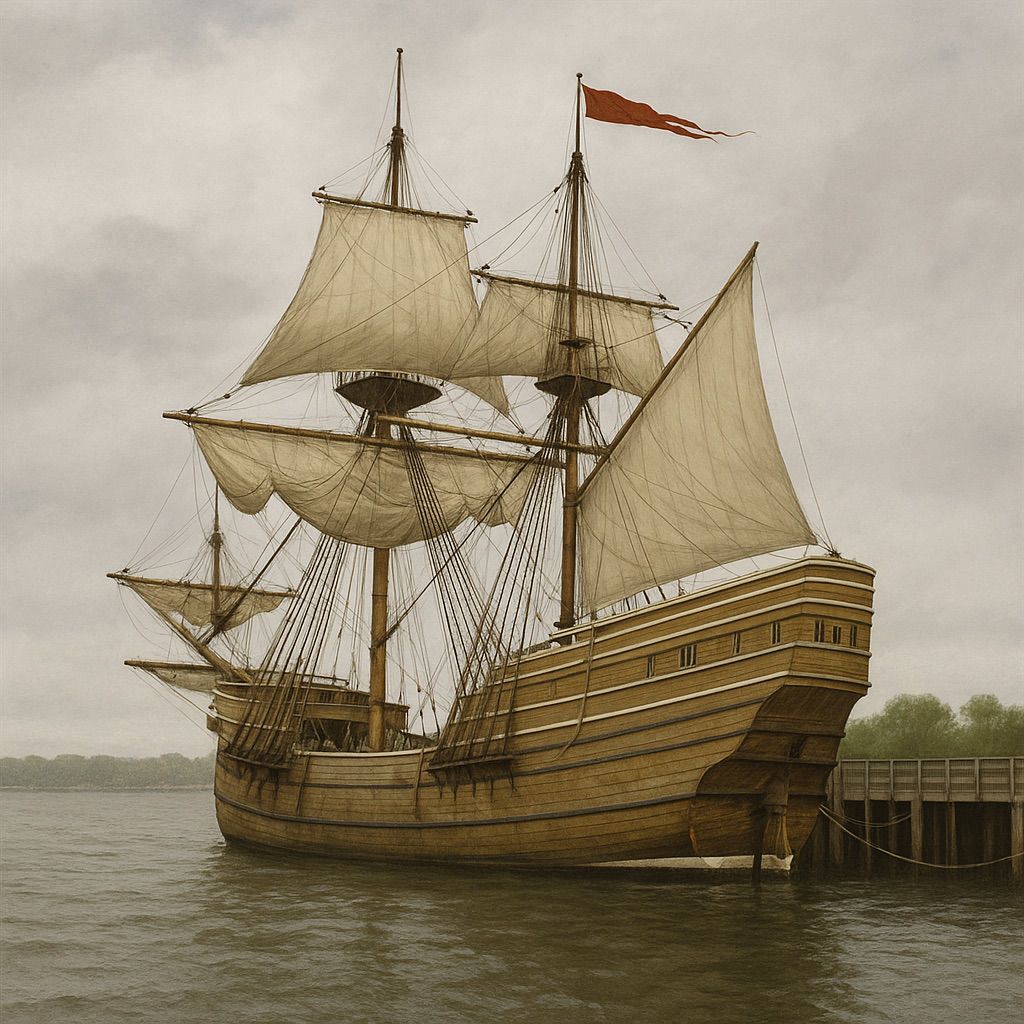
On September 16, 1620, a small wooden ship slipped away from the port of Plymouth in southern England and set its bow toward the unknown. The vessel was called the Mayflower, a merchant ship never designed for the burden of history it would soon carry, and aboard were just over one hundred passengers — men, women, and children — bound for a land across the ocean that most of them had never seen. They were not adventurers in the romantic sense, nor conquerors with armies at their back. Many were Separatists seeking religious freedom, others were entrepreneurs and laborers chasing economic opportunity, and some were simply caught up in the momentum of the voyage. But together, they embarked on a journey that would become one of the foundational myths of America, shaping the story of a nation that would rise from the struggles, survival, and contradictions of that crossing. The day the Mayflower departed was not just the beginning of a voyage. It was the beginning of an idea.
The decision to leave England was not taken lightly. For the Separatists, who would later be remembered as Pilgrims, life in England had become intolerable under the religious conformity demanded by King James I. Some had fled earlier to the Netherlands, where greater religious tolerance existed, but economic hardship and fear of losing their cultural identity pushed them to seek a more permanent solution. The New World — vast, mysterious, and dangerous — offered both risk and possibility. Backed by financial investors in London who sought profit from colonial ventures, the group secured passage on two ships, the Speedwell and the Mayflower. But fate intervened early. The Speedwell proved unseaworthy, leaking badly, and was forced to turn back. In the end, only the Mayflower would carry them forward, overcrowded and laden with the dreams and fears of those aboard.
The Mayflower itself was not a grand ship. At about 100 feet in length, it was meant for cargo, not passengers. The voyage would be harsh and claustrophobic, with people crammed into tight quarters below deck, enduring seasickness, foul smells, and the constant roll of the Atlantic. Food supplies were limited, fresh water scarce, and storms frequent. For over two months, the passengers lived in damp, dark conditions, buffeted by winds and waves. The Atlantic in autumn was no gentle crossing. Gales tested the ship’s timbers, and at one point, the main beam cracked, threatening to end the voyage. Yet the passengers and crew pressed on, driven by faith, necessity, or sheer stubbornness.
What made the Mayflower voyage significant was not only the journey itself, but the moment it represented in history. These were not the first Europeans to cross the Atlantic, nor the first to attempt colonization. Spanish, Portuguese, Dutch, and French ventures had already spread across the Americas. Even the English had planted settlements in Virginia, most famously at Jamestown. But the Mayflower’s passengers were different in purpose and story. They were families, not soldiers. They sought permanence, not just profit. They envisioned a community, however fragile, where they could worship freely and live according to their own convictions. That dream, however imperfect, became enshrined in the mythology of the voyage.
One of the most enduring legacies of the Mayflower was the Mayflower Compact, signed aboard the ship before the passengers disembarked. This short agreement, crafted because the ship had landed north of its intended destination in Virginia and outside the authority of its charter, established a form of self-governance. The signers pledged to create “just and equal laws” for the good of the colony, and to abide by them collectively. Though simple, the compact planted seeds of democratic governance that would echo through American history. It was born not of lofty ideology, but of necessity — a recognition that survival in a harsh and foreign land required unity and cooperation. Yet in that practicality lay the roots of something profound: the idea that government derives its power from the consent of the governed.
The Mayflower finally reached the coast of Cape Cod in November 1620, after more than 60 grueling days at sea. The landfall was not greeted with triumph, but with exhaustion and uncertainty. Winter was approaching, supplies were dwindling, and the passengers were weakened by sickness. Their arrival was far from the promised paradise. It was a harsh, frozen wilderness. The months that followed would be brutal. Nearly half of the passengers and crew would die that first winter from disease, hunger, and exposure. Yet those who survived endured, thanks in part to the assistance of Indigenous peoples such as the Wampanoag, who shared knowledge of agriculture and survival. The relationship between the settlers and Native Americans would grow complicated and tragic in the decades that followed, marked by cooperation but also by mistrust, violence, and dispossession. The Mayflower story, in this sense, is not only a tale of courage and faith, but also a story of collision between worlds — one of resilience and hope, but also of loss and conflict.
Looking back, the departure of the Mayflower feels like the opening scene of a much larger drama. In the moment, it was a gamble, taken by ordinary people under extraordinary circumstances. They could not have imagined that their voyage would become enshrined in history books, celebrated in school plays, and mythologized in national identity. They could not have foreseen that the story of their small ship would be invoked centuries later as a symbol of freedom, perseverance, and the American dream. Yet they also could not have foreseen how their arrival would mark the beginning of profound disruptions for the Indigenous peoples who had lived on the continent for thousands of years. The Mayflower’s departure is remembered as a beginning, but every beginning is also an ending for someone else.
The mythology of the Mayflower endures because it speaks to universal themes. It is the story of leaving behind the familiar in search of something better. It is the story of faith and survival against overwhelming odds. It is the story of people daring to imagine a future not given to them, but carved by their own hands. And it is also a story that forces us to wrestle with complexity — the bravery of the Pilgrims alongside the suffering their arrival brought to others. To tell the Mayflower story honestly is to hold both truths together, to acknowledge both the hope it inspired and the consequences it carried.
On September 16, 1620, as the Mayflower departed Plymouth Harbor, its passengers could not have known the weight of their voyage. To them, it was simply a chance to begin again, to escape old constraints and test their fate on new shores. But history would turn their departure into legend. The small ship and its weary passengers would become a symbol of beginnings, a reminder that even the most ordinary of journeys can change the course of nations. When the Mayflower’s sails filled with wind that autumn morning, the world shifted — quietly at first, but profoundly, forever.