The collapse of the Soviet Union in 1991 felt, to many who lived through it, like watching a glacier crack apart in real time—slow at first, almost imperceptible, and then suddenly explosive, unstoppable, and world-changing. It was a moment that reshaped international politics, ended a decades-long ideological conflict, and forced millions of people to rethink their identities overnight. Yet despite how monumental the collapse appears in hindsight, it was not the result of any single action, speech, or political decision. Instead, it was the culmination of decades of contradictions, internal weaknesses, bold reforms, lost faith, rising nationalism, and individual personalities whose ambitions collided at precisely the wrong—or right—moment in history. The Soviet Union had always projected an image of impenetrable strength, but in the end, the foundations had hollowed so deeply that the slightest tremor could send the whole structure crumbling.
To understand the Soviet Union’s dissolution, one must go back to the early 20th century, when the Russian Empire imploded under the combined pressures of war, poverty, and political upheaval. Lenin and the Bolsheviks capitalized on that chaos, promising a radically new world—a society built on the principles of equality, ideological purity, and total state control. For decades, the Soviet system expanded across continents, transforming itself into a superpower that rivaled the United States and dominated the narrative of global politics. From the ashes of tsarism arose a nation that commanded fear, respect, and bewilderment around the world.
Yet even during the height of its power, the Soviet Union carried within it the seeds of its eventual disintegration. The sheer size of the empire—spanning 11 time zones and housing over 100 nationalities—meant that unity came through force rather than organic cohesion. Stalin’s brutal tactics kept the republics tightly bound, but at the cost of enormous suffering. The traumas of collectivization, purges, and war crimes lay hidden beneath the might of Soviet propaganda. The façade was powerful enough to intimidate outsiders, but fragile enough that once cracks appeared, they spread rapidly.
After Stalin’s death, the Soviet leadership searched for stability—something calm, predictable, manageable. But a system built on centralized control is inherently brittle, and beneath the bureaucratic monotony of the Khrushchev and Brezhnev eras, resentment simmered. National identity, suppressed but not erased, continued to live quietly in Ukrainian villages, Baltic cities, and the Caucasus mountains. The economy, for all its industrial output, lagged dangerously behind the West. Consumers wanted more than empty shelves and long lines. Technology fell further behind each year. And the political system remained rigid and unresponsive, choking off innovation in a world that was rapidly evolving.
By the 1980s, the Soviet Union was no longer merely struggling—it was ossifying. Factories relied on outdated machinery. Citizens joked about shortages that no longer felt funny. And the government’s attempt to maintain control through secrecy and censorship increasingly felt like a relic of another century. Enter Mikhail Gorbachev, a leader unlike any who had come before him—energetic, articulate, reform-minded, and deeply aware that change was no longer optional. He believed the system could be saved, but only if it was opened, restructured, and reimagined.
His reforms—glasnost, meaning openness, and perestroika, meaning restructuring—were designed to revitalize a failing economy and modernize the Soviet state. But in practice, they loosened the bolts holding the entire structure together. Glasnost revealed truths the government had hidden for decades: corruption, environmental disasters, state-sponsored atrocities, and the sheer inefficiency of central planning. Millions experienced a profound shock as they learned that the world outside was freer, wealthier, and more technologically advanced than they had been led to believe. Perestroika introduced market-style reforms, but without the necessary safeguards, creating inflation, unemployment, and confusion in a society that had never known them.
For the first time, Soviet citizens began questioning not just policies, but the entire legitimacy of the system. If the government had lied about the past, could it be trusted with the future?
Meanwhile, nationalism—long suppressed but never extinguished—burst into the open. The Baltic states led the charge, forming human chains, organizing mass demonstrations, and reviving a cultural pride that had survived decades of Russification. Others soon followed. Armenia, Georgia, Ukraine, Moldova—all began imagining a future outside Soviet control. The idea of independence, once unthinkable, became a rallying cry that spread like wildfire.
The external world was changing too. Across Eastern Europe, communist governments fell one by one, unable to survive the wave of revolutions sweeping the continent. The Berlin Wall, that imposing symbol of ideological division, collapsed almost overnight. For the first time since World War II, Eastern Europe was breaking free from Moscow’s grip. The Soviet Union could not suppress these movements without risking international condemnation—and perhaps more dangerously, internal rebellion.
Inside the USSR, political tensions escalated dramatically. Boris Yeltsin, once a rising star within the Communist Party, reinvented himself as a populist reformer and direct rival to Gorbachev. While Gorbachev tried to preserve the union through compromise, Yeltsin championed Russian sovereignty and democratic reform. Their rivalry grew so fierce that it became impossible for the Soviet state to function coherently. Two visions of the future collided: one trying to save the Soviet Union, the other trying to move beyond it.
The summer of 1991 marked the point of no return. Hardline members of the government, terrified that Gorbachev’s reforms would destroy the state, attempted a coup. Tanks rolled into Moscow. Troops surrounded key buildings. Gorbachev was placed under house arrest. But in one of history’s most defining images, Boris Yeltsin climbed atop a tank outside the Russian White House and denounced the coup, calling on citizens to resist. Tens of thousands gathered in the streets, barricading the city and defying the military. The coup collapsed within days, but the damage was irreversible. The Communist Party’s authority evaporated. Gorbachev returned to Moscow weakened, while Yeltsin emerged as the hero of the people.
In the months that followed, the republics declared independence one after another. Ukraine’s vote for independence in August 1991 shocked even seasoned political observers—its overwhelming support meant that the second-largest republic was gone for good. Without Ukraine, the Soviet Union was a union in name only.
Then came December 8, 1991. In a secluded forest lodge in Belavezha, the leaders of Russia, Ukraine, and Belarus signed an agreement stating that the Soviet Union “as an international subject and geopolitical reality” had ceased to exist. It was a stunning declaration, drafted quietly and signed without ceremony. A country that had controlled one-sixth of the planet had dissolved on a winter morning without a single shot fired.
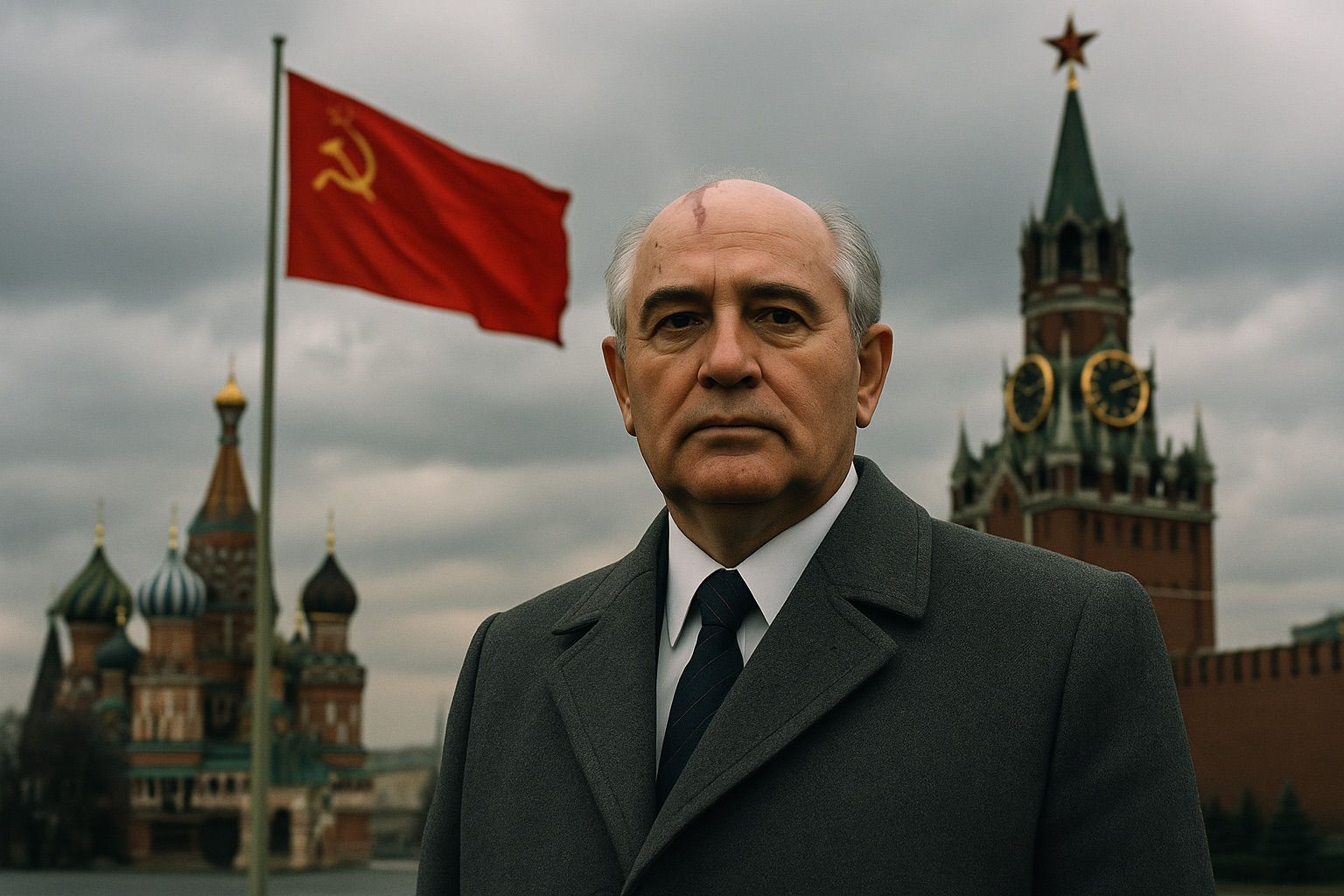
Gorbachev, stunned and increasingly powerless, resigned shortly afterward. On December 25, 1991, the red Soviet flag over the Kremlin was lowered for the last time and replaced with the tricolor of the Russian Federation. After nearly 70 years, the Soviet Union was gone.
Yet the collapse was not clean or simple. It unleashed enormous uncertainty—economic turmoil, political instability, and regional conflicts that continue to shape global affairs today. Russia struggled through a chaotic transition, marked by corruption, poverty, and a desperate attempt to redefine its national identity. The Baltic states pushed rapidly toward NATO and EU integration. Ukraine faced internal divisions that still echo through modern geopolitics. Central Asia navigated a path between independence and authoritarian consolidation. Meanwhile, the West declared victory in the Cold War, believing liberal democracy had triumphed once and for all.
But history is rarely so tidy. The legacy of the Soviet collapse is still unfolding, its effects rippling across the political landscape decades later. The resurgence of nationalism, renewed great-power rivalries, and debates over sovereignty all trace their roots back to 1991. The world that emerged in the aftermath is still grappling with the contradictions created by the sudden disappearance of a superpower.
If there is one lesson to be learned, it is that political systems—no matter how vast or powerful—are never as stable as they appear. Empires can vanish in a moment. Ideologies can crumble under the weight of their own contradictions. And leaders, whether visionary or flawed, can inadvertently unleash forces they cannot control. The Soviet Union’s dissolution was not merely the collapse of a government. It was the unraveling of a worldview, the end of an era, and the beginning of a new global reality that continues to evolve.
Even today, when looking back on those final months, the collapse feels almost surreal. A superpower with millions of soldiers, thousands of nuclear weapons, and decades of ideological dominance simply… ended. Not with a war, not with an invasion, but with signatures on a document in a quiet Belarusian forest. The shockwaves of that moment still reverberate in international conflicts, diplomatic tensions, economic relationships, and the identities of millions who once called themselves Soviet citizens.
History often moves slowly, but sometimes it crashes forward with breathtaking speed. In 1991, the world watched as one of the most powerful empires in human history dissolved into memory—its fall as dramatic, complex, and consequential as its rise. And to this day, the question that lingers is not only why the Soviet Union collapsed, but what its fall means for the future of nations still wrestling with the same forces of nationalism, reform, ambition, and identity that tore an empire apart.