
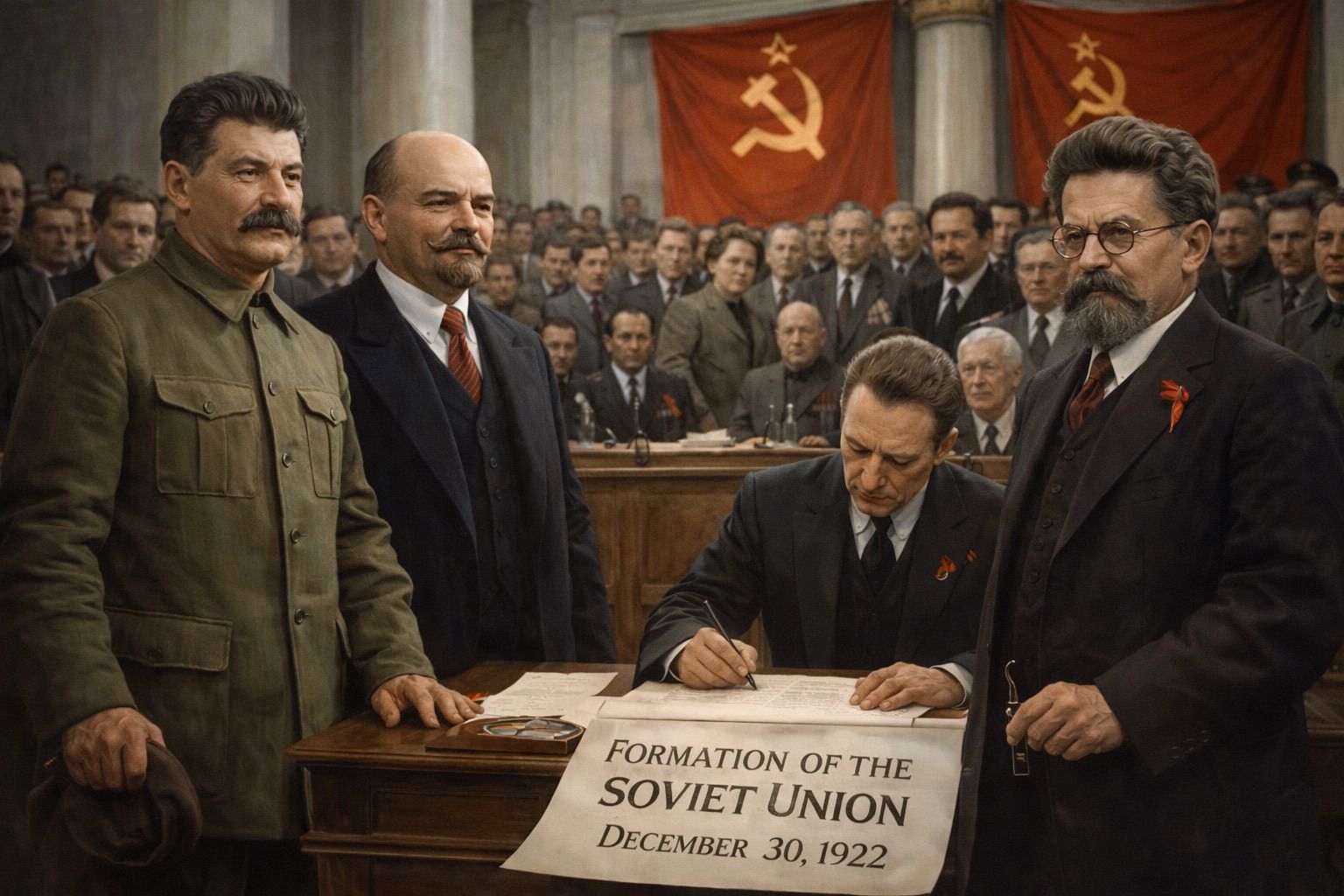
The formation of the Soviet Union marked a pivotal moment in modern history, one that would shape the destiny of nations and empires for generations to come. The culmination of revolutionary fervor and imperial ambitions, the Soviet Union was forged from the ashes of the Russian Empire, which had been ravaged by civil war and foreign intervention.
In the aftermath of World War I, the Romanov dynasty lay in tatters, its autocratic regime overthrown by a coalition of liberal and socialist forces. The Provisional Government, led by Alexander Kerensky, struggled to maintain order in the face of growing chaos and anarchy. However, with the Bolsheviks gaining momentum, Kerensky’s government was eventually toppled, paving the way for Vladimir Lenin to seize power.
Lenin, a charismatic leader and brilliant strategist, had returned from exile to find his party on the brink of collapse. Yet, with his trademark energy and ideological conviction, he rallied the Bolsheviks and guided them through the turbulent months that followed. The October Revolution, which saw the overthrow of Kerensky’s government, was the most pivotal moment in modern Russian history, marking the beginning of a new era.
As Lenin consolidated power, he set about transforming Russia into a socialist state. He nationalized key industries, imposed strict controls on the economy, and established the Red Army to maintain order. The Cheka, precursor to the KGB, was founded to root out counter-revolutionaries and suppress dissent. While these measures secured the Bolsheviks’ grip on power, they also spawned widespread opposition, from monarchists and Mensheviks to social democrats and peasant groups.
As the Soviet Union took shape, Lenin’s foreign policy became increasingly confrontational. He repudiated the Treaty of Brest-Litovsk, which had ended Russia’s participation in World War I, and instead began mobilizing against the emerging capitalist powers. The Rapallo Treaty with Germany, signed in 1922, was a significant milestone, marking a rapprochement between the Soviet Union and its former enemy.
Meanwhile, the newly established Comintern, under the leadership of Grigory Zinoviev, was busy spreading revolutionary fervor across Europe and beyond. The organization’s slogan, “Communism in one country,” became a clarion call for socialists worldwide to join forces with the Soviet Union. As Lenin navigated treacherous international waters, he remained steadfast in his commitment to Marxist ideals.
In 1922, at the 11th Party Congress, Lenin proposed the formation of a federal state, comprising three republics: Russia, Ukraine, and Belarus. The Soviet Union was born, with its first constitution drafted to enshrine the principles of socialism and workers’ power. As the new state took shape, its leaders set about consolidating control over the periphery, annexing territory from neighboring states, and suppressing nationalist movements.
The early years of the Soviet Union were marked by intense ideological conflict, with factions vying for influence within the Communist Party. The “New Economic Policy” (NEP), introduced in 1921, allowed for limited capitalist enterprise and was a pragmatic response to economic hardship. However, it also fueled resentment among radicals, who saw it as a betrayal of Marxist principles.
The struggle between the moderate Left, led by Leon Trotsky, and the hardline Right, headed by Joseph Stalin, would ultimately decide the course of Soviet history. Lenin’s illness and eventual death in 1924 created a power vacuum that both factions sought to exploit. As Stalin’s star rose, he began to eliminate his opponents, beginning with the murder of Sergei Kirov in 1934.
The subsequent reign of terror saw millions of innocent people sent to their deaths in the Gulag or through forced labor camps. The show trials and public executions of prominent Bolsheviks, including Bukharin and Rykov, served as a stark reminder of Stalin’s ruthless consolidation of power.
As the Soviet Union expanded its borders, it also faced growing opposition from neighboring countries. Poland, Finland, and Estonia all resisted Moscow’s advances, but were eventually subjugated through military force or economic coercion. The Red Army, having defeated the Polish Army in 1920, became a symbol of Soviet strength and resilience.
The Soviet Union’s relations with Western powers were fraught from the outset, with the Allies refusing to recognize its legitimacy until 1933. However, as Hitler’s Germany began to flex its muscles, the Soviet Union found itself forced into an uneasy alliance with its former enemies. The Molotov-Ribbentrop Pact, signed in 1939, allowed for a temporary truce between the two powers, but ultimately proved disastrous for both.
The Soviet Union emerged from World War II as one of the victorious Allies, having suffered the heaviest losses of all combatants. As the Cold War began to unfold, the United States and its NATO allies faced off against the Soviet bloc in a decades-long struggle for ideological supremacy. The Soviet Union’s subsequent expansion into Eastern Europe, coupled with the Berlin Blockade and Airlift, solidified the division between East and West.
Throughout its existence, the Soviet Union remained a bastion of Marxist ideology, even as it grappled with issues of national identity and diversity. As dissent grew within the ranks, reformers like Mikhail Gorbachev sought to introduce liberalizing measures, which ultimately proved fatal to the regime’s survival. The collapse of the Soviet Union in 1991 marked the end of a long and complex chapter in world history.
The formation of the Soviet Union was not just a domestic development, but also a response to the global turmoil that followed World War I. The Russian Revolution had set off a chain reaction across Europe and beyond, as socialists and communists saw in Lenin’s victory a model for their own movements. In Germany, France, and Italy, Marxist parties gained strength and began to organize strikes and protests.
In the Soviet Union itself, Lenin’s government was determined to export revolution to other countries. The Comintern, founded in 1919, became a hub for international communist activity, with agents dispatched to foment rebellion and instability worldwide. From Turkey to China, from Spain to Brazil, Soviet-backed movements emerged, often with disastrous consequences.
Lenin’s own vision of socialism in one country was increasingly at odds with the Comintern’s ambitions. He saw the Soviet Union as a beacon for revolutionaries everywhere, but also recognized that its own economic and military needs had to be prioritized. This led to tensions within the party, particularly between Lenin and Trotsky, who advocated for greater international cooperation.
As the 1920s wore on, the Soviet Union faced growing challenges at home. The economy was in shambles, with famine and industrial collapse crippling the country. The NEP, introduced by Lenin in 1921, attempted to address these issues by allowing limited capitalist enterprise, but it also fueled resentment among radicals who saw it as a betrayal of Marxist principles.
The struggle between moderate Left and hardline Right within the Communist Party would continue for years, with both factions vying for control. The “Left Opposition,” led by Trotsky and his allies, advocated for greater economic decentralization and international cooperation. However, Stalin’s consolidation of power had already begun, and he would stop at nothing to crush opposition.
The brutal suppression of dissent, particularly in the early 1930s, was a hallmark of Stalin’s rule. The show trials, where leading Bolsheviks were accused of treason and executed, became a grim spectacle, as did the forced collectivization of agriculture, which led to widespread famine in Ukraine and other areas.
Despite these atrocities, the Soviet Union continued to grow in power and influence. Its industrial production soared, with massive projects like the Baikal-Amur Railway and the Moscow Metro transforming the country’s infrastructure. The Red Army, having defeated the Polish Army in 1920, became a symbol of Soviet strength and resilience, capable of defending its borders against any foe.
However, the Molotov-Ribbentrop Pact, signed in 1939, marked a turning point for the Soviet Union. By allying with Nazi Germany, Stalin’s regime sacrificed its ideological integrity for temporary gains, which ultimately proved disastrous. The subsequent German invasion of June 1941 caught the Red Army off guard, leading to one of the bloodiest battles in history.
The Great Patriotic War would prove a crucible for the Soviet people, testing their resolve and resilience against unimaginable odds. Despite initial setbacks, the Red Army eventually turned the tide, pushing the Germans back across Eastern Europe. The losses were staggering – estimates suggest over 20 million Soviet citizens died during World War II – but the victory marked a turning point in Soviet history.
In the aftermath of the war, Stalin’s regime was at its most powerful, with satellite states stretching from Poland to Mongolia under Moscow’s control. However, as the Cold War began to unfold, the United States and its NATO allies faced off against the Soviet bloc in a decades-long struggle for ideological supremacy.
The division between East and West became increasingly entrenched, with Berlin serving as a focal point of conflict. The city’s blockade by Soviet forces in 1948 led to the historic Airlift, which provided vital supplies to the Western sector until the blockade was lifted. This event marked a new phase in the Cold War, as both sides dug in for a protracted standoff.
Throughout its existence, the Soviet Union struggled with issues of national identity and diversity. The various ethnic groups that made up the country’s population often felt marginalized or suppressed by Moscow’s central authority. In the Baltic states, Ukraine, and Georgia, nationalist movements emerged, seeking greater autonomy or even independence.
The reformers who came to power in the late 1980s, led by Mikhail Gorbachev, sought to address these issues through glasnost (openness) and perestroika (restructuring). However, their attempts at liberalization ultimately proved fatal to the regime’s survival. The Soviet Union began to disintegrate from within, with republics declaring independence one by one.
In December 1991, the Soviet Union ceased to exist as a functioning state. Its legacy remains complex and contested – some see it as a pioneering effort in socialism and international cooperation; others condemn its authoritarianism and atrocities. Regardless, the Soviet Union’s impact on modern history is undeniable, shaping global politics, economies, and societies for generations to come.