
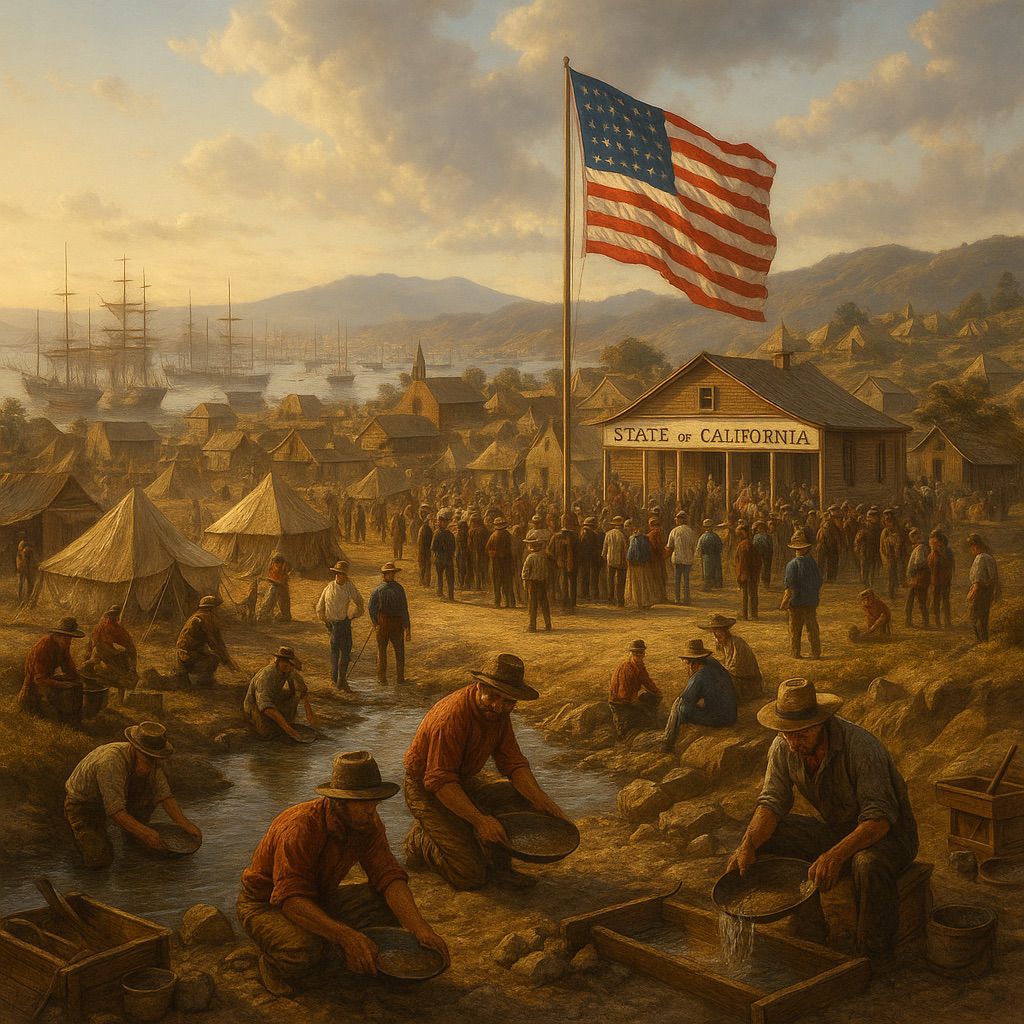
When California joined the Union on September 9, 1850, it did so with the kind of drama, speed, and chaos that perfectly suited the place we now think of as the land of reinvention. In a country that was still wrestling with slavery, westward expansion, and fragile compromises, California didn’t wait politely in line like the other states before it. It came barreling in on a tidal wave of gold dust, fortune seekers, and wild ambition. The Gold Rush that began in 1848 didn’t just transform a quiet Mexican province into a bustling epicenter of global migration; it hurled California onto the national stage in record time. In just two short years, what had been a sparsely populated land of missions, ranchos, and Native tribes became the obsession of prospectors, entrepreneurs, and schemers from around the globe. The state’s sudden leap into the Union was not just about gold, though the glitter of it colored everything; it was also about power, politics, and the uneasy balance between free and slave states. To understand California’s admission is to understand the fever of possibility and peril that defined America in the mid-19th century, and to see why California’s identity as a place of extremes and contradictions was written into its DNA from the very beginning.
California’s path to statehood was not the gradual process most territories endured. Normally, the United States took its time: a territory would be organized, settlers would arrive, infrastructure would develop, and eventually, once the population reached a certain threshold, petitions for statehood would be considered. California blew past all of that. In January 1848, James Marshall spotted gold flakes in the water of the American River at Sutter’s Mill. By March 1848, word was trickling through San Francisco, and by that summer, the town had emptied of able-bodied men who all rushed to the hills with pans and dreams. By late 1848 and into 1849, word spread beyond California, across the United States, and around the world. The result was one of the most astonishing migrations in history: over 300,000 people descended upon California, arriving by ship around Cape Horn, trekking across the deadly deserts of the Southwest, or trudging through the treacherous Sierra Nevada. San Francisco’s population exploded from a sleepy 1,000 to over 25,000 in just a year. Tents and hastily built shacks replaced the mission quiet with saloons, gambling dens, and the kind of lawlessness that made California feel less like a future state and more like a fever dream.
The sheer speed of this population boom made California’s admission urgent. The land had only just been acquired by the United States under the Treaty of Guadalupe Hidalgo, which ended the Mexican-American War in 1848. Barely had the ink dried on that treaty when California transformed into the ultimate prize. Politicians in Washington saw not just gold but strategic power: a Pacific port, a connection to Asia, and a chance to demonstrate the manifest destiny ideology in glittering reality. Yet, there was a problem. The nation was already tearing itself apart over slavery. Would California enter as a free state or a slave state? The balance of power in Congress teetered on that question, and every new state threatened to tip the scales. Slaveholding southerners wanted California’s fertile valleys to join their system, while abolitionists insisted the land should be free. Meanwhile, Californians themselves—miners and merchants, farmers and fortune seekers—were far more concerned about striking it rich than building slave plantations, and the climate of their society, with its rapid growth and fierce independence, tilted toward free labor.
In 1849, California convened a constitutional convention in Monterey, and in true California fashion, they didn’t wait for Washington’s permission. Delegates, drawn from all over the territory and speaking a dizzying array of languages, drafted a constitution that outlawed slavery. They wanted admission immediately, skipping the territorial stage entirely. It was bold, audacious, and exactly in line with the character of the Gold Rush itself. They didn’t want to be governed by distant politicians or dragged into the slow bureaucratic grind of territorial status; they wanted recognition as equals, as a state, as fast as possible.
The debate in Washington was heated. Adding California as a free state would tip the balance of power in the Senate against the South. Southern senators raged that the Union could not withstand such imbalance, while northern politicians pushed back against the expansion of slavery. The crisis culminated in the Compromise of 1850, one of the most dramatic deals in American legislative history. Crafted by Henry Clay and supported by figures like Daniel Webster, the compromise admitted California as a free state but offered concessions to the South, including the notorious Fugitive Slave Act, which required that escaped enslaved people be returned to their owners even if they reached free states. The compromise held the Union together temporarily, but the fault lines remained, and just a decade later, the country would plunge into civil war. California’s admission was not just another star on the flag; it was a spark in the ongoing tinderbox of slavery and sectionalism.
Life in California during those early years was anything but orderly. The Gold Rush brought dreamers and desperados, men and women from every continent, and with them came both energy and chaos. Law was improvised, justice often carried out at the end of a rope, and fortunes could be made or lost in a single day. Chinese immigrants arrived in large numbers, facing discrimination but contributing significantly to mining, agriculture, and construction. Latin American miners brought techniques and expertise but were often pushed out violently by nativist mobs. Native American populations, already devastated by disease and mission systems, suffered terribly under the onslaught of newcomers, facing violence, dispossession, and systemic extermination campaigns. The promise of California was immense, but so too was the cost, and the rush for gold exposed the darker side of America’s hunger for expansion.
Yet even in that chaos, California’s myth took root: the idea that here was a place of opportunity, of reinvention, of fortune. If the East was about tradition and hierarchy, California was about starting fresh, about staking a claim, about daring to believe in possibility. That ethos shaped the state’s future far beyond gold. When California became the 31st state on September 9, 1850, it did so as a land already defined by extremes: astonishing wealth and crushing poverty, breathtaking beauty and ecological destruction, innovation and injustice. That paradox would echo through its history, from Hollywood’s dreams to Silicon Valley’s digital gold rush.
The speed with which California went from a sparsely settled province to a state was unprecedented. Most states crawled into existence; California sprinted. It was a state born not from patient growth but from frenzy. That frenzied birth is why California often feels different from the rest of the Union—less bound by tradition, more volatile, more visionary, more restless. It entered the United States not as a cautious supplicant but as a force demanding recognition. The Gold Rush was not just a story of nuggets in pans; it was the engine that propelled California onto the national stage, cementing its reputation as a place where anything could happen, for better or worse.
Looking back at September 9, 1850, it’s easy to see California’s statehood as inevitable. But at the time, it was anything but. The compromise that allowed its entry was fragile, the tensions surrounding it immense, and the gamble profound. Yet California’s admission showed the magnetic pull of opportunity. It revealed that America’s destiny was indeed westward, toward the Pacific, toward a future where the old rules didn’t apply. It also showed that the contradictions at the heart of America—freedom and slavery, opportunity and exploitation—were not easily resolved. California embodied both the dream and the nightmare, the promise and the peril, all at once.
And so, on that September day, when California joined as the 31st star on the flag, it was more than paperwork, more than ceremony. It was the moment when the United States reached the Pacific, when the Gold Rush turned from a regional frenzy into a national transformation, when the future of the Union tilted just a little more precariously toward its inevitable reckoning. California didn’t just join the Union. It crashed into it, demanded a seat at the table, and forever changed the conversation.