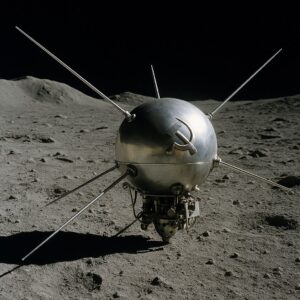
The first color photograph of Earth taken from space is one of those rare moments in human history when technology, curiosity, and sheer wonder converge into a single image that changes how we see ourselves. Before that moment, our understanding of Earth was rooted almost entirely in maps, globes, paintings, and imaginations shaped by the …
Tag: spacehistory
How Lunokhod 1 Turned the Lunar Surface into Humanity’s First Roadway
When the Soviet Luna 17 spacecraft touched down on the Moon on November 17, 1970, the world witnessed a moment so quietly revolutionary that its full significance took years to appreciate. Nestled inside that lander was Lunokhod 1, a peculiar-looking, bathtub-shaped, eight-wheeled machine whose arrival would mark one of the most remarkable engineering triumphs of …
Touching the Moon: The Day Humanity First Reached Another World
On September 14, 1959, something extraordinary happened. For the first time in history, an object built by human hands escaped Earth’s gravity, traveled across the void of space, and crashed into the Moon. That object was Luna 2, a Soviet spacecraft, and though its mission ended in a violent impact, its legacy was monumental: humanity …
Ash and Light: The Day the Earth Looked Back and the Mountain Spoke
On a late summer day that sits like a hinge in the calendar, August 23 offers a startling diptych: a mountain that devoured cities and a machine that taught us to see our own. In AD 79, Mount Vesuvius erupted with a ferocity that turned Pompeii and Herculaneum into time capsules of terror and tenderness, …
Red Horizons and Concrete Divides: When a Moon Was Found and a Wall Rose
Under a warm August sky, two moments in history—separated by nearly a century—emerged on the same date, each shaping the human story in profoundly different ways. On August 17, 1877, Asaph Hall, an astronomer at the U.S. Naval Observatory in Washington, D.C., peered into the vast darkness through the largest refractor telescope in the world …
Mir: The Soviet Union’s Floating City in the Stars
1986 marked a pivotal moment in space exploration as the Soviet Union launched the Mir space station, a technological marvel that would orbit Earth for 15 years. Assembled in space over a decade, Mir became a symbol of human ingenuity and international cooperation, serving as a microgravity laboratory, a training ground for astronauts, and a …