
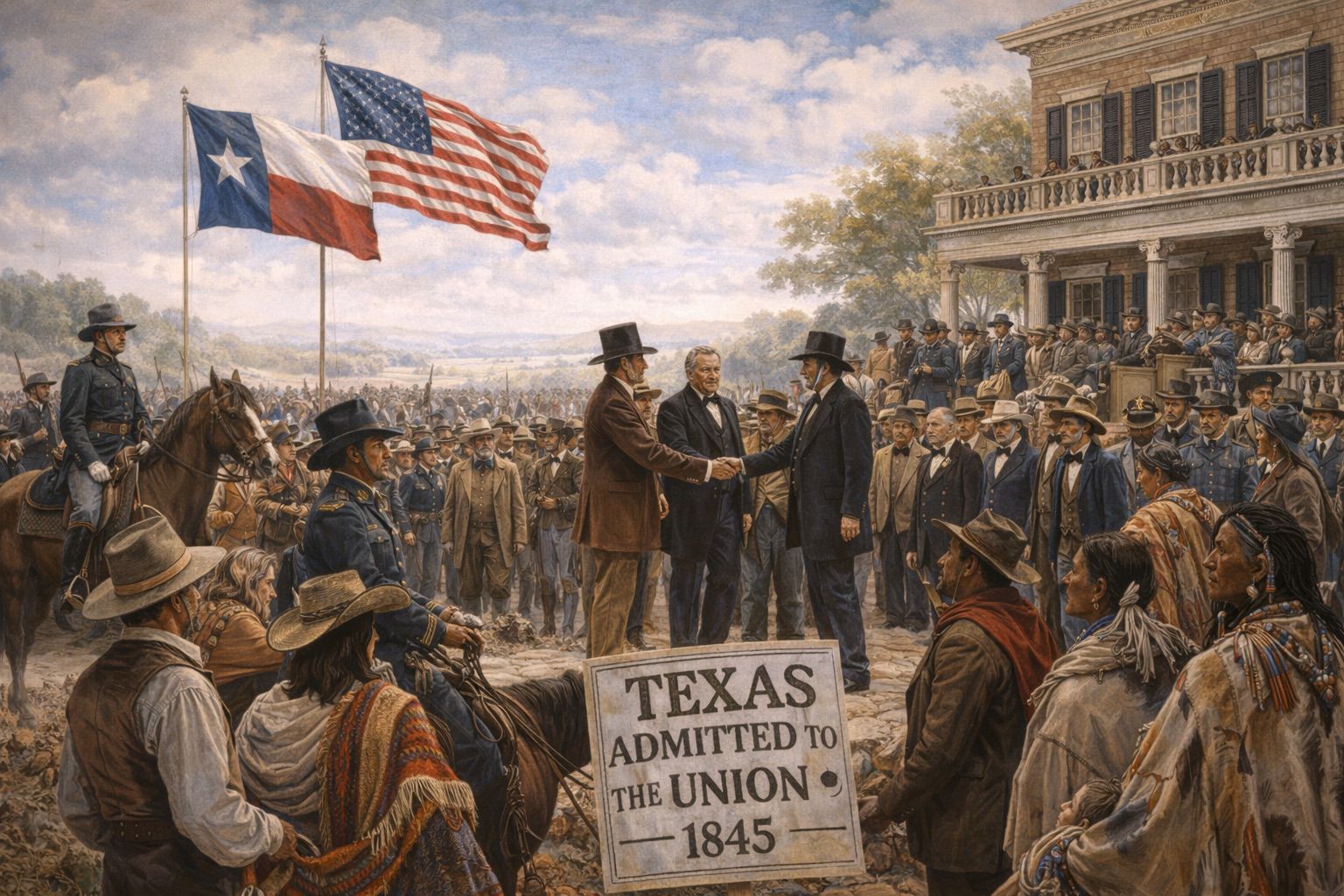
The admission of Texas as the 28th U.S. state on December 29, 1845, marked a significant milestone in the country’s history. The annexation of the Lone Star Republic by the United States was a long and arduous process that involved complex negotiations, debates, and even violence. To understand the significance of this event, it is essential to examine the historical context leading up to Texas’ admission as a state.
In the early 19th century, the United States and Mexico were both struggling with their own internal issues. The Mexican War of Independence from Spain had just ended in 1821, but the new nation was still grappling with its own identity and borders. The U.S., on the other hand, was expanding westward, fueled by a desire for Manifest Destiny – the idea that it was America’s divine mission to spread across North America.
The relationship between the two nations was further complicated by the fact that Texas had been part of Mexico since gaining independence from Spain in 1821. However, as the Mexican government struggled to maintain control over its vast territories, a group of American settlers arrived in the region with the intention of establishing their own colonies. These settlers were largely from the Southern states and brought with them their own culture, language, and social norms.
In the early 1830s, tensions began to rise between the Mexican government and these American settlers. The Mexican government, which was dominated by centralists who wanted a strong federal system, saw the Texans as a threat to its authority. The Texans, on the other hand, wanted greater autonomy and even independence from Mexico. In 1835, a group of rebels in San Antonio launched the famous Battle of Gonzales against the Mexican army, marking the beginning of the Texas Revolution.
The conflict between the Texans and the Mexicans continued for several years, with the Texans emerging victorious at the Battle of San Jacinto on April 21, 1836. The newly formed Republic of Texas declared its independence from Mexico and established its own government, led by Sam Houston as president. However, the new republic faced significant challenges, including a struggling economy and a lack of recognition from other countries.
In 1837, the U.S. Congress passed the Webster-Ashburton Treaty with Great Britain, which resolved border disputes between the two nations. However, the treaty also led to increased tensions between the U.S. and Mexico over the issue of Texas’ status. The Mexican government refused to recognize the Republic of Texas as a sovereign state, and instead saw it as part of its own territory.
Meanwhile, in the United States, there was growing support for the annexation of Texas. Many Americans saw the young republic as a potential addition to the Union, and believed that its inclusion would strengthen the country’s economy and military. In 1843, President John Tyler sent a special envoy, John Slidell, to Mexico City to negotiate an agreement on Texas’ status. However, the mission was unsuccessful, and tensions between the two nations continued to rise.
In March 1844, Congress passed a resolution calling for the annexation of Texas by joint resolution, which would bypass the need for Senate approval. However, this resolution was met with fierce opposition from Northern Democrats, who saw it as an attempt by Southern states to expand slavery into new territories. The issue became increasingly polarized, with pro-slavery Southerners supporting annexation and anti-slavery Northerners opposing it.
Despite these challenges, the Texas annexation movement continued to gain momentum. In December 1844, Congress voted in favor of the joint resolution, but President Tyler vetoed it, citing concerns about Senate opposition. However, when Congress reconvened in March 1845, they passed a new joint resolution that included provisions for the abolition of slavery in Texas. This compromise led to the signing of the annexation treaty by the U.S. and Texas on April 12, 1845.
The final step towards statehood was taken on December 29, 1845, when President Polk signed a proclamation admitting Texas as the 28th U.S. state. The admission was met with widespread celebration across the country, but it also sparked outrage in Mexico and among anti-slavery groups in the North. The annexation of Texas had significant implications for the balance of power in both nations, setting the stage for future conflicts over slavery, states’ rights, and westward expansion.
The legacy of Texas’ admission as a state continues to shape American politics today. The debate over Manifest Destiny and its impact on Native American tribes is still relevant, as is the issue of immigration and border security. The annexation of Texas also highlights the complexities of nation-building and the challenges of integrating diverse cultures into a unified whole.
The relationship between the U.S. and Mexico has continued to evolve over time, with periods of cooperation and conflict. Today, the two nations maintain close diplomatic ties and cooperate on issues such as trade and security. However, the legacy of Texas’ admission as a state remains a source of tension between the two countries, particularly when it comes to issues related to immigration and border control.
As the Republic of Texas entered its second decade, the struggle for survival became increasingly dire. The economy was in shambles, with many Texans struggling to make ends meet due to a series of devastating crop failures and economic downturns. Meanwhile, the Mexican government continued to refuse recognition of the Republic’s sovereignty, maintaining that Texas was still part of Mexico.
In an effort to bolster its economy and strengthen its claim to independence, the Republic of Texas turned to the United States for support. In 1839, a group of Texans traveled to Washington D.C. to lobby for recognition and financial aid from Congress. However, their efforts were met with skepticism by many lawmakers, who viewed the Republic as little more than a ragtag collection of settlers.
Despite these setbacks, the Texas Revolution continued to gain momentum, thanks in large part to the leadership of Sam Houston. A veteran of the War of 1812 and a skilled politician, Houston was instrumental in rallying support for the Republic among Texans and Americans alike. In 1839, he traveled to Washington D.C. to meet with President Martin Van Buren and other government officials, pressing his case for recognition and aid.
The following year, the Texas Revolution received a significant boost when Stephen F. Austin, one of the most influential figures in the Republic’s early history, arrived in Washington D.C. with a petition signed by over 5,000 Texans calling for annexation by the United States. The petition, which was presented to President Van Buren on March 1, 1840, marked a significant turning point in the struggle for Texas’ independence.
As the debate over Texas’ status continued to rage within Congress and among the American public, a group of Texans began secretly negotiating with U.S. officials to pave the way for annexation. In May 1843, John Slidell, a former U.S. diplomat who had previously served as minister to Mexico, was dispatched to Washington D.C. by President Tyler to negotiate a secret treaty with Texas that would set the stage for annexation.
The negotiations, which took place over several weeks in June and July of 1843, resulted in the signing of a secret treaty between Slidell and Sam Houston. The treaty, which was not made public at the time, provided for the terms of Texas’ annexation by the United States. It also included provisions for the abolition of slavery in Texas, which would become a contentious issue during the debate over statehood.
However, just as it seemed that annexation was all but assured, the treaty was derailed by the arrival of Slidell’s instructions from President Tyler. The instructions, which were not made public at the time, revealed that Tyler had secretly offered to sell Texas to the United States for $30 million. This move, which would have allowed the U.S. government to purchase rather than annex the Republic, was seen as a betrayal by many Texans and was ultimately rejected by Congress.
The failure of the Slidell mission marked a significant setback for the annexation movement, but it did not deter its proponents. In 1844, President Tyler began secretly negotiating with Texas officials once again, this time seeking to bypass Congress altogether in favor of a joint resolution that would admit Texas as a state by a simple majority vote.
The debate over annexation continued to rage within Congress throughout the spring and summer of 1844. Pro-slavery Southerners argued that annexing Texas was essential for maintaining the balance of power between slave and free states, while anti-slavery Northerners countered that it would only serve to further entrench slavery in American society.
In March 1845, after weeks of tense debate, Congress finally voted on a joint resolution admitting Texas as a state. The measure passed by a margin of just four votes, with Northern Democrats ultimately failing to block its passage. However, President Tyler vetoed the resolution, citing concerns about Senate opposition and the potential impact on the balance of power within the Republic.
Undeterred, Congress reconvened in April 1845 and passed an amended version of the joint resolution that included provisions for the abolition of slavery in Texas. This compromise, which was seen as a significant concession by many pro-slavery Southerners, ultimately paved the way for the signing of the annexation treaty between the U.S. and Texas on April 12, 1845.
The final step towards statehood came on December 29, 1845, when President Polk signed a proclamation admitting Texas as the 28th U.S. state. The admission was met with widespread celebration across the country, but it also sparked outrage in Mexico and among anti-slavery groups in the North.
As the nation celebrated its newest addition, many Texans saw their long struggle for independence come to an end. But others knew that a new era of challenges lay ahead, one that would test the very fabric of American society. For as the Republic of Texas officially became part of the United States, it also brought with it a host of complex issues – including slavery, states’ rights, and westward expansion – that would shape the course of American history for generations to come.
The legacy of Texas’ admission as a state continues to be felt today. The debate over Manifest Destiny and its impact on Native American tribes remains a contentious issue, with many critics arguing that it was used as a justification for the forced relocation of indigenous peoples from their ancestral lands. Similarly, the issue of immigration and border control has been a source of tension between the U.S. and Mexico since the annexation.
In recent years, however, there have been signs of renewed cooperation between the two nations on issues such as trade and security. In 2013, the two countries signed a memorandum of understanding aimed at strengthening their bilateral relationship, including increased cooperation on issues related to border security.
Despite these efforts, the legacy of Texas’ admission as a state remains a source of tension between the U.S. and Mexico. For many Texans, the annexation marked the beginning of a new era of American expansionism that would ultimately lead to the displacement of Native American tribes from their ancestral lands. And for many Mexicans, it serves as a painful reminder of the country’s loss of territory and influence in the region.
Today, as Americans continue to grapple with the complexities of nation-building and cultural integration, they might do well to reflect on the lessons of Texas’ admission as a state. The Republic of Texas was born out of a desire for independence and self-governance, but it also brought with it a host of complex issues that would shape the course of American history.
The annexation of Texas serves as a reminder that nation-building is never easy, and that the integration of diverse cultures and identities can be a contentious process. It highlights the importance of careful consideration and compromise in shaping our national identity and informing our policies towards other nations.
As we move forward into an increasingly complex and interconnected world, it is more important than ever to learn from the experiences of the past. The legacy of Texas’ admission as a state remains a source of tension between the U.S. and Mexico today, but it also offers valuable lessons for policymakers and citizens alike about the complexities of nation-building and cultural integration.
In the end, the annexation of Texas marked a significant turning point in American history, one that would shape the course of our national identity and inform our policies towards other nations for generations to come. As we continue to grapple with the challenges of nation-building and cultural integration, we might do well to reflect on the lessons of Texas’ admission as a state – and strive to build a more inclusive, compassionate, and just society for all.