On December 8th, 1980, the world seemed to stop for a moment, as if shaken by a sudden and impossible truth. News stations flickered with the same headline, radios interrupted their music with trembling voices, and fans from New York to Tokyo felt the same hollow ache settling inside their chests: John Lennon, the voice that helped define a generation, had been shot outside his New York City home. For many, it felt surreal, like waking up from a dream that had ended too abruptly to make sense. Lennon had always seemed larger than life — a visionary, an icon, a rebel, a poet — and suddenly the idea that he was simply gone felt not just heartbreaking, but fundamentally wrong. People didn’t just lose a musician that night. They lost a part of what made the world feel full of possibility.
John Winston Lennon had never belonged solely to Liverpool, even though the winding streets of that city shaped him in ways that would ripple across the globe. Born on October 9th, 1940, John grew up in a world still recovering from war, surrounded by adults who were trying their best but often had little to give. It was a childhood marked by love and absence, by music and confusion, by the fierce independence that comes from growing up with more questions than answers. John admired the rock ’n’ roll greats before he even understood what greatness meant. He heard Elvis Presley on the radio, felt something electric spark inside him, and realized music could be more than entertainment — it could be expression, rebellion, a doorway out of the narrow life he saw ahead of him.
Like many teenagers at the time, John started with skiffle — homemade instruments, cheap guitars, rhythms that felt rough around the edges yet pulsing with energy. The Quarrymen began as a group of boys fumbling their way toward sound and identity. John didn’t know it then, but the universe was already aligning the pieces that would transform the world. Paul McCartney walked into his life one summer afternoon in 1957, showing up with a guitar, a grin, and a talent that matched John’s spark with its own irresistible fire. George Harrison soon followed — younger, quieter, but just as hungry to create something meaningful. When Ringo Starr stepped in later to complete the lineup, the band that would change history finally had its pulse.
What happened next is the stuff of legend. The Beatles didn’t just play music; they became a cultural phenomenon so intense that no one — not even the band itself — could fully understand it while it was happening. Screaming fans chased them down streets, airports flooded with crowds, records sold faster than stores could stock them. The Beatles weren’t merely popular; they were a global movement, a wave of youth and energy and hope that seemed unstoppable. Through it all, John Lennon stood at the center: sharp-tongued, insightful, irreverent, brilliant. His songwriting cut through the noise, weaving tenderness with wit, vulnerability with rebellion. Songs like “Help!,” “In My Life,” “Strawberry Fields Forever,” and “All You Need Is Love” weren’t just hits — they were pieces of John’s soul carved into melody.
The 1960s were turbulent times, and Lennon’s voice fit that era like a spark to a fuse. As war raged and social norms cracked under pressure, he used his platform to speak up in a way that few artists had dared to do. Some adored him for it. Others despised him. But John had never been the kind of man to sit quietly and look pretty for the cameras. He wasn’t built for silence. Every interview, every lyric, every performance carried a shadow of defiance — a reminder that he viewed the world with equal parts wonder and frustration.
When The Beatles parted ways in 1970, the world felt fractured. The band that had carried millions through cultural upheaval suddenly dissolved into four separate paths. Lennon took his portion of the spotlight and reshaped it into something rawer, more intimate. His solo career, especially his work with the Plastic Ono Band, revealed a side of him that felt deeply personal. He sang about trauma, loneliness, childhood wounds, societal illusions — the things people try to bury but never fully escape. “Imagine,” the song that would become synonymous with his message, wasn’t just a ballad. It was a prayer disguised as a melody, a vision of a world that could be softer, kinder, borderless, free.
His relationship with Yoko Ono became one of the most scrutinized unions in modern history. Racism, misogyny, and narrow-mindedness fueled relentless criticism. People saw her as an outsider, a disrupter, a threat to the myth they had built around John Lennon. Yet John saw something different: a partner, a collaborator, a muse. Their love was unconventional, but it was also fiercely genuine. Together, they orchestrated protests like the “Bed-In for Peace,” transforming the media frenzy around them into a weapon against war. They invited the world to imagine peace not as a dream, but as a responsibility.
But fame is a double-edged sword. While John inspired millions, he also attracted people whose admiration warped into obsession. One such man was Mark David Chapman — a troubled, unstable individual who built a dark fantasy around Lennon. In Chapman’s unraveling mind, John had failed to meet the impossible expectations he had created. This resentment, twisted and fed by delusion, ultimately led him to plan the unthinkable.
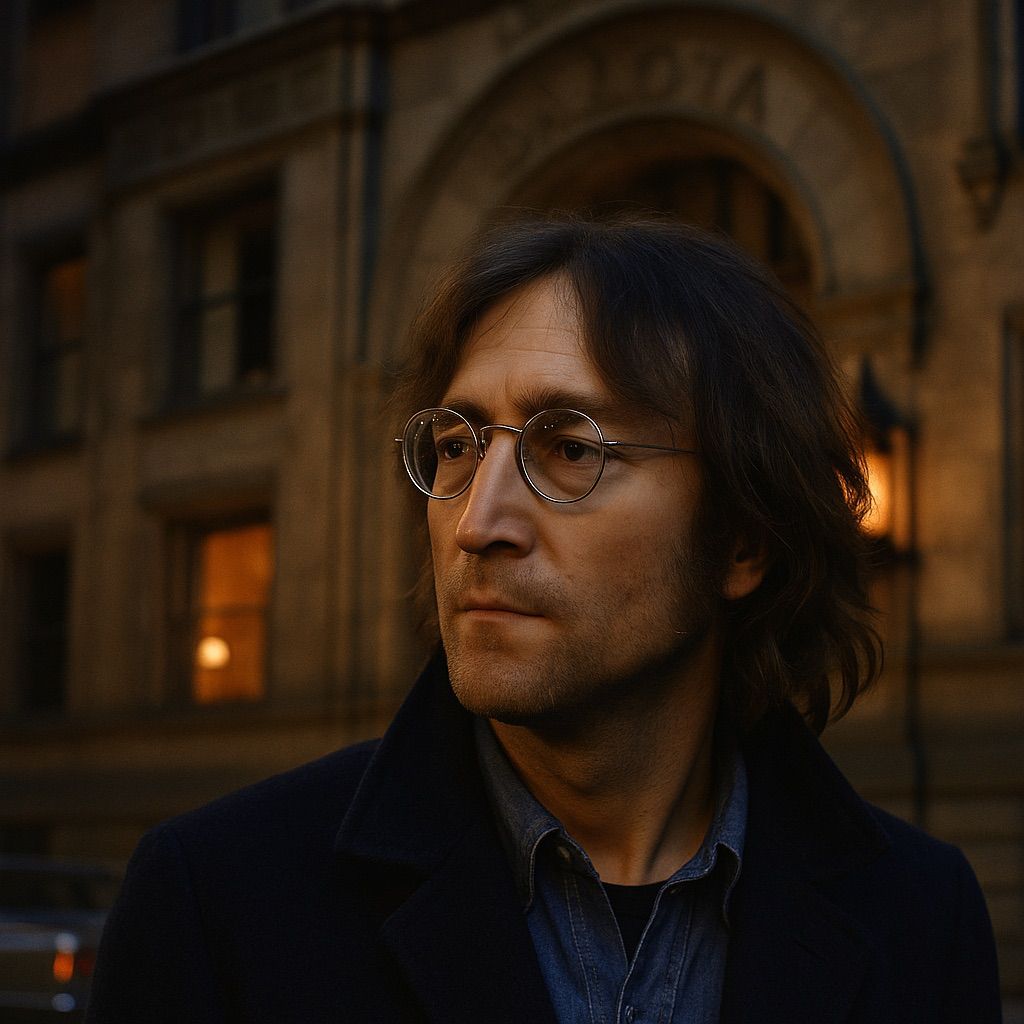
On the night of December 8th, 1980, John and Yoko returned to the Dakota after a long day at the studio. Just hours earlier, John had autographed an album for Chapman, unaware that the encounter was the prelude to tragedy. As John stepped toward the archway of the building, Chapman fired five shots — four of which struck the musician who had spent a lifetime advocating for peace. The world didn’t know it yet, but in those few seconds, history shifted.
John Lennon was rushed to Roosevelt Hospital, but the damage was irreversible. He died shortly after, leaving Yoko shattered and millions grieving. Announcers choked through the news, radio stations played Beatles songs on loop, and crowds gathered outside the Dakota in stunned silence. Some cried. Some stood motionless. Some sang as if their voices could stitch the world back together. For a generation that had grown up believing that peace and love might truly change society, the loss felt like a brutal contradiction — the violent death of a man who had devoted his life to nonviolence.
What followed was not just mourning, but reflection. Fans wrote letters, created memorials, held vigils. In Central Park, near the Dakota, crowds by the thousands gathered to celebrate John’s life. Across oceans, from London to São Paulo, similar gatherings emerged. People felt connected by their grief, as though Lennon’s spirit had woven them into a global tapestry of remembrance. Even those who hadn’t grown up with The Beatles felt the weight of what had been lost.
The media, unsurprisingly, swirled with sensationalism. Conspiracy theories emerged — wild claims about government plots or hidden motives — none of which held truth but all of which reflected the intensity of John and Yoko’s cultural impact. For many, the couple represented rebellion, counterculture, and honesty, and anything associated with them was fertile ground for speculation. Through it all, Yoko Ono endured unimaginable pain with grace, preserving John’s legacy while carving her own path forward.
And the legacy did continue. In 1982, Yoko established the John Lennon Foundation, dedicated to promoting the arts, peacebuilding, and human rights — causes that had defined John’s life. His music remained timeless, rediscovered by young listeners who found themselves moved by lyrics written decades before they were born. Artists from every genre have cited Lennon as an influence, from David Bowie to U2 to Radiohead. His courage to be vulnerable — to write openly about pain, politics, love, and his own imperfections — reshaped what music could be.
Lennon was a visionary, but he was also deeply human. He made mistakes. He struggled with identity, with anger, with fame. He wasn’t always gentle, nor was he always right. But he grew, he apologized, he learned, and he worked relentlessly to become better. That complexity is part of what makes him endure in the public consciousness. He wasn’t a saint. He wasn’t a myth. He was a flawed, brilliant man who believed deeply in the potential for human goodness — and spent his life urging others to believe in it too.
Today, decades after his death, the world still pauses on December 8th to remember him. Fans still place flowers at Strawberry Fields in Central Park. Musicians still play his songs during peace rallies. His lyrics still appear on protest signs, in classrooms, on murals, on the walls of young people trying to find their voice. Lennon’s message — that love is powerful, that peace is worth fighting for, that imagination can shape reality — hasn’t faded. If anything, it matters more now than ever.
The night John Lennon died was a moment of darkness. But the life he lived, the art he created, and the legacy he left behind continue to shine with a brightness that even violence could not extinguish. His voice may have fallen silent that December evening, but his message still echoes across generations, reminding us that music — and the people who dare to use it for good — never truly disappear.