
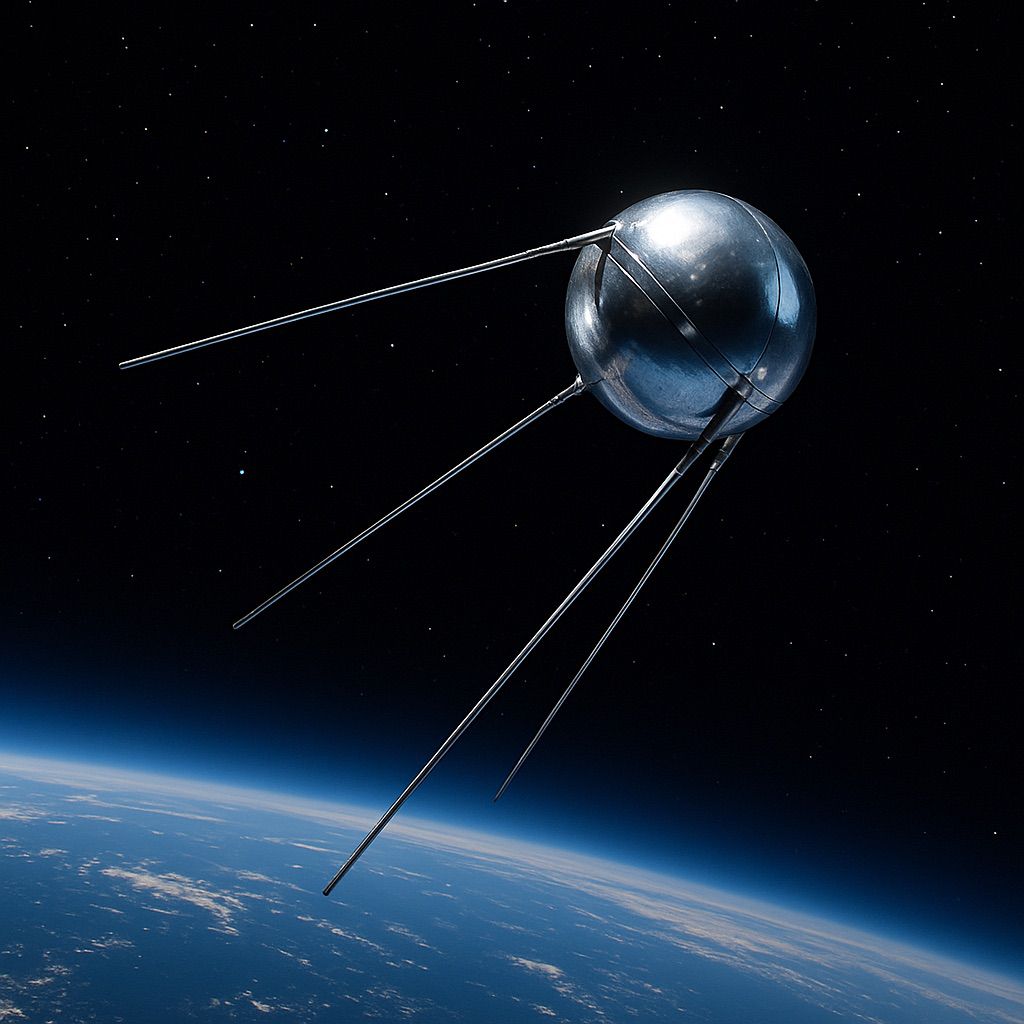
On the evening of October 4, 1957, a faint, rhythmic beep-beep-beep drifted down from the skies above Earth. It wasn’t the sound of a bird, a plane, or even the hum of earthly machines. It was the voice of a metal sphere, no larger than a beach ball, hurtling through the heavens. That voice belonged to Sputnik 1, the first artificial satellite launched by humankind. And those beeps, simple as they were, marked the birth of something far greater than anyone could have imagined: the Space Age.
That single act of launching a 184-pound sphere into orbit by the Soviet Union changed history in an instant. It wasn’t just science; it was psychology, politics, fear, and wonder. For the first time, humanity had broken free from Earth’s gravitational prison, proving that dreams whispered for centuries by poets and visionaries could be real. Yet, as the world tilted its head toward the night sky, it also trembled. Sputnik was more than a satellite—it was a spark that ignited competition, paranoia, and eventually, breathtaking achievements that would redefine what it means to be human.
To grasp why Sputnik shook the world, one must first appreciate the context. The 1950s were an era of tension and suspicion. The Cold War had divided the globe into two camps: the United States and the Soviet Union, each armed to the teeth, glaring at one another with ideological hostility. Technology was no longer neutral—it was a weapon, a stage, and a symbol of superiority. When the Soviets announced that they had launched the world’s first satellite, it wasn’t just a scientific triumph—it was a political earthquake.
Americans, in particular, were stunned. The United States had assumed technological dominance, yet here was the Soviet Union—a country often dismissed in the West as backward and inefficient—leaping ahead. The press dubbed it the “Sputnik Shock.” Parents peered at their children and wondered whether their schools were failing them. Politicians scrambled to explain why America had fallen behind. Defense strategists worried that if the Soviets could launch a satellite, they could also launch nuclear warheads across oceans. The night sky, once a place of calm and mystery, suddenly carried the shadow of fear.
And yet, beyond fear, Sputnik also ignited imagination. People looked up and realized they were not alone under the stars anymore. A human-made object was out there, circling Earth every 96 minutes. Children pressed their ears to radios to hear the satellite’s beeps. Astronomers tracked it through telescopes, its silvery body reflecting sunlight as it crossed overhead. For the first time, humanity had touched the realm of the gods, leaving behind not footprints but signals—beeps that said: We are here. We are reaching further.
Technically, Sputnik was modest. It carried no cameras, no instruments beyond its radio transmitter, and no passengers. But simplicity was its genius. Its launch was proof of concept. And proof of concept is often all it takes to change the world. Behind its beeps lay a truth: the sky was no longer the limit.
The ripple effects were immediate and profound. In the United States, Sputnik spurred sweeping reforms. The government poured money into science and engineering education. NASA was born in 1958, a direct child of Sputnik’s wake-up call. The arms race merged with the space race, each side pushing technology to unimaginable heights. Rockets became symbols of ideology: freedom versus communism, democracy versus dictatorship. But beneath those labels, what was really at stake was who could claim humanity’s future beyond Earth.
The Soviets capitalized on their momentum, launching Laika the dog aboard Sputnik 2 only a month later. Then came Yuri Gagarin, the first human in space in 1961. The Americans, spurred by fear and pride, responded with President John F. Kennedy’s audacious promise: to land a man on the Moon before the decade’s end. The Moon landing in 1969 would never have happened without Sputnik’s beeps echoing a dozen years earlier.
But Sputnik’s story is not just geopolitical; it is deeply human. Imagine the Soviet engineers, working with limited resources, battling failures, and facing immense pressure from their government. They were not simply building a machine—they were staking their careers, their reputations, and their nation’s pride on a hollow sphere that had to sing to Earth from space. Imagine the awe of a farmer in Kansas, gazing up and realizing that humanity had put a star in the sky. Imagine the mix of fear and exhilaration in a child who heard those beeps and decided to become a scientist.
Sputnik’s legacy reaches far beyond Cold War politics. It opened the door to satellites that today guide our GPS, power our communications, and monitor our climate. It paved the way for telescopes that peer into galaxies and probes that touch the edges of our solar system. It birthed the International Space Station, where Russians and Americans—once bitter rivals—now work side by side in orbit. Sputnik was a beginning, not an end.
And yet, its genius lies in its humility. It was not flashy. It did not roar triumphantly. It whispered. And in that whisper, the world heard a new possibility.
October 4, 1957, should remind us that revolutions are not always loud. Sometimes, they are a steady pulse, a rhythm in the background that changes how we see everything. Sputnik’s beeps were not merely radio signals—they were a heartbeat, the first thump of a species daring to step into the cosmos.
As we look today at billionaires launching rockets, at Mars rovers roaming distant worlds, at telescopes seeing light from the dawn of time, we should remember that it all began with a small silver sphere that didn’t do much except orbit and sing. But in that song, humanity recognized itself in the stars.
Sputnik’s lesson is timeless: progress often begins not with certainty, but with courage. A simple satellite launched by a rival power shook the world awake, spurred generations to dream bigger, and redefined humanity’s place in the universe. On October 4, 1957, the sky ceased to be a ceiling. It became a gateway.