
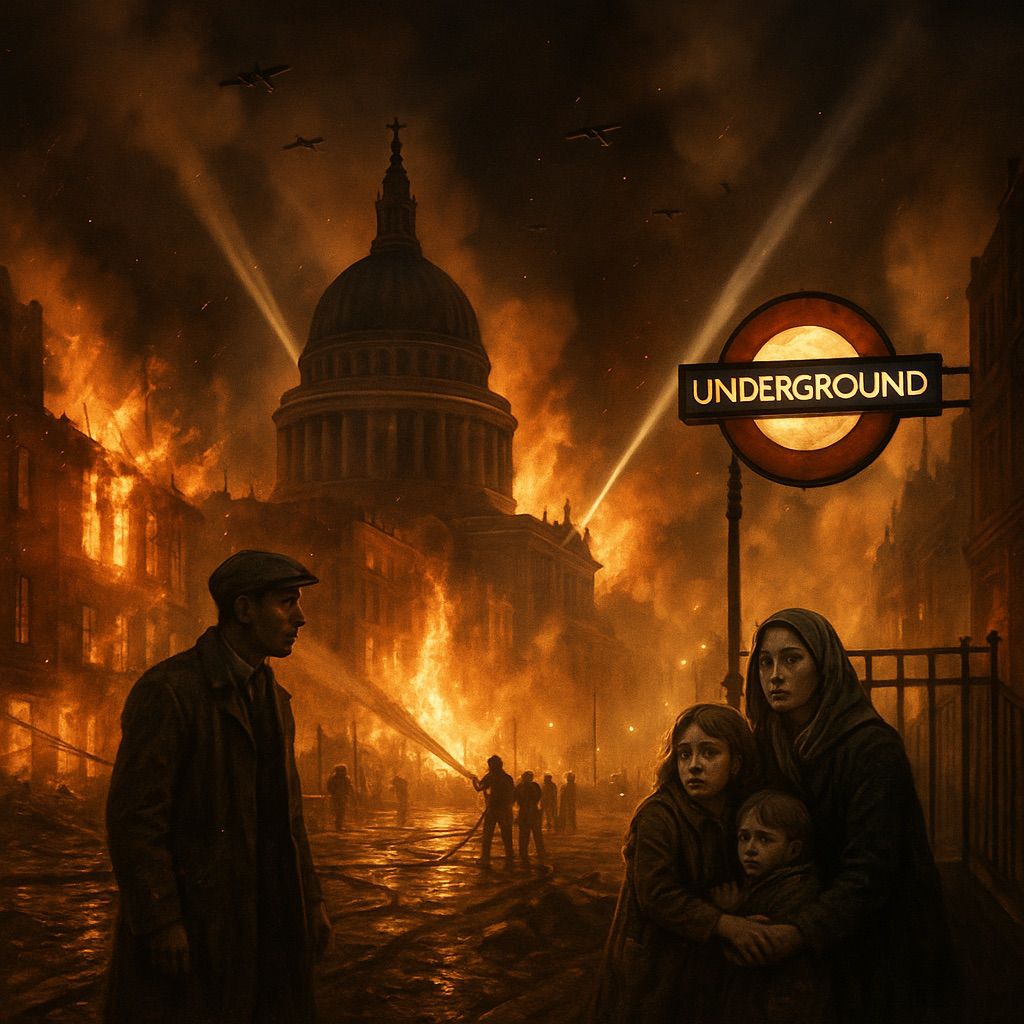
On the evening of September 7, 1940, the people of London looked to the sky and saw their city’s fate written in the darkening clouds. At first it was only a hum, a vibration just on the edge of hearing, but soon the sound swelled into a roar as hundreds of German aircraft advanced across the Channel. What began that night was more than an air raid; it was the opening act of a relentless campaign of terror that would stretch across months, reduce entire neighborhoods to rubble, and forever sear itself into the collective memory of a nation. It was the Blitz, and it would test London not only with bombs and fire but with the question of whether its people could endure the unbearable. They did, and in doing so, they created a story of defiance that still resonates eight decades later.
The Blitz was not born suddenly; it was the result of a shift in Hitler’s strategy. During the summer of 1940, the Luftwaffe had sought to crush the Royal Air Force, targeting airfields, radar stations, and aircraft production. Operation Sea Lion, the planned invasion of Britain, depended on clearing the skies. Yet the RAF refused to yield, aided by radar, home advantage, and the courage of young pilots who fought at staggering odds. In frustration, and in response to a British bombing raid on Berlin that wounded his pride, Hitler turned his fury on London itself. The theory was simple: bomb the capital, terrify the population, cripple industry, and force Britain to the negotiating table. What he underestimated was the resilience of ordinary people, who would rather endure hell than submit to tyranny.
On that first night, the Luftwaffe sent nearly 350 bombers escorted by 600 fighters against East London. The docks along the Thames, warehouses stacked with food, timber, and oil, became a cauldron of flame. Witnesses described a wall of fire so high it looked like the horizon itself was burning. Explosions tore through streets, flames leapt from building to building, and smoke choked the air. Entire families clutched one another in shelters, listening to the whistle of falling bombs, praying not to be among the unlucky. When the dawn finally came, the docks were devastated, hundreds lay dead, thousands were injured, and Londoners knew their lives had changed forever. What none of them realized was that this was just the beginning: the city would be bombed every night for 57 consecutive nights.
From that moment forward, the Underground became a refuge. At first the government resisted the idea, worried about panic, disease, and disruption, but as the raids grew in intensity, Londoners forced their way in. The Tube stations transformed into subterranean villages, filled with families who brought blankets, food, and children’s toys. It was not comfortable. The air was heavy, the noise of trains continued overhead, and the toilets were few. Yet people made lives down there. Children played hopscotch between the rails, musicians entertained the crowds, and impromptu dances and church services were held in the gloom. The Underground became more than a shelter; it became a symbol of how ordinary people adapted to extraordinary circumstances, turning hardship into community.
Above ground, firefighters became some of the great unsung heroes of the Blitz. Night after night they climbed ladders into infernos, battling flames that spread from incendiary bombs designed not merely to destroy but to ignite. With buckets of water and hoses that sometimes ran dry, they fought to contain the blazes even as bombs continued to fall around them. Many never returned home. Civilians too became fire watchers, standing on rooftops with sand and stirrup pumps, ready to douse small fires before they could consume entire blocks. The city’s survival was a collective effort, one fought not just by soldiers and airmen but by ordinary men and women who refused to let their homes burn without a fight.
Children grew up with war as their backdrop. Many had already been evacuated to the countryside, sent away on trains clutching name tags and small suitcases. But thousands remained. For them, the siren’s wail became as familiar as a school bell. They slept in bunk beds underground, carried gas masks everywhere they went, and tried to learn arithmetic while wondering if their homes would still be standing when they returned. Some grew numb to it all, playing in the rubble of their own neighborhoods. Others carried the scars for life. Yet even in their innocence, they embodied the resilience that came to define the Blitz: small figures clutching teddy bears in the flicker of candlelight, surviving a nightmare with remarkable courage.
Winston Churchill became the voice of defiance. Touring bombed-out neighborhoods, he clasped hands, offered words of encouragement, and most importantly, gave speeches that turned suffering into a kind of moral victory. “We can take it,” he told them. His voice carried across radios into homes and shelters, reminding people that their endurance was not meaningless but part of a larger battle for freedom. Churchill understood that morale was the real target of the Luftwaffe. Hitler wanted to break the British spirit. Churchill made certain that every shattered window and every crater in the street became not a symbol of weakness but of determination.
As the months wore on, London was hit again and again. On December 29, 1940, one of the worst nights came. Tens of thousands of incendiary bombs rained down, setting the City of London ablaze in what became known as the Second Great Fire of London. Ancient guildhalls, libraries, and historic churches vanished in the flames. Yet when the smoke cleared, St. Paul’s Cathedral still stood, blackened but unbroken. The image of its dome rising above the inferno became one of the most iconic photographs of the war. For Londoners, it was proof that their city, like their spirit, could not be destroyed.
The psychological toll of the Blitz was immense. Families lived with constant uncertainty. Any night could be their last. Children woke screaming from nightmares indistinguishable from reality. Parents tried to keep a sense of normalcy—sending kids to school, shopping in markets, holding church services—even as shops collapsed and churches crumbled. Yet from this chaos emerged what became known as the Blitz Spirit: a mixture of stoicism, humor, and collective solidarity. People cracked jokes in shelters, painted defiant slogans on walls, and carried on with daily life as best they could. Milkmen delivered bottles among the rubble. Bus drivers rerouted around bomb craters and kept their routes. Couples still married, children still played, and London kept living, even as bombs fell.
By the time the Blitz eased in May 1941, more than 43,000 civilians across Britain had been killed, with London suffering the heaviest toll. Hundreds of thousands of homes were destroyed, entire neighborhoods erased, and lives forever changed. Yet the campaign failed in its ultimate aim. The British government did not sue for peace. Morale, though battered, remained intact. The RAF was never destroyed. Operation Sea Lion was abandoned. Hitler’s gamble had failed.
What emerged instead was a story of resilience that shaped Britain’s identity for generations. The Blitz became more than history; it became legend. It was recounted in diaries, memorialized in photographs, and passed down in family stories. Survivors spoke of the terror, yes, but also of the camaraderie, the small acts of kindness, the laughter in the darkness. The Blitz Spirit was not a myth; it was lived reality, created by ordinary people who refused to let fear define them.
The legacy of the Blitz is complicated. It was a period of immense suffering, of children buried under rubble, of families torn apart, of centuries-old architecture reduced to dust. But it was also a period that revealed the depths of human resilience. It showed that bombs could destroy buildings but not hope, that terror could create fear but also forge unity, and that even in the darkest nights, light could endure. For Londoners of 1940, survival was itself an act of defiance. For the world watching, it was proof that Britain would not fall.
September 7, 1940, will always be remembered as the night the Blitz began. It was the night London entered fire and emerged, scarred but unbroken. It was the night Hitler discovered that cities can burn, but courage cannot.