The 2000 United States presidential election remains one of the most polarizing political events in modern American history, a moment when the nation found itself suspended in uncertainty, divided not only by ideology but by the mechanics of democracy itself. For many Americans, the night of November 7 began like any other presidential election night: a flurry of electoral maps, pundit predictions, and partisan hopefulness. Yet as the hours wore on, what initially seemed like a tight but ordinary race between Vice President Al Gore and Texas Governor George W. Bush began twisting into something far more complex, a legal and political storm centered around one unexpected battlefield—the State of Florida.
Florida’s election results were razor-thin, decided by mere hundreds of votes out of more than six million cast. At the stroke of midnight, news networks retracted earlier projections, tempers flared, and election officials braced themselves for a process they had never imagined would be thrust upon them. Hanging chads, butterfly ballots, and punch-card irregularities suddenly became part of the national vocabulary. Every vote mattered—but only if it could be properly counted.
As recounts began, confusion reigned in county offices where exhausted workers scrutinized ballots by hand, holding flimsy punch cards up to the light like archaeologists examining ancient inscriptions. What had started as a simple procedural recount soon devolved into a legal war of attrition, as each campaign tried to seize control of the narrative. The Gore campaign insisted that every voter deserved to have their intention accurately recorded, while the Bush team argued that the continuing recounts threatened chaos and undermined the fairness of the electoral process.
On December 8, 2000, the Florida Supreme Court ordered a statewide manual recount of undervotes—ballots where no presidential choice had been detected by machines. To Gore supporters, this ruling offered the possibility of a narrow but legitimate path to victory. To Bush supporters, it represented what they viewed as judicial activism motivated by partisan loyalty. And to the nation, watching anxiously, it added yet another twist in a saga that seemed increasingly surreal.
Just days later, the U.S. Supreme Court agreed to hear Bush v. Gore—a sign that the conflict had escalated beyond Florida into a constitutional crisis of national consequence. In a country where courts traditionally avoided entangling themselves in political disputes, the fact that the Supreme Court had intervened stunned both legal scholars and ordinary citizens. The stakes were immense: the presidency itself hung in the balance.
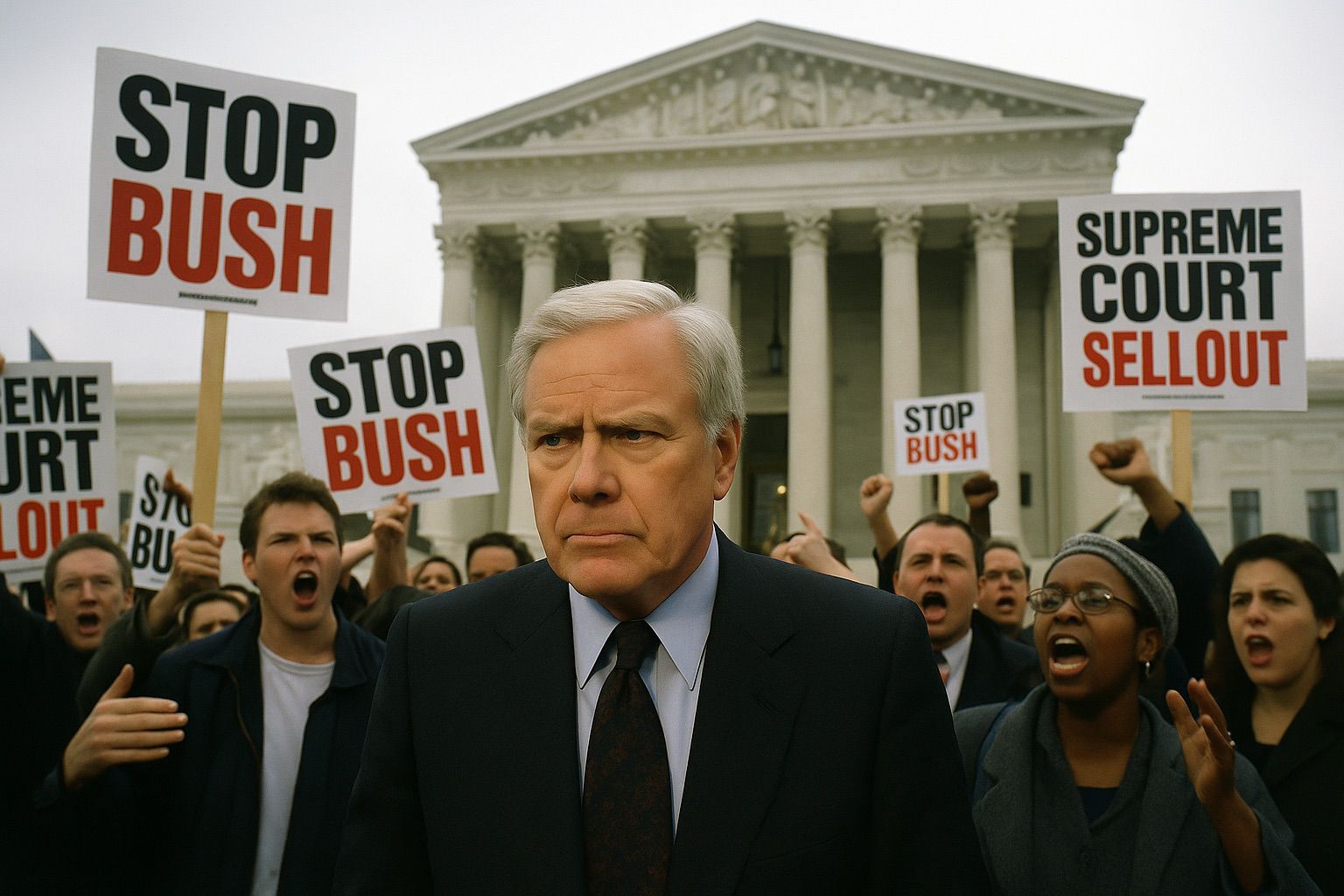
Oral arguments took place on December 11, setting the stage for what would become one of the most scrutinized judicial decisions in American history. Inside the marble chambers of the Court, attorneys battled over questions of equal protection, state authority, and whether time had simply run out for a fair recount. Outside, protesters from both parties gathered, waving signs and chanting, their faces lit by camera crews who broadcast every moment.
On December 12, at approximately 10 p.m., the Court issued its ruling. In a 5–4 decision split along ideological lines, the justices halted the Florida recount, determining that varying standards across counties violated the Equal Protection Clause. With no constitutional way to continue the recount before the deadline, George W. Bush effectively became the next President of the United States. Gore conceded the following day, his voice somber yet resolute, emphasizing unity even as millions of Americans felt lingering frustration and disbelief.
For many people, the decision left deep emotional scars. Some saw it as a necessary intervention to preserve electoral order; others believed it was a judicial coup that disrupted the democratic will of the people. Scholars dissected the decision for years, debating whether it had been motivated by legal principle or political preference. What became clear, however, was that public trust in institutions—especially the Supreme Court—had been shaken.
In the months that followed, recounts conducted by newspapers and academic institutions found that the results remained excruciatingly close, with hypothetical outcomes varying depending on the standards used. Yet regardless of these findings, the nation had already moved on, propelled forward by the inauguration of Bush and the beginning of a new political era.
In the shadow of Bush v. Gore, America began reconsidering its electoral processes. Calls for election reform grew louder. New voting technologies were implemented, though not without their own controversies. Voter access, ballot design, recount standards, and election integrity became central political themes for decades to come. Even today, echoes of the 2000 election reverberate through debates about democracy, voting rights, and the responsibilities of the judicial branch.
The 2000 election exposed both the fragility and resilience of American democracy. It showed how a nation of millions could be brought to a standstill by a few hundred votes, and how the machinery of government could withstand enormous pressure while still revealing its flaws. It demonstrated that democracy is not merely a system of rules and procedures, but a living institution that depends on the faith of its citizens.
For those who lived through it, Bush v. Gore remains unforgettable—an election night that lasted for 36 days, a courtroom drama broadcast nationwide, and a reminder that the most powerful democracy in the world is not immune to uncertainty. The legacy of 2000 endures, shaping how Americans view elections, courts, politics, and the delicate balance between law and legitimacy. It is a story not only about ballots and legal briefs, but about the enduring struggle to ensure that every voice matters, even when the path forward is shrouded in doubt.