
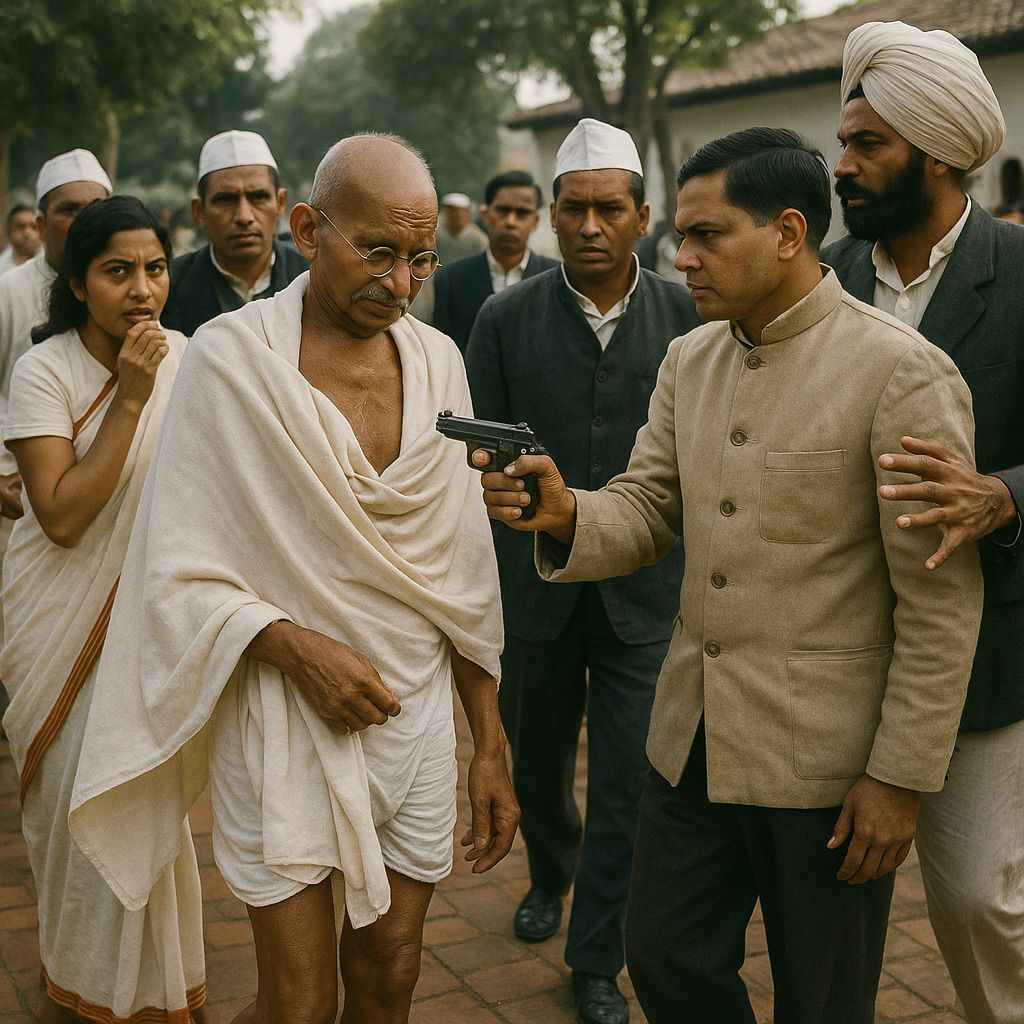
There are some days when the world seems to pause. Not for joy, not for celebration, but because the air has been pulled out of history. January 30, 1948, was such a day. On that day, India—the heart of a newborn nation—felt the thunderous silence of grief, and the world lost not just a man, but a moral compass. Mohandas Karamchand Gandhi, known to millions as Mahatma—“Great Soul”—was gunned down in the gardens of Birla House in Delhi. His assassination shook a nation that was just beginning to heal from the wounds of Partition and called into question the very nature of nonviolence in a world increasingly consumed by political rage. Though the bullets that killed him were fired by an assassin’s hand, they were forged in the fires of hatred, division, and radicalism. Yet Gandhi’s story does not end in that tragic moment; it lives on, not in statues or currency notes alone, but in the conscience of humanity.
Born in 1869 in Porbandar, Gujarat, Gandhi’s journey began far from the epicenter of revolutionary politics. He was a shy child, devout and disciplined, and by no means destined for the towering role he would play on the world stage. He studied law in London, a foreign world where he trained his mind and soul as rigorously as he trained in jurisprudence. But it was in South Africa, not India, where Gandhi began to sharpen the tools of passive resistance. It was there, in response to racial discrimination, that he crafted the philosophy of satyagraha—truth-force—which would eventually become his answer to tyranny and injustice. When he returned to India in 1915, the nation was a colony straining under British rule. What followed over the next three decades was a struggle unlike any the world had seen—a revolution powered not by rifles or bombs, but by hunger strikes, salt marches, and an unshakeable belief in human dignity.
Gandhi’s India was no utopia. It was a country fractured by caste, religion, and colonial manipulation. And yet, Gandhi dared to dream of unity. He fasted to erase the lines drawn by caste, embraced untouchables whom society discarded, and reached out across religious divides even as tensions boiled. His relationship with Indian Muslims was complex and layered, but always built on the foundation of shared humanity. He was no stranger to controversy; many Hindus thought he favored Muslims too much, especially during Partition when he demanded that India pay Pakistan the money it was owed. He was threatened, reviled, and even ostracized by segments of the very community he loved so deeply.
When independence finally came in August 1947, it was bittersweet. India was free, yes, but it was also torn in two. Pakistan had been carved out as a separate homeland for Muslims, and the resulting mass migrations became some of the most horrific in modern history. Hindus, Sikhs, and Muslims slaughtered each other in the streets. Millions were displaced. Gandhi, rather than join in the political fanfare, walked barefoot into the ashes of communal violence. In Calcutta, he fasted until Hindus and Muslims agreed to lay down their weapons. He had no government post, no security detail, no political power—and yet he held the nation in his palm.
But peace was a fragile dream. And Gandhi was not universally loved. Among his harshest critics were Hindu nationalists who believed he had capitulated to Muslim interests. They viewed Partition as a betrayal and Gandhi as a traitor. One of them, Nathuram Godse, would ultimately decide that Gandhi’s dream of harmony was an obstacle to a Hindu nationalist vision of India. Godse saw Gandhi’s nonviolence not as moral strength, but as political weakness. He believed Gandhi had emasculated the Hindu spirit and weakened India’s resolve. And so, he plotted his murder with cold precision.
The final hours of Gandhi’s life were marked, as always, by quiet humility. He was staying at Birla House in New Delhi, a place he had made into a spiritual refuge. Every evening, he led prayer meetings in the garden. On January 30th, at 5:17 p.m., he walked out to greet a gathering of followers. Frail from fasting, he leaned on two grandnieces for support. Nathuram Godse emerged from the crowd, pushed through the people surrounding Gandhi, and fired three bullets from a Beretta pistol into his chest at point-blank range. Gandhi’s final words, as witnesses recall, were “Hey Ram”—a cry to God that echoed through the garden like a hymn of resignation. He fell instantly, draped in white, his blood soaking the earth beneath him.
The scene was one of disbelief. In the moments after the shots rang out, silence fell—not just over the garden, but across the conscience of a country. People didn’t just mourn Gandhi’s death; they mourned what it signified. The man who had taught them to fight without hatred, to resist without harming, had been felled by an ideology that knew no such restraint. India wept. Jawaharlal Nehru, the first Prime Minister of independent India and one of Gandhi’s closest confidants, announced the death to a stunned nation with trembling lips: “The light has gone out of our lives, and there is darkness everywhere.”
Godse was captured immediately and later tried and executed. During his trial, he offered a chilling rationale for his act—claiming that Gandhi’s politics were suicidal for Hindus and that his refusal to resist Islamic aggression would doom the nation. What made the assassination even more tragic was that Gandhi had predicted it. He knew he was hated. He had survived previous attempts on his life. But he refused protection, insisting that he would not live in fear. “If I am to die by the bullet of a madman, I must do so smiling,” he had once said. And that, heartbreakingly, is exactly how he died.
In the days that followed, riots were quelled not by force, but by Gandhi’s legacy. His death brought a stunned hush to communal tensions. In many ways, his martyrdom sealed his place in history not just as a leader, but as a saint. The world responded with an outpouring of grief. In America, President Truman expressed sorrow. In the UK, Winston Churchill—Gandhi’s former nemesis—offered uncharacteristically kind words. Albert Einstein said, “Generations to come will scarce believe that such a one as this ever in flesh and blood walked upon this earth.”
But Gandhi was not a god. He was flawed, and he knew it. He battled personal demons, wrestled with doubts, and frequently admitted his own inconsistencies. He was a man who experimented with truth in every sense of the word—from his diet to his celibacy to his political ideals. What made him powerful wasn’t his perfection, but his transparency. He led by example, not decree. He challenged colonialism with a spinning wheel. He fought bigotry with prayer. He faced death with serenity. He was, at his core, a man who believed in the goodness of people—even when they failed him.
The legacy of Gandhi’s assassination goes beyond the tragedy of a life lost. It asks enduring questions: Can nonviolence survive in a violent world? Can tolerance defeat extremism? Can spiritual strength stand against political might? Gandhi believed the answer to all these was yes. And though the world has often failed to live up to his ideals, the echo of his life still lingers in every peaceful protest, in every hunger strike for justice, in every act of civil disobedience against tyranny.
His death marked the end of an era, but also the beginning of a new chapter in global consciousness. Martin Luther King Jr. would later walk in Gandhi’s footsteps during the Civil Rights Movement. Nelson Mandela found courage in Gandhi’s philosophy during his long imprisonment. Across continents, Gandhi’s legacy became the blueprint for moral resistance. The bullet that killed him could never kill his idea.
India today is a far more complex and conflicted place than the one Gandhi left behind. It’s an economic powerhouse, a nuclear state, and a chaotic democracy pulsing with energy and contradiction. Yet, amidst all its change, the memory of Gandhi persists—not just in the institutions named after him, but in the quiet decisions people make each day to choose peace over violence, tolerance over bigotry, love over hate.
On every anniversary of his death, the nation observes Martyrs’ Day. At Raj Ghat, the site of his cremation, leaders gather to lay wreaths and offer prayers. But the real tribute to Gandhi lies not in ceremonies but in action. In refusing to hate, in choosing dialogue over bullets, in believing that the arc of the moral universe, as Dr. King said, bends toward justice.
January 30 was the day Gandhi died. But it is also the day that Gandhi became eternal. And every time the world turns toward hatred, every time oppression rears its head, we remember a frail old man in homespun cloth, walking unarmed into the heart of conflict, armed only with faith and truth.