
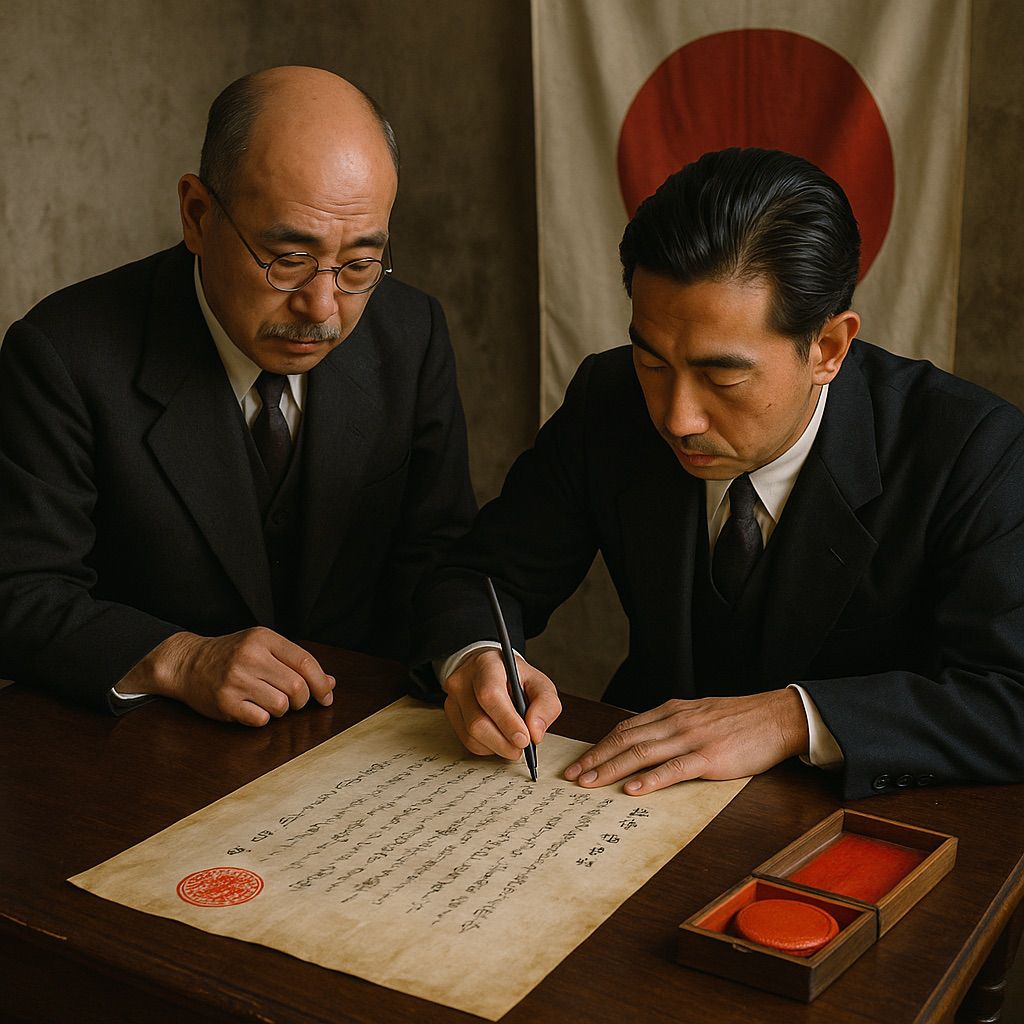
The world in August 1945 was exhausted, battered, and holding its breath. For six years, the most destructive war humanity had ever seen had consumed cities, toppled empires, and stolen tens of millions of lives. Europe lay in ruins, its cities scarred with craters and charred buildings, its people worn thin from years of rationing and fear. In the Pacific, the war had been raging relentlessly since the attack on Pearl Harbor in December 1941. By the summer of 1945, the United States and its allies had fought their way across the Pacific island by island, enduring brutal battles in places like Iwo Jima and Okinawa. But as August dawned, something was about to change forever.
On August 10, 1945, the Japanese government made a historic move: it offered to surrender, but with one important condition—that the sovereignty of Emperor Hirohito be preserved. This proposal would become one of the most pivotal moments in modern history, a single day that crystallized the tension between military necessity, diplomatic maneuvering, and the dawning realization that the world had entered the nuclear age.
The Japanese offer did not come in a vacuum. Just two days earlier, on August 8, the Soviet Union had declared war on Japan and launched a massive invasion of Japanese-held Manchuria, sending shockwaves through Tokyo’s military leadership. And only the day before that, on August 6, an American B-29 bomber named the Enola Gay had dropped the world’s first atomic bomb on Hiroshima, obliterating the city and killing tens of thousands instantly. On August 9, Nagasaki suffered a similar fate. These unprecedented attacks, combined with the Soviet entry into the war, brought Japan’s leaders face-to-face with the reality that their nation could no longer continue the fight.
Yet surrender was not a simple matter for Japan. The country’s political and military leadership was sharply divided between moderates who recognized the inevitability of defeat and hardliners who clung to the hope of securing better terms—or even inflicting enough damage to force the Allies into a negotiated peace. Central to this division was the fate of Emperor Hirohito. To many Japanese, the Emperor was not just a political leader but a divine figure, the living embodiment of the nation’s spirit. Losing him—or seeing him tried and punished like other wartime leaders—was unthinkable.
When Japan’s surrender offer reached the Allies through diplomatic channels in Switzerland and Sweden, it was framed as acceptance of the Potsdam Declaration of July 26, 1945, with the single caveat that the “prerogatives” of the Emperor would be maintained. The Potsdam Declaration had demanded Japan’s unconditional surrender, warning of “prompt and utter destruction” if it refused. But it had not explicitly stated what would happen to the Emperor. This ambiguity now became the central question: could the Allies accept Japan’s condition without betraying the principle of unconditional surrender that had guided their war policy?
In Washington, the reaction was cautious but pragmatic. President Harry S. Truman and his advisers recognized that the Emperor’s role could be a critical lever in bringing the war to an immediate end. The American public, though weary of war, was still reeling from the attack on Pearl Harbor and years of brutal combat in the Pacific. Many in the U.S. military were already preparing for Operation Downfall, the planned invasion of Japan’s home islands—a campaign projected to cost hundreds of thousands of American lives and potentially millions of Japanese casualties. If sparing the Emperor could prevent such a catastrophe, it was a price some were willing to pay.
The Allies ultimately responded with a carefully worded statement. They reiterated the terms of the Potsdam Declaration but clarified that the Emperor would be subject to the authority of the Supreme Commander for the Allied Powers. In other words, Hirohito could remain as a figurehead, but his powers would be stripped, and Japan would have to undergo a complete transformation into a peaceful, democratic state. This compromise struck a delicate balance between principle and pragmatism, offering Japan a way to save face while ensuring the war would truly be over.
For the Japanese leadership, this response was enough. On August 14, Emperor Hirohito recorded a speech—the Gyokuon-hōsō—to be broadcast to the nation the next day. In it, he spoke in formal, archaic language, never explicitly using the word “surrender” but making clear that Japan would accept the Allied terms. When the recording was played on August 15, millions of Japanese heard their Emperor’s voice for the first time, delivering the sobering news that the war was ending. For many, it was a moment of grief, relief, and uncertainty all at once.
The events of August 10, 1945, reveal the human complexities that lie behind history’s turning points. This was not simply a matter of political declarations and military strategy—it was about identity, tradition, and the difficult process of letting go. The condition about the Emperor’s sovereignty was more than a bargaining chip; it was a reflection of a society grappling with the collapse of a worldview that had shaped it for centuries.
It’s tempting, in hindsight, to see Japan’s conditional surrender as an inevitable step, especially after the devastation of Hiroshima and Nagasaki. But in that moment, nothing was guaranteed. The war could have dragged on for months. The Soviet invasion of northern Japan might have turned the country into a divided, occupied state like Germany or Korea. A bloody invasion could have unfolded, leaving an even deeper scar on both nations. Instead, the conditional surrender opened a narrow but decisive path toward peace, one that would reshape Japan and the postwar world.
The legacy of that day still echoes. Japan’s postwar constitution, drafted under Allied supervision, renounced war entirely and transformed the Emperor into a symbolic figure. Hirohito himself would reign until 1989, his image shifting from that of a wartime leader to a reserved, almost ceremonial presence. The U.S.-Japan alliance that emerged from the occupation became one of the strongest partnerships of the 20th and 21st centuries.
Yet the moral and historical debates surrounding the end of the Pacific War remain. Was it right to drop the atomic bombs? Could the war have ended without them, perhaps through the Emperor’s mediation? Should the Allies have insisted on a trial for Hirohito, as they did for other Axis leaders? These questions still spark fierce discussion among historians, ethicists, and political thinkers.
In the end, August 10, 1945, was the day when the war’s end began to take its final shape. It was a day when diplomacy, culture, and the raw human desire to preserve life intersected in a fragile, historic agreement. And for millions of people around the world, it was the first real glimpse of a future without war—a future that had seemed almost unimaginable just days before.