
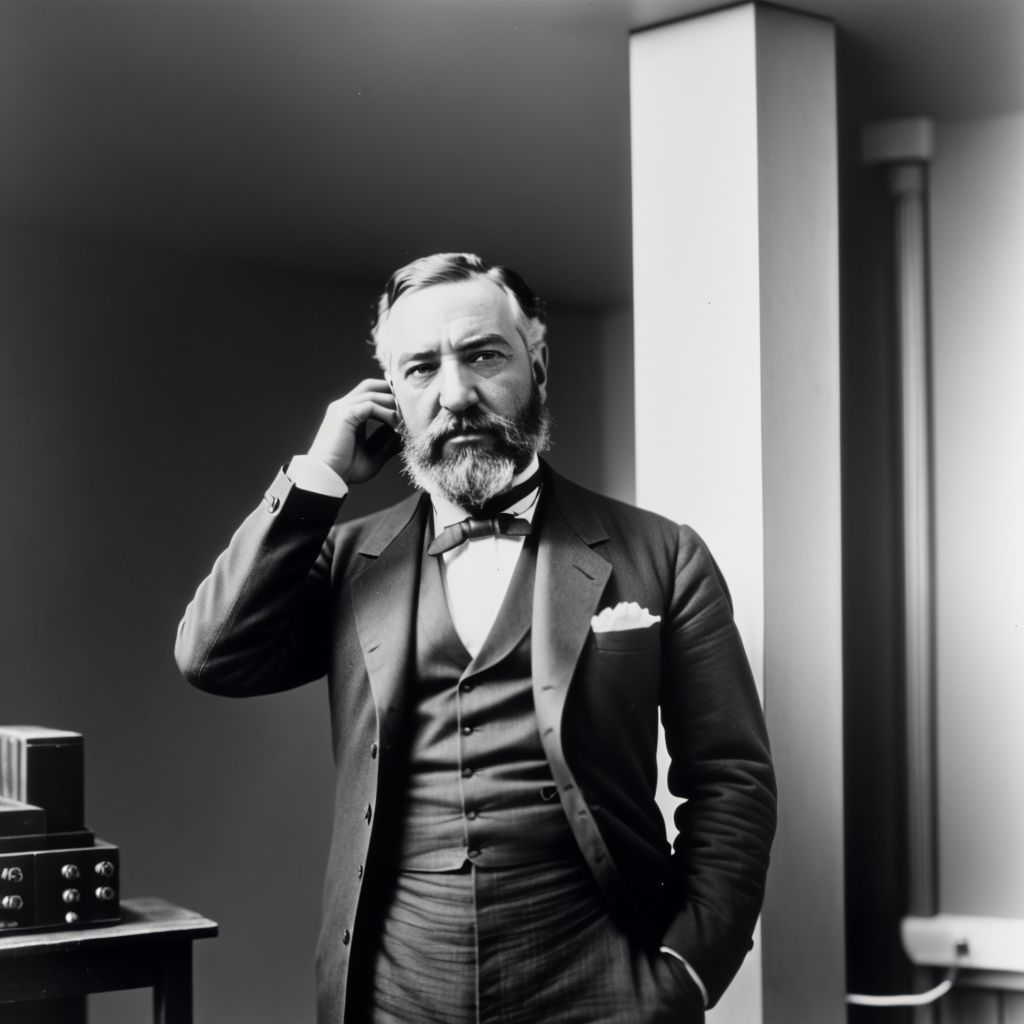
When Alexander Graham Bell received U.S. Patent No. 174,465 on July 31, 1876, he couldn’t have fully anticipated the extent to which his invention would change the world. What began as a rudimentary device capable of transmitting the human voice over a wire would evolve into one of the most transformative technologies in human history. That single patent didn’t just recognize a device; it codified the dawn of a new era in communication, one that would shrink distances, collapse time zones, redefine how humans interacted, and eventually embed itself into the fabric of daily life so thoroughly that it would become nearly invisible. But Bell’s story—and that of the telephone—was far from a straight line. It was filled with serendipity, rivalry, innovation, and above all, a profound belief in the human voice’s power to bridge space.
Alexander Graham Bell was born into a family already immersed in the study of sound. His father, Alexander Melville Bell, developed a system called “Visible Speech,” which was designed to help the deaf communicate through written symbols that represented vocal sounds. His mother, though hard of hearing, encouraged his pursuits in acoustics. And Bell, inheriting both curiosity and purpose, committed his life to the intersection of communication and science. It’s important to note that Bell’s interest in the telephone was not born from an obsession with gadgets or profit—it stemmed from his passion for helping the hearing impaired and connecting people through voice.
The story of the telephone is often narrated with Bell as the sole hero, but history is never so simple. In the 1870s, inventors around the world were racing to solve the problem of transmitting voice electronically. Elisha Gray, an American electrical engineer, submitted a caveat—a sort of placeholder for a patent—for a similar voice-transmitting device on the same day as Bell filed his patent application. This set the stage for one of the most heated patent battles in history. Though Bell was ultimately awarded the patent and recognized as the telephone’s inventor, controversy would swirl around the legitimacy of that victory for decades.
But it was Bell’s design that proved both novel and practical. It worked. The prototype used a diaphragm, a magnet, and a coil of wire to convert sound waves into electrical signals and then back into sound. Bell demonstrated his invention to the world at the 1876 Centennial Exposition in Philadelphia, famously calling to his assistant, “Mr. Watson, come here, I want to see you.” Those words, carried across a wire, electrified the minds of onlookers. For the first time in human history, a person could speak in one place and be heard clearly in another. It was not magic. It was science, and it was astonishing.
Bell was just 29 years old when the patent was granted. At that time, he had little money and no real infrastructure to commercialize his invention. But he quickly recognized its potential. Partnering with investors like Gardiner Greene Hubbard (who would later become his father-in-law) and Thomas Sanders, Bell helped form the Bell Telephone Company. The initial vision was modest—connect offices, government buildings, and perhaps some wealthy homes. What followed was an explosion in demand. Business owners understood immediately how revolutionary the device could be. Instead of sending a messenger across town, they could simply speak a sentence and be heard instantly. Efficiency skyrocketed.
Yet, acceptance wasn’t immediate across the board. Many skeptics dismissed the telephone as a toy or a novelty. The telegraph was still king, and it had the advantage of being well-established and understood. Western Union, the dominant player in the telegraph industry, even refused to buy Bell’s patents for what now seems a comically small amount of money. But the telephone had something that the telegraph didn’t—emotion. Human voice carried tone, urgency, warmth, and nuance in a way Morse code never could. Bell had unlocked a door to something profoundly human.
As the infrastructure for telephony expanded, so too did the technology. Switchboards were developed, allowing operators to manually connect calls. Then came the creation of telephone exchanges, rotary dialing, touch-tone phones, and eventually the transition from analog to digital systems. Each step along the way built on Bell’s original idea, refining it, expanding its reach, and making it ever more indispensable.
The cultural shift the telephone introduced was just as significant as the technological one. The notion that people could maintain relationships over distance—hear the voice of a loved one hundreds of miles away—altered family dynamics and business operations alike. Politicians could coordinate strategies faster, journalists could chase leads in real-time, and ordinary citizens could connect in ways never before imagined. It democratized information and emotion alike. And as the 20th century progressed, the telephone would become both a status symbol and a necessity. It found its way into nearly every household, reshaping architecture, etiquette, and even language itself.
And yet, Alexander Graham Bell never considered himself just an inventor of machines. Throughout his life, he continued to work with the deaf and champion causes related to education, aviation, and sound transmission. He founded Science magazine, worked on early aeronautics, and remained an intellectual force long after his telephone patent changed the world. In many ways, he saw the telephone not as an endpoint, but as a beginning—a foundation on which future generations would build new ways to connect.
Fast forward to the present, and the echoes of Bell’s first call can still be felt in every pocket and purse. The smartphone, packed with far more computing power than the Apollo missions, is a direct descendant of Bell’s 1876 prototype. Apps like FaceTime, Zoom, and WhatsApp are all modern manifestations of that original dream: connecting voices across space. The conversations we now have with AI voice assistants, the calls we make from the farthest corners of the Earth—all of them trace their roots back to that simple yet profound act of filing a patent and speaking across a wire.
But it’s not just the physical evolution of the telephone that’s worth reflecting on. It’s the human one. Bell’s invention didn’t merely change how we talked; it reshaped how we felt. It brought comfort during times of crisis, laughter in moments of joy, and urgency in emergencies. It provided a lifeline during world wars, a connection point in long-distance relationships, and a way for families separated by migration, war, or work to remain whole in spirit. That emotional bandwidth—the invisible thread connecting voices—is perhaps the most revolutionary aspect of all.
And like all powerful technologies, the telephone has also mirrored the times. During the civil rights movement, activists used telephones to organize. During the Cold War, hotline phones were established between world leaders to avert disaster. During the COVID-19 pandemic, voice and video calls replaced face-to-face interactions for months on end, reminding us that connection—while physical—is often sustained emotionally through voice.
The story of July 31, 1876, then, is more than a historical footnote. It’s the ignition point of a communications revolution that still reverberates. It’s a reminder that innovation often begins not with a profit motive, but with a human need—a desire to connect, to understand, to bridge distance with empathy. It’s a story of ambition, rivalry, triumph, and transformation. And it’s still unfolding.
As we stand today, surrounded by smart devices, satellites, fiber-optic cables, and wireless towers, it’s easy to overlook the fact that all this began with a young inventor’s deep desire to make voice travel. Bell may not have imagined the exact shape the future would take, but he knew it would speak—and that someone, somewhere, would be listening.