
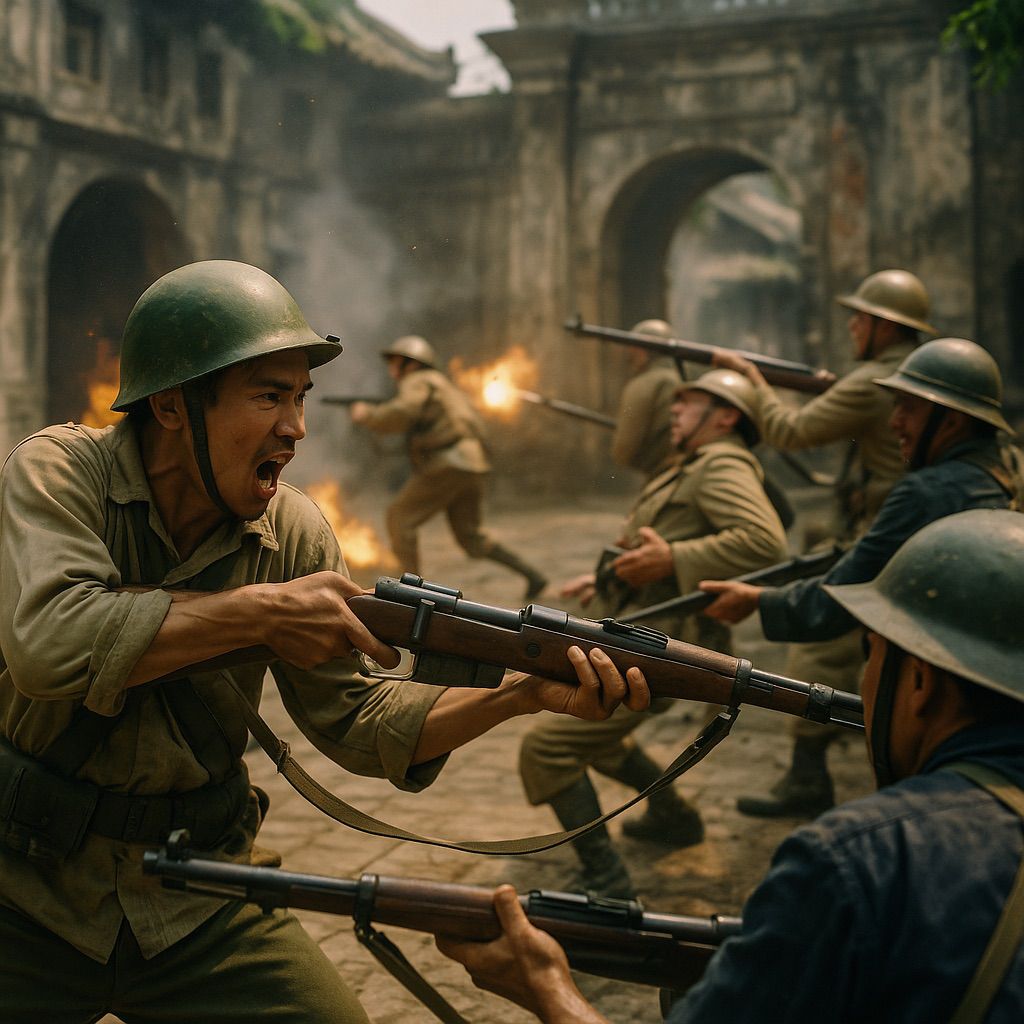
The First Indochina War began not with a single dramatic declaration, but with a collision of history, ambition, and betrayal. On December 19, 1946, gunfire echoed through Hanoi as Vietnamese nationalists attacked French colonial positions, igniting a conflict that would fundamentally reshape Southeast Asia and alter the course of global geopolitics. What followed was not simply a war between armies, but a prolonged struggle between an old imperial order desperate to reclaim its authority and a determined nationalist movement willing to endure extraordinary sacrifice to secure independence.
Vietnam had endured decades of French colonial rule before the Second World War disrupted the balance of power in Indochina. When Japan occupied the region during the war, French authority collapsed almost overnight. Vietnamese nationalists, long suppressed, seized the moment. Among them was Ho Chi Minh, a revolutionary who blended nationalism with communist ideology and possessed an uncanny ability to frame Vietnam’s struggle as both a patriotic uprising and part of a global movement against imperialism. When Japan surrendered in 1945, Ho Chi Minh proclaimed Vietnamese independence in Hanoi, invoking the language of freedom and self-determination in front of massive crowds at Ba Dinh Square.
That declaration, however, was never accepted by France. Emerging battered and humiliated from World War II, the French government viewed Indochina as essential to restoring national prestige and economic stability. Rubber plantations, rice exports, and mineral wealth were not merely resources; they were symbols of France’s continued relevance as a global power. Granting independence to Vietnam threatened to unravel the remaining fabric of the French colonial empire.
The postwar Allied occupation of Indochina only deepened tensions. Instead of allowing Vietnamese self-rule, the region was divided into zones controlled by foreign powers. British and Chinese forces temporarily occupied parts of Vietnam, while French troops steadily returned under the protection of Allied agreements. What followed was an uneasy standoff, punctuated by negotiations that collapsed almost as soon as they began. Mutual distrust grew, and both sides quietly prepared for war.
That war exploded in December 1946 when French positions in Hanoi came under coordinated attack. The Viet Minh, Ho Chi Minh’s nationalist coalition, understood that they could not defeat France through conventional means. Instead, they relied on guerrilla warfare, patience, and intimate knowledge of the land. Fighters melted into villages, jungles, and mountains, striking suddenly and disappearing just as quickly. For French troops trained in traditional European warfare, the enemy seemed invisible.
The French response was brutal and increasingly desperate. Determined to reassert control, they launched sweeping military campaigns aimed at pacifying rural areas. Villages suspected of aiding the Viet Minh were destroyed or forcibly relocated. Civilians were caught in the crossfire, punished collectively for the actions of guerrillas who often lived among them. These tactics, intended to isolate the insurgents, instead hardened local support for the resistance.
As years passed, the war became one of attrition. The Viet Minh suffered enormous losses, yet they continued to replenish their ranks through popular support and ideological commitment. The Chinese Communist victory in 1949 proved decisive, opening supply lines and providing training, weapons, and strategic depth. Suddenly, the Viet Minh were no longer an isolated insurgency but part of a broader revolutionary movement stretching across Asia.
By 1950, French control of the countryside had largely collapsed. Major cities remained in colonial hands, but rural Vietnam increasingly belonged to the Viet Minh. French commanders rotated in and out, each promising a new strategy that might finally break the resistance. One of the most prominent was General Jean-Marie de Lattre de Tassigny, who arrived with a reputation for brilliance and determination. His reforms temporarily stabilized the situation, introducing mobile warfare and improved coordination. For a brief moment, it appeared France might salvage victory.
But the war had already turned against them. The United States, fearing the spread of communism, began pouring money, equipment, and aircraft into the French war effort. By the early 1950s, America was financing the majority of the conflict. Yet this support only prolonged the inevitable. Superior firepower proved useless against an enemy willing to absorb losses and fight indefinitely.
The decisive moment came in 1954 at Dien Bien Phu. The French, confident in their airpower and fortified positions, established a base in a remote valley in northwest Vietnam. They believed the Viet Minh could not transport heavy artillery through mountainous jungle terrain. They were wrong. Through sheer human labor and ingenuity, the Viet Minh hauled artillery piece by piece into the hills overlooking the valley. When the siege began, French forces found themselves trapped and outgunned.
After weeks of relentless bombardment and ground assaults, the French position collapsed on May 7, 1954. Dien Bien Phu was more than a military defeat; it was a psychological catastrophe. The myth of European invincibility in colonial wars was shattered. Across Asia and Africa, nationalist movements took note.
The Geneva Accords later that year formally ended the war. Vietnam was temporarily divided, with the Viet Minh controlling the north and a Western-backed government ruling the south. Independence was granted to Laos and Cambodia. France withdrew, its colonial ambitions in Indochina extinguished.
Yet the war’s legacy was far from over. The division of Vietnam laid the groundwork for an even larger conflict that would soon draw in the United States. Millions of Vietnamese civilians bore the scars of displacement, violence, and loss. Entire regions were devastated, and political divisions hardened into ideological fault lines that would define Southeast Asia for decades.
The First Indochina War was not simply a prelude to the Vietnam War. It was a defining struggle in its own right, demonstrating how colonial powers could be defeated through endurance, popular support, and strategic patience. It revealed the limits of military force in suppressing nationalist movements and exposed the dangerous entanglement of Cold War ideology with local struggles for independence.
Today, the war stands as a reminder that history is rarely shaped by clean victories or moral clarity. It is forged in compromise, suffering, and relentless determination. The First Indochina War ended an empire, birthed a nation, and reshaped the global balance of power — consequences that continue to echo through the modern world.