
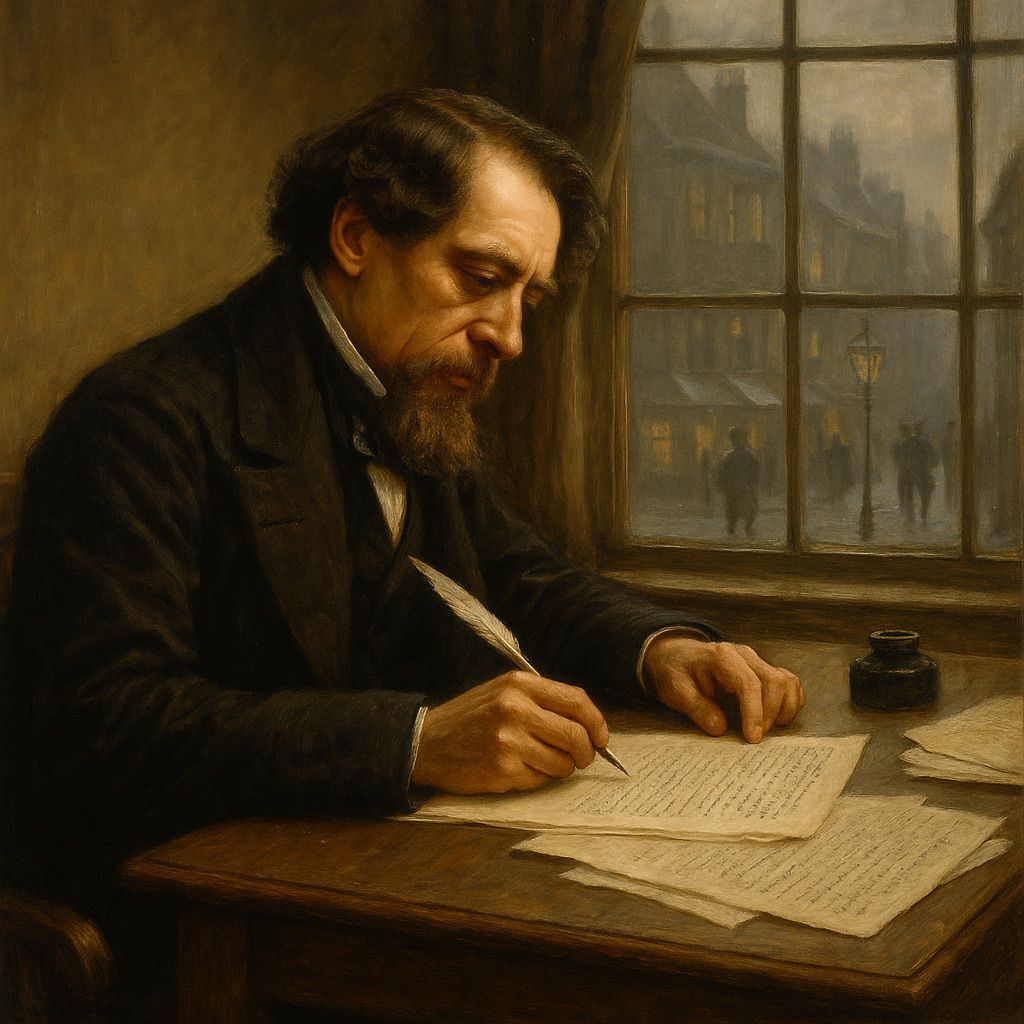
London, December 1843. The city was wrapped in fog and frost, the streets slick with mud and the smell of coal smoke thick in the air. Gas lamps flickered against the dark as hurried footsteps echoed off cobblestones. Winter had descended with its usual cruelty—especially on the poor. In narrow alleyways, ragged children huddled for warmth, their faces pale with hunger. And yet, in that same bleak city, a miracle of words was about to be born. On December 19, 1843, Charles Dickens published A Christmas Carol, a slender little book of less than 30,000 words that would forever change how the world celebrated Christmas—and how it understood compassion itself.
It’s hard now to imagine a world without Dickens’ ghosts, without the sneer of Scrooge or the innocent smile of Tiny Tim. But when A Christmas Carol first appeared, Christmas was a fading tradition in industrial England. The old customs—carols, feasts, merriment—had been overshadowed by factories, time clocks, and the cold precision of commerce. The poor toiled long hours for meager wages, while the wealthy insulated themselves behind iron gates and moral distance. Dickens saw it all. He walked those same grim streets, feeling both pity and rage. The Industrial Revolution had made England richer—but not kinder.
By 1843, Dickens was no stranger to success. He was already famous for The Pickwick Papers and Oliver Twist, but his finances were strained, and his social conscience was on fire. During a visit to Manchester earlier that year, he had seen the brutal reality of child labor—tiny bodies working in factories, little fingers raw and eyes weary before they had even learned to read. The image haunted him. At the same time, he was reading government reports on poverty and attending charity events where well-fed donors made polite speeches about “the deserving poor.” Dickens knew words could pierce the heart in ways policy never could. He resolved to write not a pamphlet, but a story—something that would seize the imagination of rich and poor alike.
The idea came swiftly. One night, while walking the dark streets of London, Dickens conceived the image of a lonely, miserly man confronted by ghosts of his own making. A man who hoarded money but starved his soul. A man named Ebenezer Scrooge. Within weeks, Dickens wrote feverishly, often pacing his study until dawn. He wept and laughed as he wrote, possessed by the spirit of his own creation. He later said that the story “came like a thunderclap.”
When the manuscript was finished, Dickens faced another problem: publishers. His last book had not sold well, and he feared A Christmas Carol would be dismissed as sentimental folly. So he decided to publish it himself. He poured his dwindling savings into the project, personally overseeing every detail—from the binding and cover design to the illustrations by John Leech. The book would be small enough to fit in the hand, bound in crimson cloth with gilt pages, priced at five shillings—affordable but elegant. Dickens wanted it to reach everyone, from the grand parlors of Mayfair to the humblest of London’s garrets.
The book appeared in shops on December 19, just six days before Christmas. The first printing of 6,000 copies sold out within days. By New Year’s, A Christmas Carol was the talk of England. Critics hailed it as “a national benefit.” The public devoured it. Readers wept openly at the transformation of Scrooge, cheered for Bob Cratchit, and whispered prayers for Tiny Tim. The story struck something deep—a longing for redemption, for warmth in a cold age. Dickens had tapped into the collective conscience of a society teetering between industry and humanity.
At its core, A Christmas Carol was more than a ghost story—it was a moral revolution. Through Scrooge’s journey, Dickens distilled the timeless truth that no one is beyond redemption. The story’s ghosts—Past, Present, and Yet to Come—serve as mirrors, showing the cost of greed and the grace of compassion. “Mankind was my business,” laments Marley’s ghost, his chains rattling with the weight of regret. That line alone became a sermon. Dickens, more than any preacher of his day, made morality vivid and urgent.
But what truly astonished readers was how personal it all felt. Scrooge wasn’t just a character—he was an archetype, a reflection of something lurking within every person who had ever turned away from another’s suffering. The joy of Scrooge’s redemption, his childlike laughter on Christmas morning, felt like a collective release. As Dickens wrote, “I will honour Christmas in my heart, and try to keep it all the year.” Those words were both confession and commandment.
The impact was immediate and profound. Within weeks, charitable giving in England surged. Employers gave their clerks Christmas holidays. Churches revived old carols. Newspapers reprinted scenes from the book. Even politicians began to speak of “Christian duty” in language that echoed Dickens’ moral vision. In effect, A Christmas Carol reinvented Christmas—not as a feast of excess or a religious ritual alone, but as a season of generosity, empathy, and renewal.
Yet Dickens’ purpose went deeper than sentimentality. He wanted readers to confront the social evils that had made the Scrooges of the world possible. He saw the Poor Laws, debtors’ prisons, and child labor as symptoms of a moral disease—the disease of indifference. In A Christmas Carol, he transformed social criticism into a spiritual parable. The Cratchit family’s humble joy, despite their poverty, stands as both rebuke and revelation. They have nothing, yet they possess everything that matters: love, gratitude, and hope. Tiny Tim, the frail child who “did NOT die,” became the living heart of that hope.
Dickens’ genius lay in his ability to humanize the abstract. Poverty was no longer a statistic—it had faces, names, voices. Readers could no longer ignore it. In Scrooge’s redemption, Dickens offered not just comfort, but a challenge: that every reader examine their own heart.
The success of A Christmas Carol spread far beyond England. Within a year, it was translated across Europe and America. Public readings of the story became holiday traditions. Dickens himself gave hundreds of performances, reading the tale aloud with such emotion that audiences sobbed. One American journalist described it as “a religious experience.” Queen Victoria reportedly adored it. Even critics who had dismissed Dickens as a populist admitted that his story had touched something universal.
Ironically, despite its enormous popularity, Dickens made little profit from the book. High production costs and publishing disputes ate up most of his earnings. But the financial disappointment mattered little compared to its cultural triumph. The book had done what he had hoped—it had moved the hearts of men.
In the years that followed, Dickens would write several more Christmas stories, but none would capture the world’s imagination like A Christmas Carol. It was lightning in a bottle—a perfect union of moral clarity, storytelling magic, and social conscience. Every December since, the world returns to it like pilgrims to a shrine, seeking once again to be reminded of kindness and redemption.
There is something timeless about the image of Scrooge awakening on Christmas morning, the weight of his greed melted away. His laughter, so foreign to him, bursts forth like sunlight. He dances through the streets of London, promising to help the poor, to love his neighbor, to be “as good a man as the old city knew.” In that moment, Dickens gives us not just a happy ending, but a vision of what humanity can be when it chooses compassion over cynicism.
The story’s endurance is not accidental. Each generation rediscovers its meaning anew. In times of plenty, it reminds us to give; in times of hardship, it reminds us to hope. During wars, depressions, pandemics, and every trial since 1843, A Christmas Carol has remained a touchstone—a reminder that transformation is always possible.
Dickens once wrote that he hoped his “little book” would “raise the ghost of an idea.” He could not have imagined how fully it would succeed. That ghost has never left us. It lingers each Christmas in the ringing of bells, the laughter of children, the quiet act of generosity from one stranger to another.
It’s said that when Dickens died in 1870, a poor woman was heard to weep, “He made me feel I could be better.” That, perhaps, is his greatest legacy. More than any sermon or law, he reminded humanity that goodness is a choice, renewed every day, every Christmas, with every heart that dares to open.
Nearly two centuries later, as lights twinkle in shop windows and carols echo down crowded streets, the spirit of Dickens’ story still lives. The ghosts of A Christmas Carol continue their work—haunting us, yes, but with love. And every time a lonely soul finds warmth, or a hardened heart softens, or a child’s laughter fills the cold winter air, it is as if we can still hear that final echo of Dickens’ pen: God bless us, every one.