On September 25, 1957, nine African American teenagers walked through the front doors of Little Rock Central High School in Arkansas under the protection of U.S. Army paratroopers. Their names were Ernest Green, Elizabeth Eckford, Jefferson Thomas, Minnijean Brown, Terrence Roberts, Carlotta Walls, Gloria Ray, Thelma Mothershed, and Melba Pattillo. They were young, ordinary students who became extraordinary symbols, thrust onto the frontline of America’s civil rights struggle. Their steps across that threshold were not just a walk to class. They were a march into history, into the teeth of hatred, into the heart of a nation torn between its ideals and its prejudices.
The story began three years earlier, when the Supreme Court handed down its landmark decision in Brown v. Board of Education (1954). The Court declared that “separate but equal” schools for Black and white students were inherently unequal, striking down segregation in public education. It was a ruling with the force of law, but laws alone cannot erase centuries of prejudice. Across the South, resistance rose like a wall. Arkansas, like many states, dragged its feet. Integration was ordered, but integration was defied.
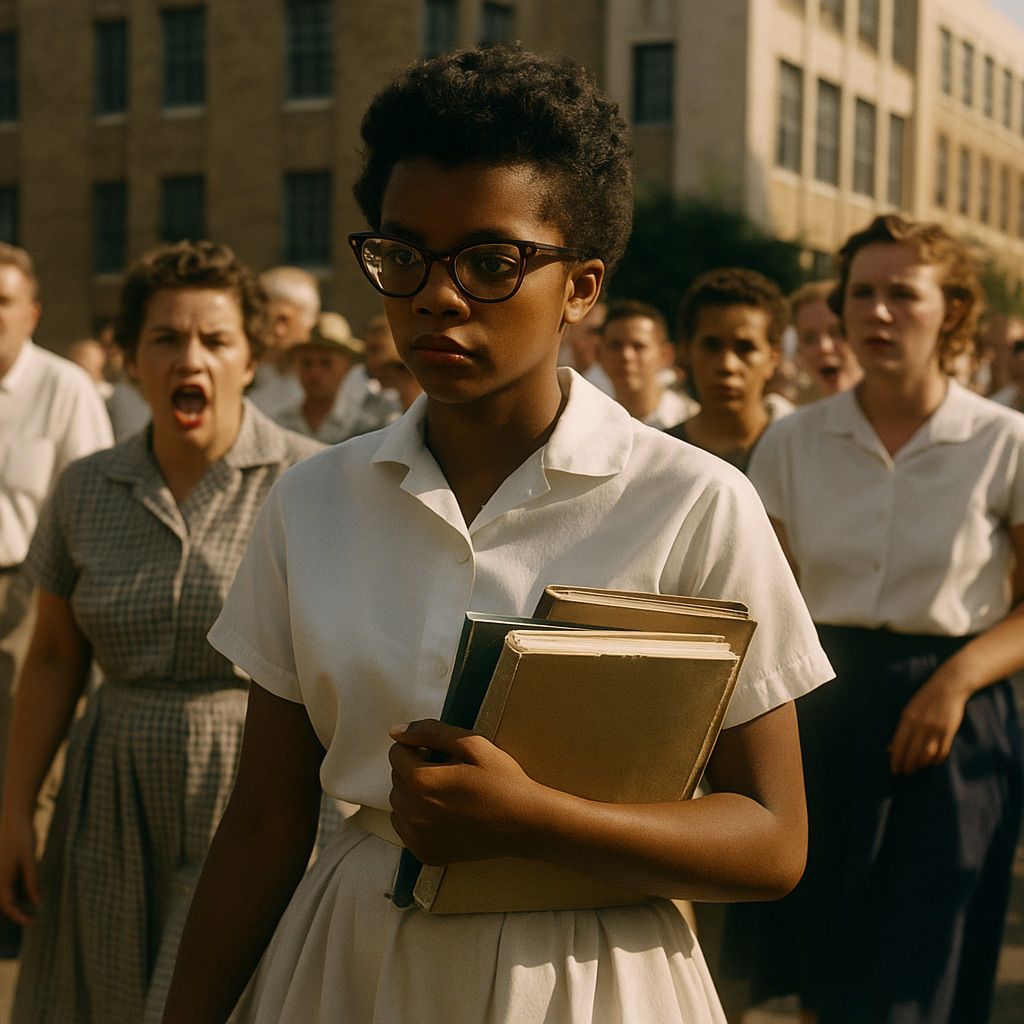
In 1957, Little Rock became the battleground. Central High School was the largest and most prestigious public high school in the city, a gleaming symbol of white supremacy in education. When the school board announced that nine Black students would enroll, the reaction was immediate and ferocious. White citizens organized protests. Politicians fumed. Governor Orval Faubus, seeking to appease segregationists and solidify his political base, called out the Arkansas National Guard — not to protect the students, but to block them. On September 4, 1957, Elizabeth Eckford arrived alone at Central High, dressed neatly, carrying her books. She was met not by classmates but by an angry white mob screaming insults, spitting, threatening violence. Photographs of her walking stoically past the jeering crowd, face set with quiet dignity, seared themselves into America’s conscience.
The crisis escalated. For weeks, the Little Rock Nine were prevented from entering. The Governor defied federal authority, and the standoff became a national embarrassment. Newspapers across the world carried images of American citizens screaming at children, of democracy cracking under the weight of racism. President Dwight D. Eisenhower, reluctant at first to intervene, realized the stakes were larger than Little Rock. The authority of the federal government, the credibility of the Constitution, and the moral soul of the nation were on trial.
On September 24, Eisenhower acted. He federalized the Arkansas National Guard and ordered elements of the 101st Airborne Division — the same soldiers who had stormed Normandy — to Little Rock. The next morning, September 25, soldiers with rifles and bayonets escorted the nine students into Central High. The streets were lined with troops. The mobs still screamed, but the children walked through them, flanked by paratroopers, into a school that did not want them.
Inside, the battle was not over. For the rest of the year, the Little Rock Nine endured harassment, threats, and violence. They were tripped in hallways, cursed in classrooms, pelted with food in the cafeteria. Minnijean Brown was suspended after fighting back against tormentors. The others pressed on, sustained by faith, family, and sheer determination. Their presence forced Central High, and by extension the nation, to confront its hypocrisy. The United States could not claim to be a land of freedom while denying freedom to children because of skin color.
The impact of that day and that year was profound. The Little Rock Nine became icons of courage, their names etched into the history of civil rights. They inspired others to push for integration across the South. Their story demonstrated that federal authority would — at least sometimes — enforce desegregation, giving hope to millions. Yet their experience also revealed the depth of resistance, the cruelty of racism, and the costs of progress. They were teenagers who wanted an education, but they became warriors in a battle they did not choose.
Looking back, September 25, 1957, stands as a day when children carried the burden of a nation. Their walk into Central High was a victory, but it was also a reminder that justice is never automatic. It must be demanded, defended, and endured. The Little Rock Nine remind us that progress often comes not from presidents or generals, but from ordinary people who refuse to bow to injustice. They were young, but they were brave, and their courage continues to echo in every struggle for equality.