The Boston Tea Party stands as one of those rare moments in history when a single night of action rippled outward to change the fate of an entire nation. It wasn’t a battle, it wasn’t a declaration, and no blood was shed, yet its impact echoed louder than cannon fire. On a cold December night in 1773, ordinary colonists made an extraordinary decision: they would no longer quietly accept being ruled, taxed, and ignored by a distant government that saw them as little more than a source of revenue. What followed was not random vandalism or mob violence, but a carefully planned act of political defiance that would become a cornerstone of American identity.
To understand why the Boston Tea Party happened, it’s important to step back into the world of the American colonies in the mid-18th century. The colonists were, in many ways, loyal British subjects. They shared language, customs, legal traditions, and a sense of pride in being part of the British Empire. But loyalty had its limits, especially when decisions made thousands of miles away in London began to directly affect daily life in the colonies without any meaningful colonial input. That tension simmered for years before finally boiling over.
The first sparks appeared after Britain emerged victorious from the French and Indian War in 1763. The war had been costly, and Parliament faced staggering debts. British leaders reasoned that the colonies, which had benefited from British military protection, should help shoulder the financial burden. From the perspective of Parliament, this seemed logical. From the perspective of the colonists, it felt deeply unfair. They had no representatives in Parliament, yet they were being asked to pay taxes decided entirely without their consent.
The Sugar Act of 1764 marked one of the earliest signs of trouble. By taxing imported sugar, molasses, and other goods, the British government struck at the economic lifeblood of colonial trade. Merchants, sailors, and artisans felt the effects almost immediately. What angered colonists just as much as the tax itself was the aggressive enforcement that accompanied it. British customs officials were given expanded powers, and smugglers faced harsh penalties. The message was clear: London was tightening its grip.
Then came the Stamp Act of 1765, and with it, a wave of outrage that swept through the colonies. For the first time, a direct tax was imposed on everyday items like newspapers, legal documents, licenses, and even playing cards. This wasn’t a distant tax hidden in shipping fees or trade regulations; it was impossible to ignore. Colonists from all walks of life suddenly felt the weight of British authority pressing down on them.
Protests erupted almost immediately. Crowds gathered in the streets, effigies of British officials were burned, and tax collectors were harassed, threatened, and sometimes forced to resign. In Boston, resistance coalesced into a more organized form with the rise of the Sons of Liberty. This loosely connected group of merchants, craftsmen, and political agitators became the beating heart of colonial resistance. Figures like Samuel Adams emerged as powerful voices, arguing that liberty itself was at stake.
Although Parliament repealed the Stamp Act in 1766, it did so with a warning. The Declaratory Act asserted that Britain retained full authority over the colonies “in all cases whatsoever.” This wasn’t reconciliation; it was a reminder of who held the power. The tension never truly faded, and before long, new taxes arrived in the form of the Townshend Acts. Duties on imported goods such as glass, paint, paper, and tea reignited colonial anger. Boycotts followed, and once again, resistance spread.
Boston became the epicenter of unrest. British soldiers were stationed in the city to maintain order, but their presence only made things worse. The streets felt occupied, tempers ran high, and mistrust grew on both sides. This volatile atmosphere eventually led to the Boston Massacre in 1770, where British soldiers fired into a crowd, killing five colonists. Though the Townshend duties were largely repealed afterward, the tax on tea remained, serving as a symbol of Parliament’s authority and the unresolved conflict between ruler and ruled.
Tea might seem like a small thing, but in colonial America, it was anything but. Tea was a daily ritual, a symbol of refinement, and a staple in households across social classes. By keeping the tea tax in place, Parliament was sending a message: it still had the right to tax the colonies. Many colonists understood this clearly. Accepting taxed tea meant accepting Parliament’s authority, and that was something growing numbers of Americans were unwilling to do.
The situation escalated dramatically in 1773 with the Tea Act. Designed to rescue the struggling British East India Company, the act allowed the company to sell tea directly to the colonies at a lower price, undercutting colonial merchants and smugglers. On paper, it made tea cheaper. In reality, it was a political trap. The tax remained, and the monopoly threatened local businesses. Colonists saw it as a calculated attempt to force them into submission.
When ships carrying East India Company tea arrived in colonial ports, resistance flared. In New York and Philadelphia, ships were turned away. In Charleston, the tea was seized and stored. But in Boston, Governor Thomas Hutchinson refused to budge. He insisted the tea be unloaded and the tax paid. With the ships sitting in the harbor and tensions rising, Boston stood at a crossroads.
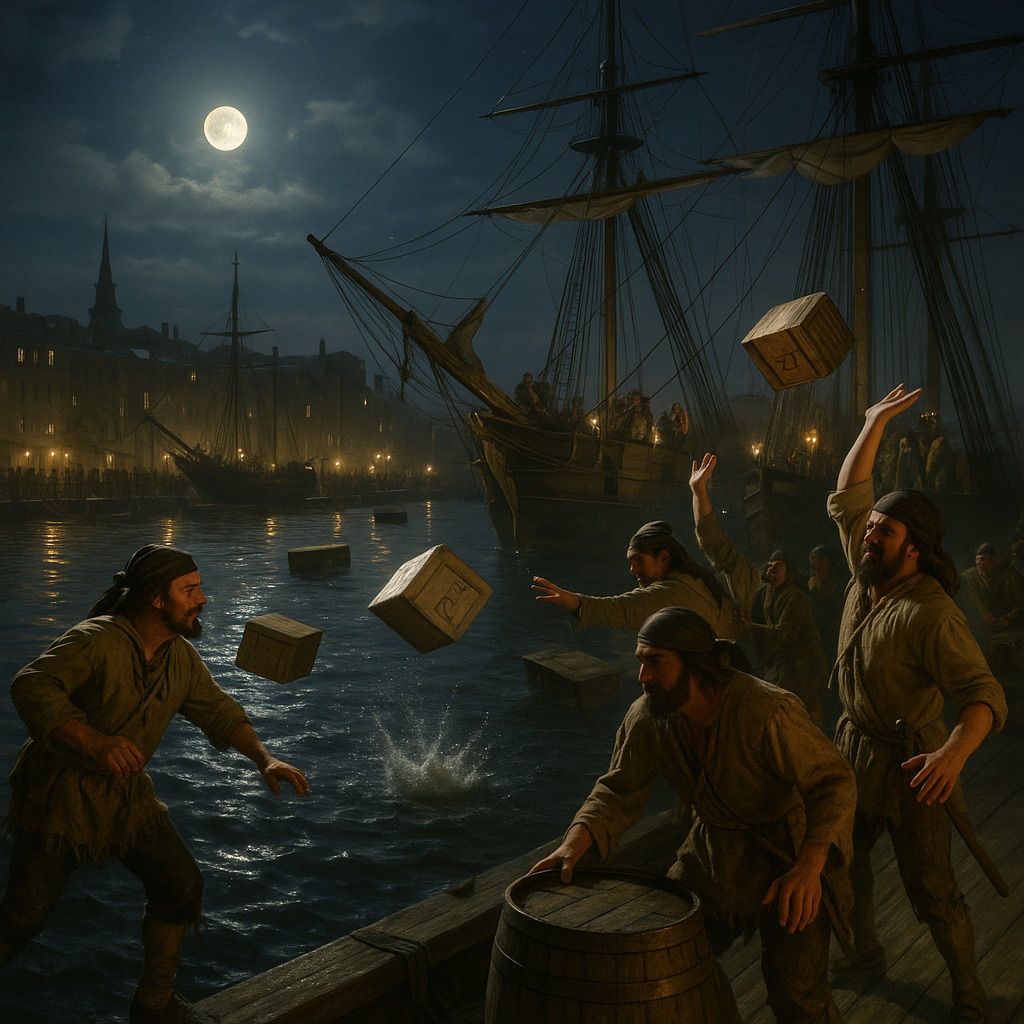
On the night of December 16, 1773, the decision was made. Thousands gathered at the Old South Meeting House, where heated debates filled the air. When it became clear that the governor would not compromise, a signal was given. As darkness fell, a group of men, many disguised as Mohawk Indians, moved quietly toward Griffin’s Wharf.
They boarded three ships—the Dartmouth, the Eleanor, and the Beaver—with remarkable discipline. This was not a drunken riot or chaotic outburst. The men worked methodically, breaking open 342 chests of tea and dumping them into Boston Harbor. They took care not to damage other cargo, and even replaced a broken padlock. By the end of the night, the harbor was thick with tea leaves, and a powerful statement had been made.
News of the Boston Tea Party spread quickly throughout the colonies and across the Atlantic. To many colonists, it was an act of courage and principle. To British officials, it was a shocking display of lawlessness and defiance. Parliament responded with fury, determined to make an example of Massachusetts. The result was the Coercive Acts, known to colonists as the Intolerable Acts.
Boston Harbor was closed until the tea was paid for. Massachusetts’ self-government was severely restricted. British officials accused of crimes were given protection from colonial courts. Soldiers were quartered in private homes. These measures were meant to isolate Boston and crush resistance, but they had the opposite effect. Instead of dividing the colonies, they united them.
Sympathy poured in from other colonies. Supplies were sent to Boston. Committees of correspondence strengthened communication and coordination. In 1774, colonial leaders gathered for the First Continental Congress, marking a new level of unity and resolve. The Boston Tea Party had transformed resistance into something far more powerful: a shared American cause.
Within two years, shots would be fired at Lexington and Concord. Within three, independence would be declared. The Boston Tea Party didn’t cause the American Revolution on its own, but it made compromise nearly impossible. It forced both sides to confront the reality that the relationship between Britain and the colonies was fundamentally broken.
Today, the Boston Tea Party is remembered not just as an act of protest, but as a defining moment in the story of democracy. It showed that ordinary people, when pushed too far, could organize, resist, and reshape their destiny. It wasn’t about tea. It was about dignity, representation, and the belief that government derives its power from the consent of the governed.
That belief continues to resonate centuries later. The image of chests splashing into dark harbor waters remains a symbol of resistance to unjust authority. It reminds us that history is often changed not by kings or parliaments, but by people who decide they have had enough and are willing to act.