
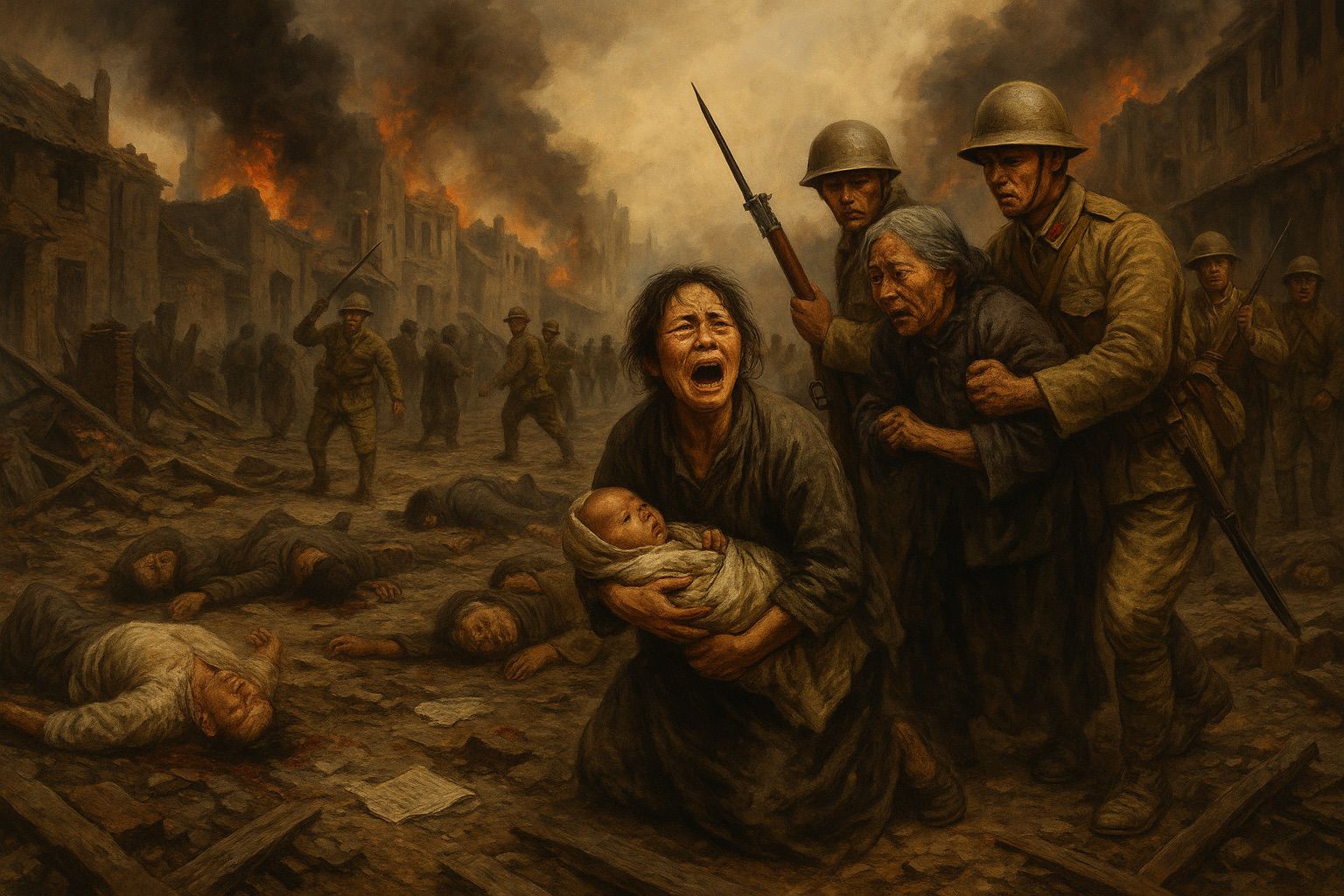
The city of Nanjing moved like a living organism on the morning of December 13, 1937—a place where street vendors shouted over one another, students hurried to classes, and families prepared meals as though the world outside the city walls was not collapsing. But beneath this surface of everyday life, anxiety churned. For weeks, news had trickled in of the Imperial Japanese Army moving closer, cutting through Chinese resistance with terrifying efficiency. Rumors of brutality accompanied every report—stories dismissed by many as exaggerations, because the alternative was too horrifying to accept.
When Japanese forces finally breached the city walls, the truth proved far worse than rumor.
Chinese Nationalist forces, exhausted and outnumbered, had fought furiously to hold back the Japanese advance. General Xue Yue had fortified the city as best he could, but Nanjing was simply not prepared to withstand the might of an army fueled by imperial ambition and conditioned for total war. Once the defenses collapsed, Japanese troops poured into the city in a flood of steel and fury. What followed would become one of the darkest chapters in human history.
The initial hours of chaos gave way to something far more organized and sinister. Soldiers began scouring the streets, dragging civilians from their homes and businesses. One street might erupt in gunfire; another might echo with screams; another might be eerily silent except for the sound of boots and bayonets tapping against concrete. Families huddled in fear, hoping their doors would not be the next ones kicked open.
The violence escalated with shocking speed. Japanese soldiers, acting not as individuals but as a collective instrument of terror, unleashed a campaign of systematic brutality. Women—some as young as eight, others well into their seventies—were raped in staggering numbers. Men suspected of being former soldiers or resisters were rounded up and marched to the edges of the city, where they were gunned down en masse or used for bayonet practice. Prisoners of war were stripped of their uniforms, marched into open fields, and slaughtered without mercy.
Eyewitnesses, including missionaries and foreign officials, kept diaries describing scenes that defy comprehension. Bodies piled along the riverbank. Infants tossed into the air and caught on bayonets. Soldiers laughing as they set fire to homes with families still inside. It was not chaos—it was cruelty refined into ritual.
Panic spread like wildfire. Thousands of civilians attempted to flee, but with Japanese troops encircling the city, escape became nearly impossible. Those who remained sought shelter anywhere they could—in churches, in abandoned buildings, or in designated “safety zones” set up by a handful of brave foreigners, including German businessman John Rabe and American surgeon Robert Wilson. These individuals risked their lives daily, negotiating with Japanese officers to protect the civilians under their care. Without their intervention, the death toll might have been even more unimaginable.
As December wore on, the violence did not abate. Homes were ransacked. Shops were looted. Entire neighborhoods were reduced to rubble. Civilians were forced into makeshift labor camps where starvation, disease, and abuse became routine. Japanese soldiers operated with near-total freedom, as if they had been instructed that everything within the city—lives, bodies, property—was theirs to take.
Reports and documentation later revealed that this was not merely a breakdown of military discipline. Many Japanese officers condoned, encouraged, or directly participated in the violence. Some soldiers kept scorecards of how many civilians they had killed. Others took photographs, which would later serve as grim evidence of the horrors inflicted.
By the end of the massacre, estimates suggest that between 150,000 and 300,000 people were dead—some historians argue even higher. The exact number is impossible to determine; the destruction was too total, the records too incomplete. But numbers alone cannot capture the scope of suffering endured by the people of Nanjing.
International reaction, when it finally came, was slow and hesitant. Reports from survivors and foreign observers did reach the outside world, but political calculations often outweighed moral outrage. Japan was an important geopolitical power, and many governments were reluctant to condemn it publicly. Some newspapers downplayed the reports; others ignored them altogether. The silence became a second betrayal.
In the aftermath of the massacre, survivors carried scars that would never fully heal. Entire families had been wiped out. Children were left orphaned. Women bore trauma that would shape the rest of their lives. The cultural, emotional, and psychological wounds endured by the people of Nanjing did not fade even after Japan’s surrender in 1945.
Justice, too, proved elusive. Though some Japanese commanders were eventually tried for war crimes, many escaped accountability entirely. Japan itself struggled—and still struggles—to fully acknowledge the extent of the massacre, creating decades of tension between China and Japan. For the victims and their descendants, the fight for recognition became a continuation of their suffering.
Yet amid the darkness, the story of Nanjing also contains moments of profound human courage. Foreign nationals who could have fled chose to stay, risking their lives to shield strangers. Some Japanese soldiers defied orders to protect civilians. Survivors helped one another, shared food, and sheltered orphans despite their own grief and fear.
History teaches us that human beings are capable of astonishing cruelty—but also astonishing resilience.
The Nanjing Massacre remains a stark reminder of what happens when hatred is weaponized, when militarism goes unchecked, and when one nation believes its people are entitled to dominate another. It stands as a warning that wartime atrocities do not occur in a vacuum; they are allowed to happen when the world turns its gaze away.
To remember Nanjing is not merely to recount a tragedy. It is to recommit ourselves to the principles of humanity, dignity, and justice. It is to listen to the voices of those who suffered and ensure their stories are not forgotten. It is to acknowledge that peace is fragile—and must be protected with vigilance.
Decades later, the survivors of Nanjing are fewer each year. But their memories endure, passed from generation to generation as both a lament and a lesson. The massacre is not just a chapter in Chinese history—it is a chapter in human history, a testament to the depths to which humanity can sink, and a call to rise above it.