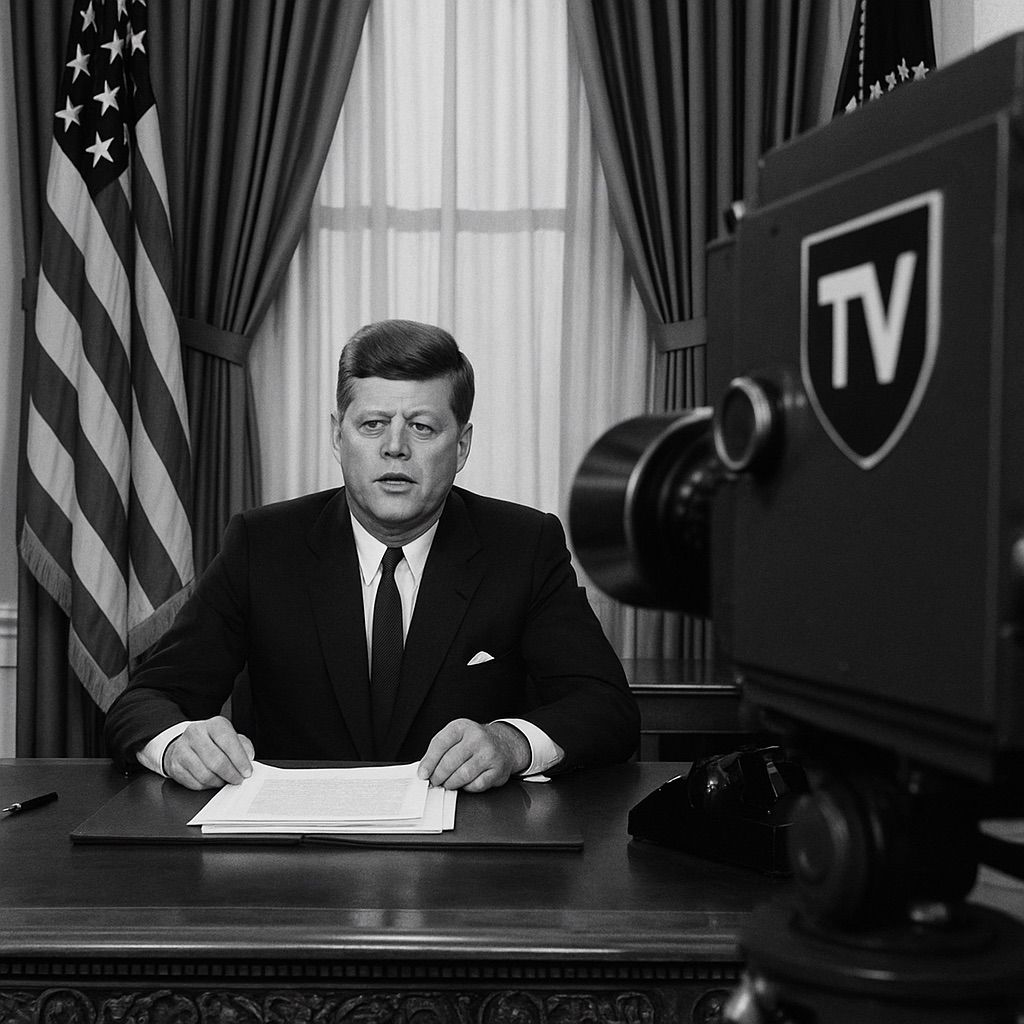
On October 22, 1962, the world stood closer to nuclear war than ever before in history. For thirteen days in October, humanity stared into the abyss of annihilation, as the United States and the Soviet Union engaged in a deadly game of brinkmanship over Soviet nuclear missiles in Cuba. On that evening, President John F. Kennedy went on television to inform the American people—and by extension, the world—that offensive nuclear weapons had been discovered just ninety miles from Florida. His announcement was firm, measured, and terrifying: a naval quarantine would surround Cuba, and any launch of nuclear missiles from the island would be met with a full retaliatory response. It was the moment when Cold War tension crystallized into existential dread, when children rehearsed duck-and-cover drills, when parents wondered if they’d live to see morning, and when the fate of the world seemed to balance on the decisions of two men.
The roots of the crisis stretched back through years of mistrust and hostility. After Fidel Castro’s revolution in 1959, Cuba became a communist ally of the Soviet Union, alarming the United States. The failed Bay of Pigs invasion in 1961, in which U.S.-backed exiles attempted to overthrow Castro, convinced him that Washington would never tolerate his regime. Meanwhile, Soviet Premier Nikita Khrushchev sought to level the playing field. The United States had surrounded the Soviet Union with nuclear missiles in Turkey and Italy, capable of striking Moscow within minutes. Khrushchev’s gamble was simple and audacious: place nuclear missiles in Cuba to deter American aggression, strengthen his hand globally, and redress the imbalance of power.
In October 1962, U-2 reconnaissance flights over Cuba revealed what many had feared: medium-range ballistic missile sites under construction, capable of delivering nuclear warheads to Washington, New York, and beyond. When Kennedy saw the photographs, he knew the world had entered uncharted territory. His advisors—divided between hawks who urged immediate airstrikes and doves who sought negotiation—debated in endless meetings. Kennedy, cautious yet resolute, chose a middle path: a naval blockade (rebranded as a “quarantine” to avoid the language of war) to prevent further missiles from arriving, coupled with demands that the existing sites be dismantled.
October 22 marked the climax of uncertainty. Kennedy’s address was broadcast to millions, his calm voice masking the enormity of the danger. Across America, families huddled around television sets, absorbing the reality that nuclear war was no longer abstract—it was imminent. Lines formed at supermarkets, fallout shelters were stocked, and churches filled with anxious congregants. The sense of dread was palpable; every hour felt like the last. In Moscow, Khrushchev bristled at Kennedy’s ultimatum, while in Havana, Castro prepared for invasion, convinced that Cuba would be obliterated.
The following days tested the world’s sanity. Soviet ships, laden with cargo, steamed toward the quarantine line. Would they stop, or would the U.S. Navy be forced to fire the first shots of World War III? On October 24, the answer came: the ships slowed, then turned back. It was a breath of relief, but the crisis was far from over. Missile sites in Cuba were still being constructed, and the U.S. military prepared for invasion. Strategic Air Command moved to DEFCON 2, one step below nuclear war. B-52 bombers circled the skies, armed with hydrogen bombs. Submarines prowled the oceans. The planet seemed primed for destruction at the press of a button.
Behind the scenes, diplomacy struggled to keep pace with the urgency of events. Khrushchev sent letters to Kennedy—one emotional and conciliatory, the next harsher and more demanding. In the first, he offered to withdraw missiles in exchange for a U.S. pledge not to invade Cuba. In the second, he insisted that U.S. missiles in Turkey also be removed. Kennedy and his advisors faced an agonizing choice: respond to both, or focus only on the first? Choosing wisely, Kennedy publicly accepted the first letter while privately agreeing to withdraw missiles from Turkey within months. It was a delicate dance, one that preserved both leaders’ dignity while de-escalating the crisis.
Amid the tension, accidents and near-misses nearly tipped the balance. A U-2 plane was shot down over Cuba, killing its pilot, Major Rudolf Anderson Jr. Another U-2 strayed into Soviet airspace, triggering panic on both sides. In one of the most chilling moments, a Soviet submarine near the blockade, harassed by U.S. depth charges, came within a heartbeat of launching a nuclear torpedo. Only the restraint of its commander, Vasili Arkhipov, prevented catastrophe. The world’s survival hinged not just on presidents and premiers, but on the judgment of individuals under unimaginable pressure.
Finally, on October 28, Khrushchev agreed to remove the missiles. The world exhaled. The thirteen days of terror ended not with a mushroom cloud, but with compromise and relief. Yet the crisis left scars. It had revealed the fragility of peace, the dangers of miscalculation, and the sheer insanity of nuclear brinkmanship. For Kennedy, it was a triumph of firmness and diplomacy, though he confided later how close disaster had loomed. For Khrushchev, it was a humiliation, weakening his standing at home and abroad. For Castro, it was betrayal, proof that Cuba was a pawn in a larger chess game.
Humanizing the Cuban Missile Crisis means remembering the ordinary people who lived in its shadow. The schoolchildren crouching under desks, teachers whispering comfort they did not feel. The farmer in Kansas staring at the sky, wondering if Soviet warheads were already inbound. The Muscovite hearing rumors of war, fearing the bombs that might rain down in retaliation. The families in Havana digging trenches and bracing for invasion, convinced they were about to become ground zero. The world’s leaders carried the weight of history, but it was the millions of ordinary lives hanging in the balance that made those days so terrifying.
The peak tension of October 22, 1962, remains one of history’s starkest reminders of how fragile civilization can be. One misstep, one miscalculation, could have ended it all. And yet, in the end, restraint prevailed. Kennedy and Khrushchev stepped back from the brink, choosing negotiation over destruction. Their decision gave the world another chance, another sunrise.
Looking back, the Cuban Missile Crisis is not just a story of power politics or Cold War rivalry. It is a story of fear, of courage, of the terrifying weight of human decisions. It reminds us that peace is not guaranteed, that survival depends on wisdom as much as strength, and that even in the darkest hours, dialogue can save us from destruction. On October 22, 1962, the world held its breath—and learned just how precious that breath was.