
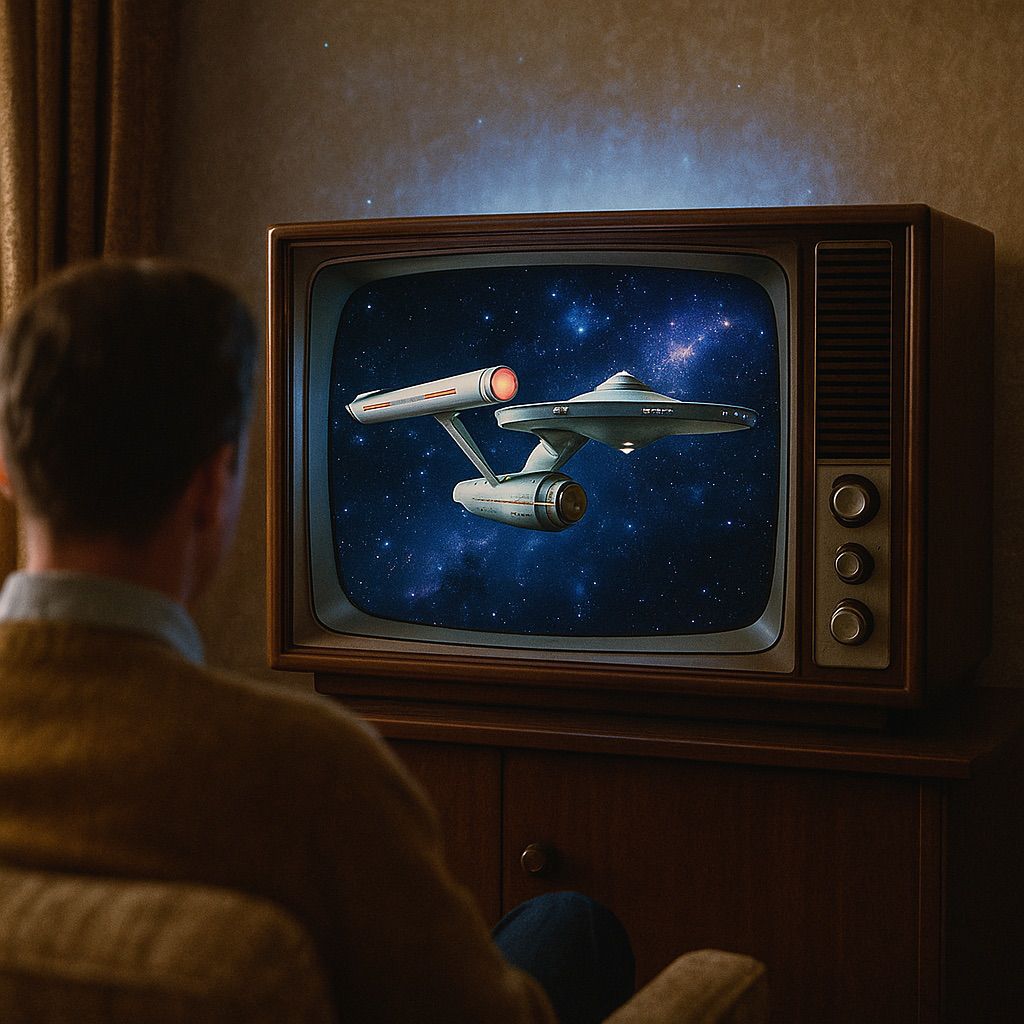
On the night of September 8, 1966, American television audiences tuned their sets to NBC and saw something they had never quite seen before. In a landscape dominated by westerns, family sitcoms, and police dramas, a new series opened with a starship streaking across the stars, accompanied by a voice intoning the now immortal words: “Space… the final frontier.” That series was Star Trek, and though its first run struggled with ratings and risked cancellation at every turn, its legacy would grow into something far larger than anyone watching that evening could have imagined. What began as a modest science fiction program became a cultural force, a global movement, and a philosophy of hope. Its launch in 1966 was not just the beginning of a TV show; it was the start of a journey that would boldly go where no series had gone before, shaping imagination, inspiring technology, and reminding audiences across decades that the human spirit is at its best when it dreams beyond the stars.
The context of Star Trek’s premiere is essential to understanding its resonance. America in 1966 was a nation grappling with profound tension and change. The Cold War was at its height, with fears of nuclear annihilation lingering beneath daily life. The Vietnam War divided families and campuses, sparking protests and outrage. The Civil Rights Movement demanded long overdue justice, with marches, legislation, and heartbreak filling the headlines. Meanwhile, the space race between the United States and the Soviet Union inspired awe and wonder as astronauts pushed further into orbit. Against this backdrop, Gene Roddenberry conceived a show not about cowboys or cops, but about a future where humanity had moved past its divisions, united in exploration, and sought understanding rather than conquest. Star Trek was not escapism; it was a vision of what we could become.
That first episode, “The Man Trap,” which actually aired as the premiere though it was not the intended pilot, told the story of a shape-shifting creature on a desolate planet feeding on human salt. On the surface, it was a monster-of-the-week tale. But woven into it were the themes that would define Star Trek: questions about identity, morality, and the fine line between survival and compassion. Audiences met Captain James T. Kirk, the commanding but deeply human leader of the USS Enterprise. They encountered Spock, the half-Vulcan science officer whose logic clashed with his hidden humanity. They were introduced to Dr. Leonard “Bones” McCoy, equal parts cranky and compassionate, and to a bridge crew that, though fictional, reflected an ideal of diversity rare on television at the time.
Nichelle Nichols as Lieutenant Uhura was a revelation—a Black woman not relegated to servitude or stereotypes, but a competent, respected communications officer on the bridge of humanity’s flagship. George Takei as Sulu, an Asian helmsman, and later Walter Koenig as Chekov, a Russian navigator introduced during the Cold War, further reinforced Roddenberry’s vision of a future beyond prejudice. Pavel Chekov at the helm was particularly bold; at a time when Americans feared nuclear war with the Soviet Union, Star Trek dared to show a world where a Russian and an American served together as allies. And, of course, Leonard Nimoy’s Spock would become an icon, a character whose struggle between reason and emotion mirrored humanity’s own quest for balance.
Yet Star Trek was not an easy sell. The first pilot, “The Cage,” was rejected by NBC executives as “too cerebral.” Instead of scrapping it, the network did something almost unheard of: it ordered a second pilot. That pilot, “Where No Man Has Gone Before,” introduced Kirk and set the tone for adventure and moral quandaries. Even with that greenlight, the show’s future was tenuous. Budgets were tight, special effects were ambitious, and ratings were mediocre. By today’s standards, Star Trek’s sets looked modest, even flimsy, but in 1966 they represented some of the best attempts at visualizing space travel on television. And the storytelling was ambitious, aiming not just for entertainment but for allegory.
Episodes tackled racism, war, authoritarianism, and the dangers of unchecked technology, all cloaked in the safe veil of science fiction. In “Let That Be Your Last Battlefield,” two aliens—each half black and half white, but on opposite sides—destroyed themselves because they could not see past their differences. In “A Taste of Armageddon,” two societies waged a computer-simulated war that required real citizens to be killed as if they had been bombed, raising questions about sanitized violence. In “The City on the Edge of Forever,” Kirk faced the agonizing choice of allowing a woman he loved to die to preserve history. Star Trek dared to ask moral questions most shows avoided.
Despite its innovation, Star Trek’s survival was precarious. Ratings were never strong, and NBC moved the show to a death-slot on Friday nights for its third season. It was nearly canceled after its second year, but an unprecedented letter-writing campaign by fans, led in part by activist Bjo Trimble, convinced the network to give it one more chance. Those fans, who saw in Star Trek not just entertainment but a vision of a better future, became the seed of something new: organized fandom. Star Trek may not have dominated the Nielsen charts, but it birthed a movement that would keep it alive long after 1969.
That movement grew into conventions, fan fiction, and a phenomenon that shocked Hollywood when reruns in syndication became more popular than the original broadcasts. By the 1970s, Star Trek was not dead but more alive than ever, setting the stage for Star Trek: The Motion Picture in 1979, a string of feature films in the 1980s, and new television series that would expand the universe far beyond Roddenberry’s initial three seasons. The Next Generation, Deep Space Nine, Voyager, Enterprise, Discovery, Picard, and Strange New Worlds would follow, each with its own take on the dream. What began on NBC in 1966 became a multigenerational story spanning more than half a century.
The cultural impact of that premiere cannot be overstated. Star Trek inspired countless scientists, engineers, and astronauts. NASA has credited the show with encouraging interest in space exploration. The communicator inspired the design of flip phones. Tablet computers, automatic doors, voice recognition, and even medical scanners all found echoes in Star Trek before becoming reality. Mae Jemison, the first Black woman in space, said Uhura inspired her. Stephen Hawking, a fan of the show, appeared in The Next Generation. The imagination sparked in 1966 continues to ripple outward into real-world innovation.
But beyond technology, Star Trek changed hearts. The sight of a diverse bridge crew working as equals was radical in the 1960s. The kiss between Captain Kirk and Lieutenant Uhura in 1968, often cited as the first interracial kiss on American television, challenged taboos. Spock’s calm logic provided a model for embracing difference. The show’s central message was that humanity could rise above prejudice, violence, and greed. It was not utopia handed on a silver platter but earned through struggle, through making better choices, through choosing to boldly go.
For audiences in 1966, the show was a curiosity, a risky experiment in a time slot dominated by familiar genres. For those who returned week after week, it became something deeper: a promise that the future did not have to be one of fear and division but of unity and wonder. That message, quietly radical at the time, has proven timeless.
Today, looking back at that night in 1966, one can see how unassuming its beginning was. The sets wobbled, the effects were primitive by today’s standards, and the network executives doubted its appeal. And yet, across decades, across languages, across cultures, Star Trek has endured. It has spawned movies, spinoffs, novels, video games, documentaries, and more merchandise than could fill a starship cargo bay. It has been parodied, referenced, and celebrated across every corner of popular culture. And most importantly, it has continued to inspire.
The premiere of Star Trek was more than a television debut. It was a cultural spark. It was the moment a simple science fiction adventure stepped into history and began shaping the dreams of millions. On September 8, 1966, few could have guessed that this modestly budgeted show, struggling for survival, would one day become a universe unto itself. But it did, because it dared to show us not what we were, but what we could become.
Star Trek did not just boldly go. It boldly dreamed. And in doing so, it gave us all permission to do the same.