On September 14, 1959, something extraordinary happened. For the first time in history, an object built by human hands escaped Earth’s gravity, traveled across the void of space, and crashed into the Moon. That object was Luna 2, a Soviet spacecraft, and though its mission ended in a violent impact, its legacy was monumental: humanity had, at last, touched another world. It was a moment that transformed the space race from a dream into a reality, proving that the Moon was no longer an unreachable light in the sky but a destination within our grasp. The thundering clash of politics and science that defined the Cold War gave birth to this astonishing leap, and on that September day, the eyes of the world turned upward to witness the impossible becoming real.
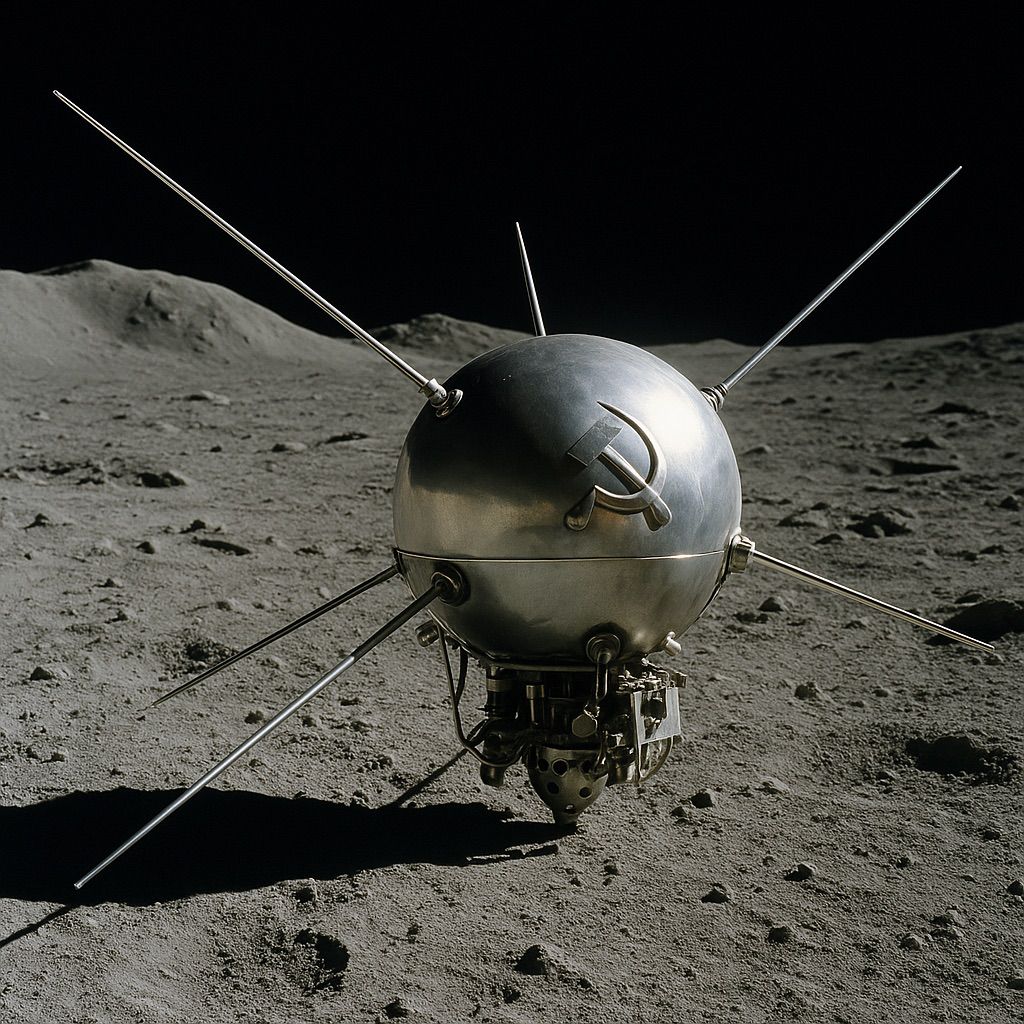
The Luna 2 mission did not look glamorous. It wasn’t sleek like the rockets we imagine in science fiction, nor did it carry astronauts with heroic grins and soaring speeches. Luna 2 was essentially a sphere bristling with antennae, weighing just under 400 kilograms, packed with scientific instruments. But appearances can be deceiving. That simple, almost awkward-looking probe carried with it the hopes of a nation, the anxieties of its rival, and the dreams of millions who had looked at the Moon since childhood and wondered if humans would ever reach it. The Soviet Union, still basking in the glow of launching Sputnik in 1957 and sending Laika the dog into orbit later that year, sought to prove once again that it was ahead in the great space race. And with Luna 2, it would deliver a triumph no one could ignore.
The mission began on September 12, 1959, when a three-stage rocket launched from the Baikonur Cosmodrome, roaring into the sky above the Kazakh steppe. Unlike earlier missions, which had only managed to orbit Earth, this one had a different purpose: to leave Earth’s gravity altogether. The trajectory was carefully calculated, the engines carefully timed. Soviet engineers, working under the guidance of Sergei Korolev, the mastermind of the Soviet space program, knew that success would prove not only technical superiority but also ideological strength. In the Cold War, every launch was not just a scientific experiment but a statement: a declaration of which system, communist or capitalist, could conquer the future.
As Luna 2 hurtled into space, it carried a payload of instruments designed to study cosmic rays, solar wind, magnetic fields, and radiation. But more than that, it carried small metal spheres, each engraved with the hammer and sickle, symbols of the Soviet Union, designed to scatter on impact across the lunar surface. To the Soviets, this was not only a scientific mission but a symbolic planting of their flag on the Moon. It was the 20th century’s new form of conquest: no longer about ships crossing oceans or armies seizing land, but machines crossing the gulf of space. And when Luna 2 finally struck the lunar surface near the Sea of Tranquility at 21:02 Moscow time on September 14, it did more than break apart on the Moon’s crust. It shattered the boundary between dream and reality. For the first time, humanity had touched another celestial body.
The world was stunned. Headlines declared that the Soviets had “hit the Moon.” Crowds around the globe reacted with awe and unease. In Moscow, the triumph was celebrated as proof of Soviet genius. In Washington, the news landed like a thunderclap, fueling fears that America was falling irreversibly behind. President Dwight Eisenhower, however, publicly congratulated the Soviet Union — a rare gesture in an age of deep rivalry — because even in competition, the magnitude of what had been achieved could not be denied. Humanity had, for the first time, reached beyond its home planet. Whether you were in New York or Moscow, Beijing or Paris, the Moon seemed just a little closer that night.
What makes Luna 2’s story remarkable is not only that it succeeded, but that it changed the way people thought about the future. For centuries, the Moon had been unreachable, a fixture in myth and poetry, a companion to human imagination but never to human science. People told stories of gods and goddesses, of rabbits and lovers, all etched into the face of the Moon. And now, a metal sphere made by humans had crashed there. The line between mythology and reality had blurred. The Moon was no longer a mystical otherworld. It was a place that could be reached, studied, and, one day, visited. Luna 2’s impact redefined what humanity thought possible.
The mission was also a turning point in the space race. The United States, caught off guard, accelerated its efforts to catch up. The Soviet Union, emboldened, pushed further, eventually sending the first human, Yuri Gagarin, into space in 1961. Each side raced not only for scientific advancement but for prestige, for global influence, for the symbolism of being the first to conquer the cosmos. And yet, in the larger arc of history, Luna 2’s success belonged not just to the Soviets but to humanity as a whole. For while the Cold War context gave it urgency, the deeper truth was that a human machine had touched the Moon. It was proof of what we, as a species, could do when imagination and technology came together.
Of course, the Moon would not be touched again until 1969, when Neil Armstrong stepped onto its surface. But Luna 2 laid the groundwork for everything that followed. Without Luna 2, there would be no Apollo program, no “giant leap for mankind.” Its crash landing showed that space could be crossed, that trajectories could be calculated, that missions could be aimed at other worlds. It turned science fiction into science fact. It ignited the imaginations of millions of children who grew up dreaming of becoming astronauts. It made the Moon not just a glowing light in the night sky, but a destination.
Looking back now, Luna 2 feels like both a relic of the Cold War and a timeless moment of human achievement. Yes, it was launched in an era defined by rivalry, propaganda, and fear. But its significance transcends politics. Luna 2 was the first messenger from Earth to reach another world. It was the first time we extended our touch beyond this planet. It was the beginning of humanity’s story as a spacefaring species. And in that sense, it belongs not only to the Soviet Union but to all of us.
On September 14, 1959, the Moon stopped being a dream and became a destination. Luna 2’s crash was violent, but its legacy was beautiful. It told us that the universe is not beyond our reach, that we are not bound forever to this Earth. It told us that imagination can become reality, that technology can make myths come true. Above all, it told us that the first step into the cosmos was not a step at all, but a crash — and from that crash, a journey was born.