
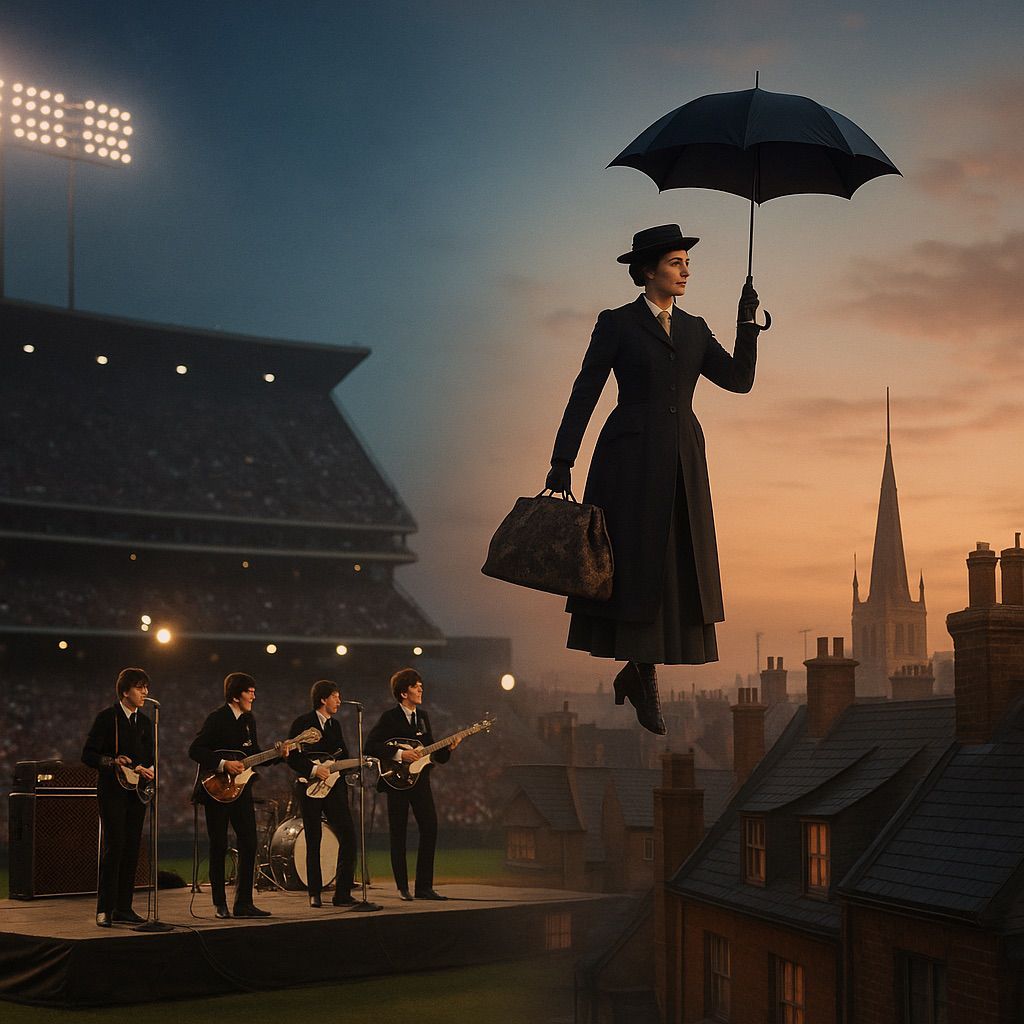
There are calendar days that feel like coin flips—two faces of the same metal, one side shine and one side grit, tossed into the air by history’s impatient hand. August 29 is one of those days. Look at it once and you see a ballpark thundering with a noise that would never be replicated quite the same way again: the Beatles, small as postage stamps at the far end of Candlestick Park, trying to throw their songs across a wind-bitten diamond while teenage awe and transistor squeals ricochet like meteors. Look again and you’re standing inside a movie palace in 1964 as a London nanny floats down from a slipping seam in the clouds and lands exactly where a family needs her, with a carpetbag’s worth of impossible solutions delivered in a voice that sounds like music smiling. One day, two tempos. One goodbye with amplifiers; one hello with a carpetbag. One crowd chanting themselves hoarse at a final concert; one crowd humbled by a film that dared to tell grown-ups to be kinder, braver, and, yes, a bit more playful. It would be easy to keep these stories in separate rooms—the rock show on the stadium’s grit, the Disney premiere in velvet shadows—but August 29 won’t let us. It insists on a single, long corridor where pop revolution and movie magic pass each other, nod, and share a secret: both of us changed how people feel about the future, and neither of us did it quietly.
Picture San Francisco first. Candlestick Park in late August, 1966. The air there never quite relaxes; it shivers even in summer, sea-salted and mischievous, taking a sweater off your shoulders just when you thought you’d warmed up. Out on the outfield grass a temporary stage stands in its own uncertainty, looking too slender to hold the decade’s heaviest fame. The Beatles arrive in a car that seems embarrassed by its cargo and step into a noise that is less cheering than weather, a jet stream of adoration pouring through every concourse and clipped by the stadium’s concrete geometry into something that wails. They have become the world’s loudest quiet men—funny, observant, sleepless, generous, overwhelmed—famous enough to be reduced to symbols and hunted by their own logistics. The Shea Stadium show a year earlier had proved a point about scale but also revealed a limit: you can’t hear a band when the band can’t hear itself. What happens on August 29 is both a concert and a decision. The setlist is a pocket of their catalog—“Rock and Roll Music,” “She’s a Woman,” “If I Needed Someone,” “Day Tripper,” “I Feel Fine,” “Yesterday,” “Nowhere Man,” “Paperback Writer,” “Long Tall Sally.” The amplification, by modern standards, is quaint: a few Vox amps, the park’s P.A., microphones befuddled by wind. Ringo’s snare sounds like a flag being flicked. The guitars skitter like dragonflies. You can hear as much crowd as band, and yet something essential makes it across—the joy of doing a thing you love in the very moment you decide to stop doing it this way.
Decisions like this do not arrive as press releases; they land in a musician’s bones as fatigue that no nap can fix, as a sense that the art is larger than the room it’s been placed in. The Beatles were tired of being décor for their own legend—tired of the shriek that swallowed chord changes, tired of death threats and segregation fights in the American South, tired of playing “I Want to Hold Your Hand” to the back wall of a baseball stadium where the usher two sections over was louder than any note they could push through the air. They were not tired of each other, not yet, not in the way that would later break their studio into corners; they were tired of a format that embarrassed the music. So they made a brave and technical choice: let the songs grow in the place where they could be carefully engineered. Touring had revealed the ceiling; the studio would open the roof. Think about what that requires—to walk off a stage you own, at the peak of a public love affair, and say, the next version of us will be invisible until it is impossible to ignore. It is not retreat. It is a tactic. It is an admission that the art you’re trying to make needs a different kind of attention than a stadium can give.
There’s a photograph from that night, one of the famous ones taken by their press officer Tony Barrow, showing the band huddled around a scrap of paper backstage, signing the date on a postcard as if notarizing their own decision. It looks almost casual—four men with pens, a bit of cardboard, jackets askew, faces half-smiling, a little sad and a little giddy. People who love the Beatles sometimes talk about their arc as if it were inevitable: start in Hamburg sweat and Cavern dust, explode into Beatlemania, then invent the modern studio album in a chain of miracles. But inevitability is what the story looks like afterward, when we’ve flattened the fear out of it. In the moment, on August 29, 1966, it looked like courage. Not the showy kind. The technical kind. The kind that says: we will trust the work and our ears; we will vanish from your applause so we can chase a sound that you don’t know you’re waiting for. Two months later, they would roll into Abbey Road and start turning the knobs toward Sgt. Pepper and everything that came with it—the orchestra swells, the varicolored tape loops, the “Being for the Benefit of Mr. Kite!” harmonium, the moaning mellotron, the bass as a lead instrument, the song as a movie in your head. People will tell you the Beatles stopped playing live because they were tired. Sure. But August 29 shows a deeper reason: they were not going to let the limits of the era become the limits of the music.
On another August 29—rewind the reel to 1964 and change coasts if you like—an entirely different kind of spectacle pulls its audience into a kind of civic charm school. The curtains open on London rooftops drawn by hand and painted by imagination. Chimneys stand like organ pipes, waiting to blow soot and melody. A wind shifts its mind. The city inhales. Down floats Mary Poppins, umbrella up like a moral compass, carpetbag in hand, hat slightly defiant, with a smile that seems to have already forgiven someone for something. “Practically perfect in every way,” she will say later, but that tidy line is only half the spell. The other half is sterner: you can be better, and it will be fun to learn. The world that welcomes her is a household in disrepair by a problem adults often fail to diagnose—Mr. Banks is very good at his job and very bad at his joy. The city around them is bright enough to hide soot and soot enough to hide tenderness. The film that unfolds from this premise is a feat of engineering disguised as whimsy: live action wed to animation without visible seams, songs that behave like lessons and lessons that behave like games, a nanny who seems to have stepped out of nineteenth-century literature and into twentieth-century cinema without losing a single ounce of agency. Disney’s “Mary Poppins,” anchored by Julie Andrews’ precision and warmth and by the Sherman Brothers’ dozen proofs that melody is the shortest distance between a stubborn adult and their inner child, offers a theme the Beatles would have recognized: there are better technologies for being human than the ones we have carelessly inherited.
Remember the songs, even if you haven’t watched in years. “A Spoonful of Sugar” is not about sweetening; it is about reframing—task becomes play when we are invited to meet it with imagination instead of dread. “Chim Chim Cher-ee” romanticizes soot at first and then quietly expands into solidarity: a sweep knows the rooftops are a commons, and a commons asks us to step lightly. “Feed the Birds” refuses spectacle and gives us a tempo of tenderness—the palace of a city-centered financial system sits across from a woman selling crumbs, and the film’s moral gravitational center tells you plainly where your heart should go. “Let’s Go Fly a Kite” is a final exam on joy shared and hierarchy softened: the father discovers that his place in the world is not a ledger but a circle made of his family’s outstretched arms. It would be easy to dismiss such narrative with grown-up cynicism, easier still to mock its sentiment as dated. But the record shows that the film’s kindness has stubborn half-life. It taught multitudes of children that the adults around them could change for the better—and taught the adults that change would require small embarrassments accepted with grace and songs stuck in their heads on purpose.
The timing matters. The mid-1960s were already humming with a kitchen’s worth of pots boiling over: civil rights demanded legal transformation, feminism began to step out of the kitchen where it had never consented to remain, the war machine was winding itself toward its ugliest efficiencies, and popular music was learning that it could be more than dancing and courtship—it could be argument and prophecy. In that climate, it might seem odd that a film about a nanny became one of the era’s cultural pillars. But look closer. What Mary Poppins proposes is not escape; it is training for a different citizenship. This is how you tidy a room and a life without throwing your neighbor into the dustbin. This is how you tell a story to a child that makes that child a partner in delight rather than a receptacle for orders. This is how you talk to a banker about value in a vocabulary that places the fragile at its center. The film’s technology—the painless stitch between live action and animation, the trick shot that makes a carpetbag’s bottom go wandering, the choreography that makes a city rooftop feel like a republic—was not showing off for its own sake. It was saying: we can build kinder illusions to teach truer truths.
Maybe that’s the link, then, between Candlestick Park and Cherry Tree Lane: both nights, August 29 taught its audiences to ask for a better technology. The Beatles asked for a better technology of listening to music together, which turned out, for a while, to be not “together” at all, but alone with headphones and liner notes, a long stare at the gatefold, a reverence toward the sequencing magic that would be drowned in a ballpark. Mary Poppins asked for better technology of listening to one another, which turned out not to be gadgets or gizmos but households practicing play like a language. One night pivoted toward four-track machines and tape loops; the other pivoted toward a kite string and a hand held at the right time. Both nights said: adjust the room if the song can’t breathe; adjust the heart if the house can’t.
The human stories inside these spectacles deserve their due. On the Candlestick stage, John wore his ironic armor a little tighter than usual; Paul kept his diplomat’s smile; George, still only twenty-three, glanced out past the cameras toward a horizon he would later chase in other ways; Ringo did what Ringo always did—keep the pocket steady and the spirits up. After the show they left in a white armored car, the kind of exit vehicle you use when you are both adored and in danger. In hotels not far away, they wrote about boredom and brilliance on hotel stationery and wondered if they were inventing or surviving. In Burbank, two years earlier, Julie Andrews had auditioned while pregnant, with a voice that could go from silver to velvet in a single syllable, and Walt Disney—part showman, part moralist, part wizard of manufacturing wonder—had bet on a film that could fail in a dozen visible ways if the tone went sour. Behind the scenes, the Sherman Brothers wrote songs that felt like they had always existed, each a little instruction manual for a life with fewer cruelties. Dick Van Dyke defied gravity with a grin; the animators learned new rules about eye-lines and shadows; the editors learned when to let a song keep the camera still. Everyone involved, both at the stadium and at the studio, knew the same professional secret: the trick is to make it look effortless when it absolutely was not.
The legacies of these August 29s are easy to trace and easy to underestimate. The Beatles, released from the physics of touring, discovered the moral of the laboratory: curiosity plus time equals breakthroughs that sound like they arrived whole. Revolver, Sgt. Pepper, Magical Mystery Tour, the White Album, Abbey Road—those projects were not only albums; they were proposals for what records could do to your sense of time. A song could be a day in a life, complete with alarm clocks and orchestral glissandos that sounded like falling through the sky. It could be a field recording from a dream. It could be a postcard from a place no one had been but everyone wanted to visit. And because they were no longer killing their ears in stadiums, they could protect those ears long enough to chase arrangements that made radio itself feel newly invented. Mary Poppins, released into a world accustomed to children’s films as confection, dared to be moral without scolding, technical without bragging, and truly intergenerational—grandparents laughed without pretending, parents cried without warning, children believed without apology. It showed a studio how to make magic look like empathy and taught the industry that spectacle earns its keep only when it is in service to a change of heart.
You can also measure these stories in the lives they quietly coached. Ask a musician what first told them that a song could be a universe and you will hear the names of Beatles albums like the catechism of a secular church. Ask a parent what taught them that routine could be a ceremony and they might hum “A Spoonful of Sugar” without noticing. Ask a school music teacher what keeps them insisting on beauty when budgets say otherwise and you will hear about a band that stopped touring so the work could get deeper. Ask a social worker what teaches a child empathy when lectures fail and you will hear about films that smuggled kindness into kids’ heads with melodies. August 29 moves through these testimonies like a ghost with good timing.
There is, inevitably, a shadow to everything we praise. The Beatles’ retreat from live performance is sometimes read as luxury—only the most famous band in the world could afford such a choice. But the point is not “do as they did” so much as “learn what they learned.” If the format betrays the work, you are allowed to choose a different room. Decades later, bands would reinvent live sound, arenas would become theaters of precision, and the Beatles themselves would reenter the world’s rooms in a different register—reissues, rooftop surprises, documentary clarity that finally let you eavesdrop properly. Mary Poppins’ primness, read unkindly, can scan as nostalgia for a Britain gentler on the surface than in policy; yet the film’s insistence on paying attention to the vulnerable remains stubbornly modern, and its belief that joy is a discipline rather than a luxury remains a counterculture all by itself. The shadows only make the lights truer. They force us to refine our praise—to say, not “perfect,” but “practically perfect in the way it moves us toward better.”
So what is August 29 asking of us now? Perhaps this: find your stadium you need to leave and your household you need to mend. If there is a room in which your best work cannot be heard, you are not required to remain because the crowd is large. Find the smaller room where the microphone is honest, the studio where collaborators hear each other, the laboratory where a failed take is an investment rather than an embarrassment. And if there is a room where the people you love have forgotten how to delight in each other, you are never ridiculous for showing up with a kite string and an invitation to the park. The Beatles teach the courage to withdraw strategically. Mary Poppins teaches the courage to engage specifically. Both teach that art is not content you consume to forget your life; it is instruction you practice to enlarge it.
In the end, a concert you couldn’t quite hear and a movie you cannot quite forget join hands across a single date on the calendar, and the handshake is firm. The boys in tailored suits walk off a stage and into a studio, and the nanny in a tailored coat steps off a cloud and into a home. One set of footsteps makes tapes hum; the other teaches feet to dance. One shows that intimacy can be engineered at scale with the right knobs and patience; the other shows that intimacy can be scaled down to a kitchen table and still alter a city. August 29 keeps whispering: make something that lasts longer than the applause. Make something that teaches the people who love it to love each other better. Make something that can be heard.