On November 3, 1964, the citizens of Washington D.C. walked into polling places carrying more than ballots—they carried the weight of history, the echo of silenced voices, and the pride of finally being recognized as participants in the democratic promise of America. For the first time since the capital’s founding in 1790, the people of Washington, D.C., voted in a presidential election. It was a moment long overdue, born from decades of frustration and advocacy, and it marked not just the casting of votes but the restoration of dignity to a community that had lived in the shadow of power yet been excluded from it.
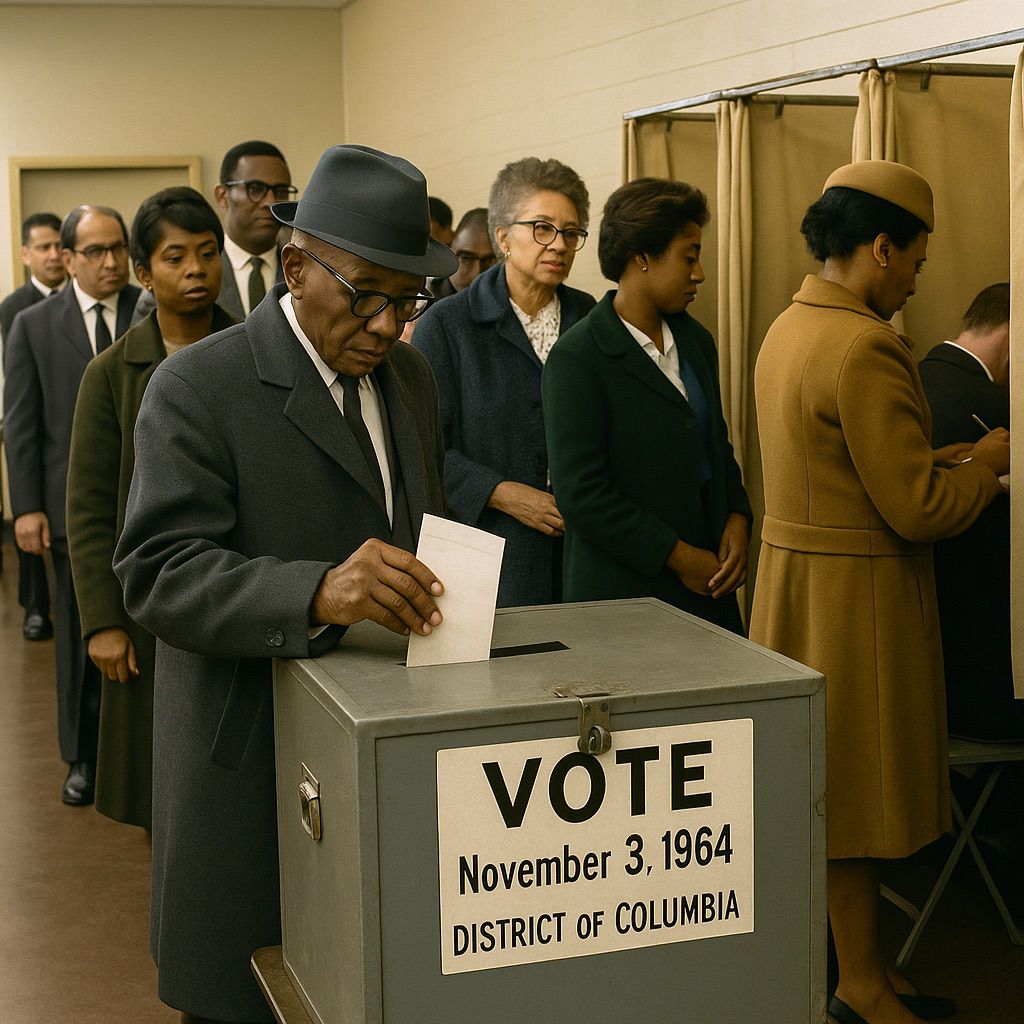
Imagine the scene that crisp November morning in 1964. Across the city, from rowhouses in Shaw to apartments along Georgia Avenue, families rose early, dressed with purpose, and made their way to polling stations. Grandmothers who had lived their entire lives in the capital, watching presidents sworn in from afar, finally had a chance to cast their own vote for who would occupy the White House. Young men and women, energized by the Civil Rights Movement and emboldened by the victories of the 1960s, stepped proudly into voting booths, aware that they were making history. The streets buzzed with anticipation. For once, Washington was not just the seat of democracy—it was part of it.
The road to this moment had been long and winding. Since its creation as the federal capital, Washington D.C. had been denied the same democratic rights granted to the states. Residents paid taxes, served in wars, and lived under federal authority, but they could not vote for president. “Taxation without representation,” the very grievance that had fueled the American Revolution, was alive in the heart of the nation’s capital. For generations, D.C. residents were voiceless, their democratic rights sacrificed to the unique status of the federal district. Petitions were written, protests organized, and voices raised, but change seemed perpetually out of reach.
That began to shift with the ratification of the 23rd Amendment in 1961. For the first time, D.C. residents were granted the right to appoint electors in presidential elections, though capped at the number allotted to the least populous state—three votes. It was not full equality, but it was a beginning, a crack in the wall of disenfranchisement. The amendment was a recognition that the people who lived, worked, and sacrificed in the capital deserved a say in the leadership of the nation they embodied.
And so, in 1964, they voted. The timing was significant. America was in the throes of monumental change. The Civil Rights Act had just been signed by President Lyndon B. Johnson earlier that year, dismantling legal segregation and striking a blow against systemic racism. The nation was embroiled in debates over Vietnam, poverty, and the very direction of its soul. For Washington D.C.—a city with a majority Black population—the vote was not only about national politics but about self-respect, representation, and the recognition of their humanity. Casting a ballot that day was more than a civic duty. It was an act of empowerment.
The election itself was a landslide. Lyndon B. Johnson defeated Barry Goldwater in one of the most lopsided victories in American history, winning over 61% of the national popular vote. In D.C., the result was even more emphatic: residents overwhelmingly supported Johnson, affirming their place within the Democratic coalition that had embraced civil rights. But the importance of the day lay not in the outcome but in the act. For the first time, the residents of Washington D.C. could point to the presidency and say, “We had a hand in this.”
To humanize the moment is to see it through the eyes of those who lived it. Imagine an elderly Black man who had fought in World War II, coming home to a city that honored his service yet denied him a vote. On that November morning, he stood tall as he cast his ballot, finally tasting a measure of the democracy he had defended abroad. Picture a young mother holding her child’s hand as she walked into the polling station, whispering to her daughter that she was voting so the child’s future might be brighter. Picture students at Howard University, energized by the Civil Rights Movement, lining up to vote for the first time, their youthful determination mingling with the solemnity of the moment.
The significance of that day extends beyond 1964. It reminds us that democracy is not static but a living promise, one that must be fought for, defended, and expanded. The residents of D.C. had been silenced for generations, yet they persisted, and when their voices were finally heard, it reshaped the capital’s relationship with the nation. Yet their struggle was not—and is not—over. Even today, Washington D.C. lacks full representation in Congress, a reminder that the cry of “taxation without representation” still echoes. The vote in 1964 was a breakthrough, but it was also a beginning.
The story of November 3, 1964, is not just about Washington D.C. It is about the broader American journey toward a more inclusive democracy. It parallels the fights for suffrage by women, by African Americans in the South, by Native Americans, by young people who earned the right to vote at eighteen. Each expansion of the vote has been a reminder that democracy grows stronger when more voices are heard, not fewer. The people of D.C. joining the electorate in 1964 was one more step in that unfinished journey.
What makes the story viral, even today, is its resonance with ongoing struggles. The fight for D.C. statehood continues, fueled by the same desire for equality and representation that animated 1964. The faces may have changed, the slogans updated, but the core principle remains the same: those who live under a government should have a voice in it. The first presidential vote of Washingtonians in 1964 is both a victory to celebrate and a challenge to remember that democracy must keep expanding.
November 3, 1964, was not just another election day. It was a day when the nation’s capital ceased to be a symbol of democracy in name only and became a participant in its reality. It was a day when ballots became bridges, linking the lives of Washingtonians to the destiny of the nation. It was a day when silence gave way to speech, when the excluded became included, and when the promise of America, however imperfectly, became a little more real.