
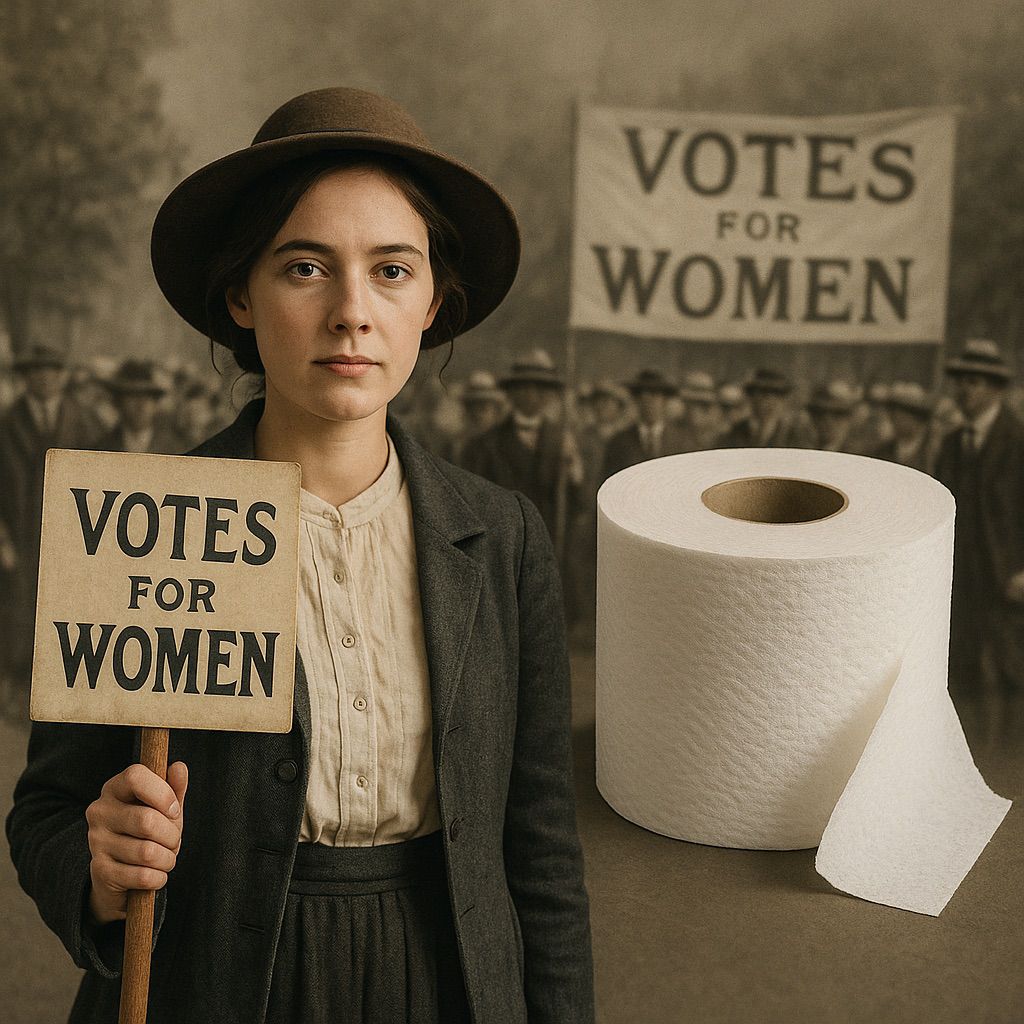
It’s strange how the calendar rarely tells us what’s important. August 26 doesn’t come bearing fireworks or fireworks’ anticipation. It doesn’t mark a new season or host a universally celebrated holiday. It’s just a hot day on the edge of summer in the United States. But to history? To culture, and comfort, and the human pursuit of dignity and choice? August 26 is a double-helix of revolution. One strand belongs to a hard-won, century-spanning struggle: the ratification of the 19th Amendment to the U.S. Constitution in 1920, finally granting women the right to vote. The other, curiously humble and chronically overlooked, is the introduction of commercially sold toilet paper, a product that—although rarely poeticized—changed the hygiene, health, and privacy standards of the modern world. Together, these two unrelated events might seem an odd pairing, yet they both speak volumes about the human condition. About how we fight for power and how we reach for comfort. About the great and small revolutions that define civilization. They both carry the same quiet echo: “I matter.” One says, “I matter in society.” The other says, “I matter in private.” So let’s go backward before we go forward and ask ourselves: How did women win the right to vote? Why did it take so long? And why on earth should we even pause to appreciate something as pedestrian as toilet paper? The answers, as it turns out, tell us more about ourselves than we might expect.
Rewind to the early 19th century, an era draped in corsets and heavy silence. In a country building itself with bold ideals but brittle execution, women were mostly confined to roles of domesticity and obedience. They couldn’t vote. They couldn’t hold office. In many places, they couldn’t even own property or keep their wages. To be a woman was to be legally invisible. But the seeds of change had already been planted. Across oceans, industrialization was changing how people lived and worked. Injustice, exposed under the light of expanding literacy and transportation, grew harder to ignore. The abolitionist movement picked up steam, and as women joined the call to end slavery, many of them—ironically—were told to sit down and be quiet. That pushback lit a fuse. If they were good enough to fight for human freedom, why weren’t they good enough to have some themselves? In 1848, a band of women gathered in Seneca Falls, New York, and held what is now remembered as the first women’s rights convention in the United States. Elizabeth Cady Stanton, one of the movement’s leading minds, drafted the Declaration of Sentiments, a document that mimicked the structure of the Declaration of Independence but added the radical line that “all men and women are created equal.” The convention was a spark, but the fire would take decades to catch. The opposition was ferocious. Critics said women were too emotional, too delicate, too simple-minded to weigh in on politics. Others claimed voting would corrupt their purity, that the sacred domain of motherhood would be tarnished by the dirty business of elections. And yet, suffragists pressed on. They organized. They wrote. They marched. They were arrested. Some were force-fed in prison during hunger strikes. Others stood silently outside the White House with signs shaming President Woodrow Wilson for ignoring their plight. Slowly, they chipped away at the edifice. Some states began granting limited suffrage. Wyoming, famously, gave women full voting rights in 1869—decades ahead of the rest. But it wasn’t until the crucible of World War I that the movement gained irreversible traction. As men went to war, women filled their roles in factories, farms, and fields. They didn’t just prove their capability—they rubbed the world’s nose in it. To deny them the vote afterward seemed both cruel and absurd. On August 18, 1920, Tennessee became the final state needed to ratify the 19th Amendment, thanks to a single legislator—Harry Burn—who had planned to vote against it but changed his mind after receiving a note from his mother urging him to do the right thing. Eight days later, on August 26, the amendment was certified. It became law. Women had the right to vote—not just in Wyoming or California, but nationwide. For the first time, nearly half the adult population of the country had their voices legally acknowledged. But it wasn’t a perfect victory. Black women, Native American women, Asian American women, and Latinas continued to face racism and voter suppression in the form of poll taxes, literacy tests, and outright intimidation. It would take decades more civil rights battles for the idea of “universal suffrage” to inch closer to reality. Still, August 26 marked a tectonic shift. It wasn’t just about ballots. It was about belonging.
Now take a hard left turn. Let’s talk about bathrooms. We laugh, we wince, we blush. But behind closed doors, the way we relieve ourselves and clean up afterward is central to health, comfort, and dignity. For centuries, humans used whatever they had—stones, shells, leaves, animal fur, even hands. In ancient Rome, a communal sponge on a stick served entire public bathrooms, rinsed off in a bucket between uses. The concept of personal hygiene was largely shaped by geography, culture, and status. Water was common in parts of Asia. The bidet gained popularity in Europe. But paper? That was rare, precious, and reserved for writing. Enter Joseph Gayetty, an American inventor who, in 1857, introduced the first commercial toilet paper in the United States. He called it “medicated paper for the water closet” and claimed it could cure hemorrhoids. It came in flat sheets, not rolls, and was sold in packages bearing his name on every sheet—an early and awkward version of branding. Despite his efforts, the product didn’t catch on. People were used to using newspaper and catalog pages, which were free. It took another few decades, and a few industrial innovations, for toilet paper to go mainstream. In the 1890s, the Scott Paper Company launched rolled toilet paper—the version we now know and often take for granted. Still, there was stigma. Ads tiptoed around the product’s function, using euphemisms like “hygienic tissue” or “comfort paper.” Social taboos made it nearly impossible to market directly, especially to the Victorian middle class. Nevertheless, the product spread. Indoor plumbing and the rise of consumer culture in the early 20th century helped normalize it. By the 1920s, toilet paper was a fixture in American households, quietly revolutionizing the way people experienced one of life’s most basic routines. Its impact was enormous but invisible. Sanitation improved. Skin health improved. Privacy became sacred. It might not carry the emotional weight of the vote, but it shares a philosophical root: personal dignity.
And so we arrive again at August 26, a day that lives in contradiction and harmony. One milestone was public and political, the other private and practical. One required decades of protest, the other decades of production and consumer persuasion. But in their own ways, they each redefined what it means to live with agency. The right to vote lets you speak. The right to clean yourself with dignity lets you live. Both are statements. Both are declarations that say, “I deserve better than what I’ve been given.” It’s easy to idolize one and mock the other, to see the vote as heroic and toilet paper as trivial. But to do that is to miss the point. Revolution doesn’t always come with fanfare. Sometimes, it comes with a signature on a document. Sometimes, it comes with a soft roll on a shelf. And sometimes, they come on the same day.
We don’t live in a world anymore where we must pick between big ideas and small comforts. We’re allowed to want both. To have both. To vote and to wipe. To scream in the streets and to shut the door behind us. That’s what modernity has offered—not just freedoms, but the freedom to be whole. To be complex. To demand justice and demand two-ply. Women’s suffrage was a political earthquake. Toilet paper was a silent reformation. And August 26? It holds both legacies in its hands. It reminds us that dignity is layered. It tells us that the fight for human rights exists not only in law books and courtrooms, but in the quiet, daily rituals of being human. We commemorate it not because it changed everything at once, but because it made change possible—both in the voting booth and in the bathroom.
The legacy continues. Today, we still fight for voting rights. We still fight for bodily autonomy. We still fight to have our voices heard in both public forums and private lives. And whether that means casting a ballot or reaching for comfort, we honor the same principle: respect for self. So on August 26, take a moment. Reflect on the women who wouldn’t take no for an answer. Reflect on the inventors and innovators who turned daily routines into humane experiences. Celebrate the ballot and the bathroom. Celebrate the loud victories and the quiet ones. Because history, when told honestly, is full of both. And the future? That’s ours to shape—vote by vote, roll by roll.