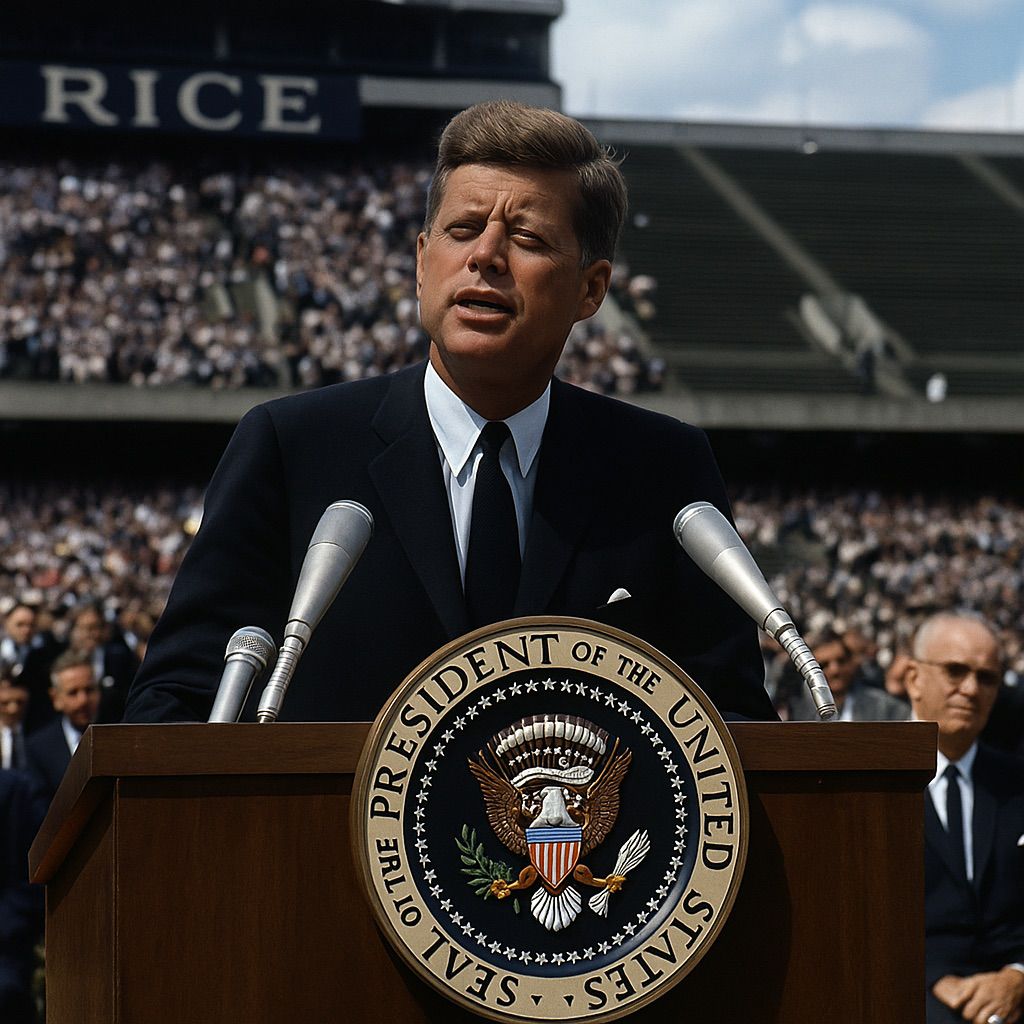
On September 12, 1962, in the sweltering Texas heat, John F. Kennedy stood before a crowd of forty thousand people at Rice University and delivered a speech that would become one of the most defining orations of the twentieth century. The president’s words, carried on the air across the stadium, beyond Houston, and ultimately around the world, did not simply outline a national policy goal. They did not read like a checklist of scientific milestones or budgetary justifications. Instead, Kennedy spoke in a way that lifted hearts, stoked imaginations, and challenged an entire nation to embrace the extraordinary. In a time when America was not only trailing its rival in the Cold War space race but also wrestling with internal anxieties about progress and identity, Kennedy pointed to the heavens and declared that the United States would go to the Moon before the decade was out. It was a bold promise, delivered with unwavering confidence, not because it was safe or easy, but precisely because it was difficult, risky, and uncertain. In doing so, he transformed the space race from a technical competition into a metaphor for human courage, for the restless desire to push past limits, and for the kind of ambition that redefines what a society believes possible. His words would echo not just in the annals of American history, but in the shared consciousness of humanity, forever symbolizing what it means to choose challenge over comfort and vision over fear.
The early 1960s were a period of turbulence and tension. The Cold War was at its height, and the Soviet Union had already made shocking advances in space exploration. In 1957, the launch of Sputnik, the first artificial satellite, had jarred American confidence, creating the uneasy sense that the Soviets were leaping ahead in both science and global prestige. The anxiety only deepened in April of 1961, when Yuri Gagarin orbited the Earth and became the first human in space. The United States, still working to stabilize its early rocketry programs, seemed to be playing catch-up at every turn. For Kennedy, the youthful and energetic leader of a nation that prided itself on innovation and dominance, the optics were unacceptable. America could not afford to appear second best. But rather than retreat into caution, Kennedy seized upon the moment as an opportunity to articulate a broader vision. Space would not merely be a field of rivalry; it would become the proving ground for national ambition, for collective purpose, for the very soul of a people who prided themselves on rising to challenges. And so, on that September afternoon in Houston, his words carried not only the weight of policy but also the weight of destiny.
Kennedy understood the importance of language, and he crafted his Rice University address with the rhythm of a poet and the conviction of a leader who knew that rhetoric could move nations. He did not disguise the magnitude of the task. He described the Moon as a distant and hostile world, its environment unlike anything humanity had ever encountered. He acknowledged the cost — billions of dollars, countless hours, and lives devoted to scientific research and engineering. Yet rather than soften the challenge, he amplified it. He told his audience that the difficulty was precisely why the mission mattered. “We choose to go to the Moon in this decade and do the other things,” he declared, “not because they are easy, but because they are hard.” In that line lies the essence of Kennedy’s genius: the ability to frame hardship not as a deterrent, but as an invitation. Difficulty was not a reason to shrink back, but the very reason to step forward. By stating that difficulty gave purpose, Kennedy elevated the moonshot into something much larger than rockets and astronauts. He made it a metaphor for all human aspiration, for every leap into the unknown that has ever defined progress.
What makes the Rice University speech endure in memory is the way it connected the immediate with the eternal. Kennedy was speaking at a particular historical moment — the height of the Cold War, in the wake of Soviet triumphs, amid political pressure and technological uncertainty. Yet the language he used transcended those specifics. He spoke of exploration as part of the human spirit, of the drive that once led explorers across oceans, that once inspired inventors to transform industries, that once compelled societies to dream beyond the limits of their time. By placing space exploration within this grand lineage, Kennedy turned the space race into something universal, something that belonged not just to Americans, but to humanity itself. The moon became a symbol of the eternal human desire to go farther, to know more, to test ourselves against the boundaries of the possible.
The impact of the speech lay also in its inclusivity. Kennedy made it clear that this was not just NASA’s mission or the astronauts’ mission. It was everyone’s mission. He spoke directly to the American people, telling them that the journey to the Moon was not just a scientific challenge but a collective one, tied to jobs, to education, to innovation, to the belief that the future could and should be brighter than the present. He reminded them that progress was not the work of the few, but the effort of the many. This was crucial in rallying support for a program whose costs would be staggering, both financially and in terms of human labor. Yet Kennedy made those costs seem not like a burden, but like an investment in the very essence of what it meant to be American: daring, ambitious, unwilling to accept defeat.
The moon landing in July of 1969 was, of course, the fulfillment of Kennedy’s promise. When Neil Armstrong stepped off the ladder of the lunar module and uttered his famous words — “That’s one small step for man, one giant leap for mankind” — it was more than a technical triumph. It was the culmination of a vision that had been planted seven years earlier in the hot Texas air, when Kennedy had dared to tell his nation that it would reach for the stars. The Rice speech, then, was not simply a piece of oratory. It was the seed of one of humanity’s greatest achievements. And yet its power goes beyond Apollo. “We choose to go to the Moon” has since become shorthand for every audacious goal, for every time a society dares to attempt what seems impossible. From curing diseases to combating climate change, from technological revolutions to cultural shifts, Kennedy’s words continue to serve as a rallying cry: difficulty is not a reason to stop; it is the reason to begin.
Decades after the speech, its resonance endures because it speaks to something deeper than politics, deeper than technology, deeper than any specific historical moment. It speaks to the very nature of human ambition. Kennedy’s declaration was not only about going to the Moon. It was about the way we, as humans, define ourselves by the challenges we accept. It was about the idea that greatness does not come from choosing the path of least resistance, but from embracing the path of most resistance. In an age where cynicism often overshadows optimism, and where fear of failure can paralyze action, Kennedy’s words are a reminder that the pursuit of the hard, the dangerous, the uncertain is what gives life its meaning. They remind us that the arc of human progress has always been drawn by those willing to try what others deem impossible.
When one listens to the recording of Kennedy’s speech, what stands out is not only the content but the conviction. There is an urgency in his voice, a cadence that builds momentum, a rhythm that pulls the listener along. The speech was not a lecture; it was a call to action, a challenge to the spirit. That is why it remains so powerful even today. It is not simply history. It is a living reminder of what humanity can achieve when it refuses to accept limitations. It is a testament to the fact that courage, vision, and imagination can take us beyond not only our fears but our wildest expectations.
The story of Rice University on September 12, 1962, is not merely the story of a president rallying support for a space program. It is the story of words that became action, of vision that became reality, of a nation that chose to believe in something larger than itself. It is the story of how a speech became a turning point, not just in the Cold War, not just in the history of space exploration, but in the broader narrative of what it means to be human. For in choosing the Moon, Kennedy reminded us that we also choose who we are. We choose whether to accept the comfort of the easy or the challenge of the hard. We choose whether to stand still or to move forward. We choose whether to shrink in the face of the unknown or to rise above it. On that day in Houston, Kennedy’s answer was clear. And it is an answer that still challenges us today.