
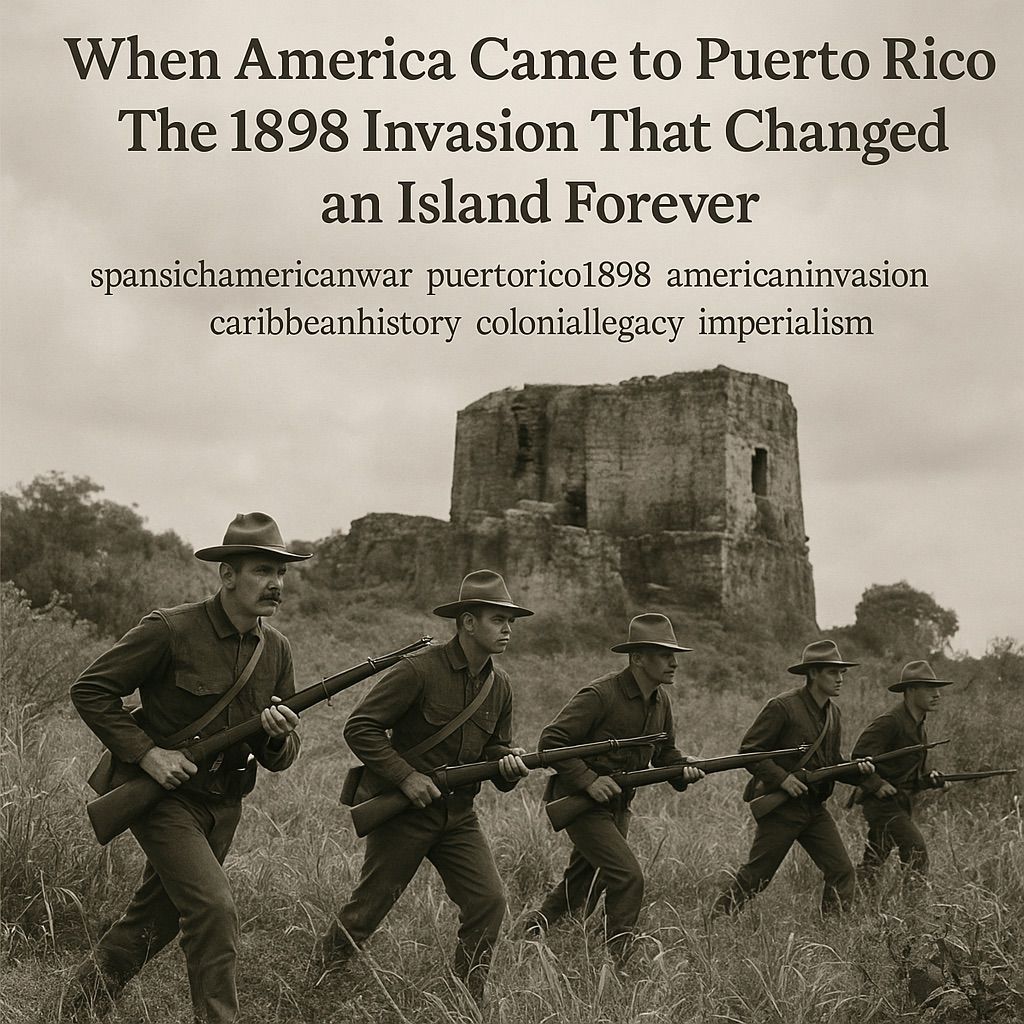
The summer of 1898 was a time of fierce battles, rapid political shifts, and the assertion of American power beyond its mainland borders. On July 25, 1898, the United States launched a decisive invasion of Puerto Rico, a pivotal moment within the larger context of the Spanish–American War that would redefine the destiny of the Caribbean island and signal America’s emerging role as a global imperial power. This essay explores the complex causes, dramatic events, and long-lasting consequences of that invasion, bringing to life the voices of the soldiers, the islanders, and the politicians whose lives intertwined during this transformative chapter in history.
In the late 19th century, Puerto Rico was a Spanish colony caught in the turbulence of empire and revolution. Spain, once a dominant global force, had been steadily losing its grip on its American territories throughout the 1800s. The Cuban War of Independence, which began in 1895, ignited fervent anti-colonial sentiment throughout the Caribbean and intensified tensions between Spain and the United States. The U.S., motivated by a combination of strategic interests, economic ambitions, and a growing sense of Manifest Destiny, had been watching these events closely. The sinking of the USS Maine in Havana Harbor on February 15, 1898, acted as the immediate catalyst, sparking outrage and calls for war against Spain in the U.S. Congress.
The Spanish–American War officially began in April 1898, initially focusing on Cuba, but swiftly expanding its theater of operations to include other Spanish possessions such as Puerto Rico and the Philippines. Puerto Rico was viewed by American strategists as a key military and economic prize—a gateway to the Caribbean and a foothold for further expansion. The island’s location made it a strategic hub for controlling vital shipping lanes and asserting influence over the region. Despite the war’s relatively short duration, lasting only a few months, the invasion of Puerto Rico was a critical and dramatic episode that captured international attention.
The invasion force that arrived on Puerto Rican shores on July 25 was led by General Nelson A. Miles, a veteran soldier with a storied military career. His troops landed near the town of Guánica on the southwestern coast of the island. The American military objective was clear: to quickly secure the island, minimize resistance, and establish U.S. control. What awaited them, however, was a complex landscape of local loyalties, resistance fighters, and a population caught between two empires.
The Puerto Rican defenders, primarily composed of local Spanish troops and militia, were vastly outnumbered and outgunned. The Spanish military presence on the island was relatively small and ill-prepared to withstand a large-scale invasion. Nevertheless, the Puerto Rican population was deeply affected by the conflict, with many caught in the crossfire or forced to choose allegiances in a war not of their own making. Some Puerto Ricans hoped for liberation from Spanish rule and saw the Americans as potential liberators, while others viewed the U.S. forces with suspicion and fear of another colonial master.
The landing at Guánica was swift and met with little immediate resistance. American forces quickly advanced inland, securing key towns such as Ponce and Arecibo within days. The battles that followed were generally brief but sometimes intense, marked by skirmishes and the difficult terrain of Puerto Rico’s mountainous interior. The American military utilized its superior numbers and firepower to outmaneuver Spanish forces, who conducted a series of defensive retreats.
One of the most notable engagements during the invasion was the Battle of Asomante, where American troops encountered determined resistance amid the rugged hills near Ponce. Despite the challenges posed by geography and climate, the U.S. soldiers persevered, gradually consolidating their control over the island. The campaign was marked not only by military action but also by logistical challenges such as supply lines, tropical diseases, and the difficulties of maintaining morale in an unfamiliar environment.
While the military campaign unfolded, the political landscape was rapidly evolving. The Treaty of Paris, signed on December 10, 1898, formally ended the Spanish–American War. Under its terms, Spain ceded Puerto Rico, Guam, and the Philippines to the United States and relinquished its claim to Cuba, which became an independent republic under American influence. For Puerto Rico, the treaty marked a profound turning point—from centuries of Spanish colonial rule to becoming a territory of the United States.
The transition was far from smooth. Puerto Ricans now faced a new colonial reality under American administration. The U.S. established a military government that later gave way to civil rule, but political and cultural tensions remained high. Many Puerto Ricans sought greater self-governance, while American officials imposed policies aimed at assimilating the island into the broader U.S. system. Language, education, and economic reforms became battlegrounds for identity and autonomy. The Foraker Act of 1900, which created a civilian government, stopped short of granting full citizenship or voting rights, sowing seeds of frustration and resistance.
Economically, the American takeover brought both opportunity and disruption. The U.S. invested in Puerto Rico’s infrastructure, expanding roads, ports, and agriculture focused on cash crops like sugar. However, the island’s economy became increasingly dependent on American capital and markets, deepening inequalities and marginalizing local farmers. The island’s social fabric changed as new political parties emerged, voicing a range of views from independence to statehood.
The legacy of the 1898 invasion still resonates in Puerto Rico today. It marked the beginning of a complicated and ongoing relationship between the island and the United States—a relationship characterized by debates over identity, political status, and rights. Puerto Rico remains a U.S. territory, with its residents holding American citizenship but lacking full representation in Congress or the right to vote in presidential elections. The questions raised by the invasion—about sovereignty, colonialism, and self-determination—continue to fuel political discourse.
From a broader perspective, the invasion of Puerto Rico symbolized the United States’ arrival on the world stage as an imperial power. It was part of a wave of territorial acquisitions that extended American influence into Asia and the Caribbean, reshaping global geopolitics. The war itself, often overshadowed by later conflicts, was a significant moment of American expansionism and a harbinger of the 20th century’s global dynamics.
The human stories behind the military maneuvers reveal the complexity of war and empire. Puerto Rican civilians lived through fear, uncertainty, and the upheaval of their daily lives. Some welcomed the Americans as a promise of change, others mourned the loss of Spanish heritage and feared the erosion of their culture. Soldiers on both sides faced the harsh realities of combat in an alien land, bound by duty yet caught in a larger historical tide.
In examining the 1898 invasion of Puerto Rico, we gain insight not only into a military campaign but into the broader themes of power, identity, and colonialism. The event is a reminder that history is not just about dates and battles but about people’s lives shaped by forces beyond their control. It invites reflection on how past actions continue to influence present realities and future possibilities.
Today, Puerto Rico’s rich cultural heritage, vibrant communities, and resilient spirit stand as a testament to its history—marked by conquest but also by resistance and renewal. The island’s journey from Spanish colony to American territory is a story of transformation and enduring complexity, one that continues to inspire and challenge all who seek to understand the tangled legacy of empire and freedom.
July 25, 1898, remains a date etched in the collective memory of Puerto Rico and the United States alike—a day when the tides of history brought new rulers and new challenges, forever altering the course of an island and its people.