
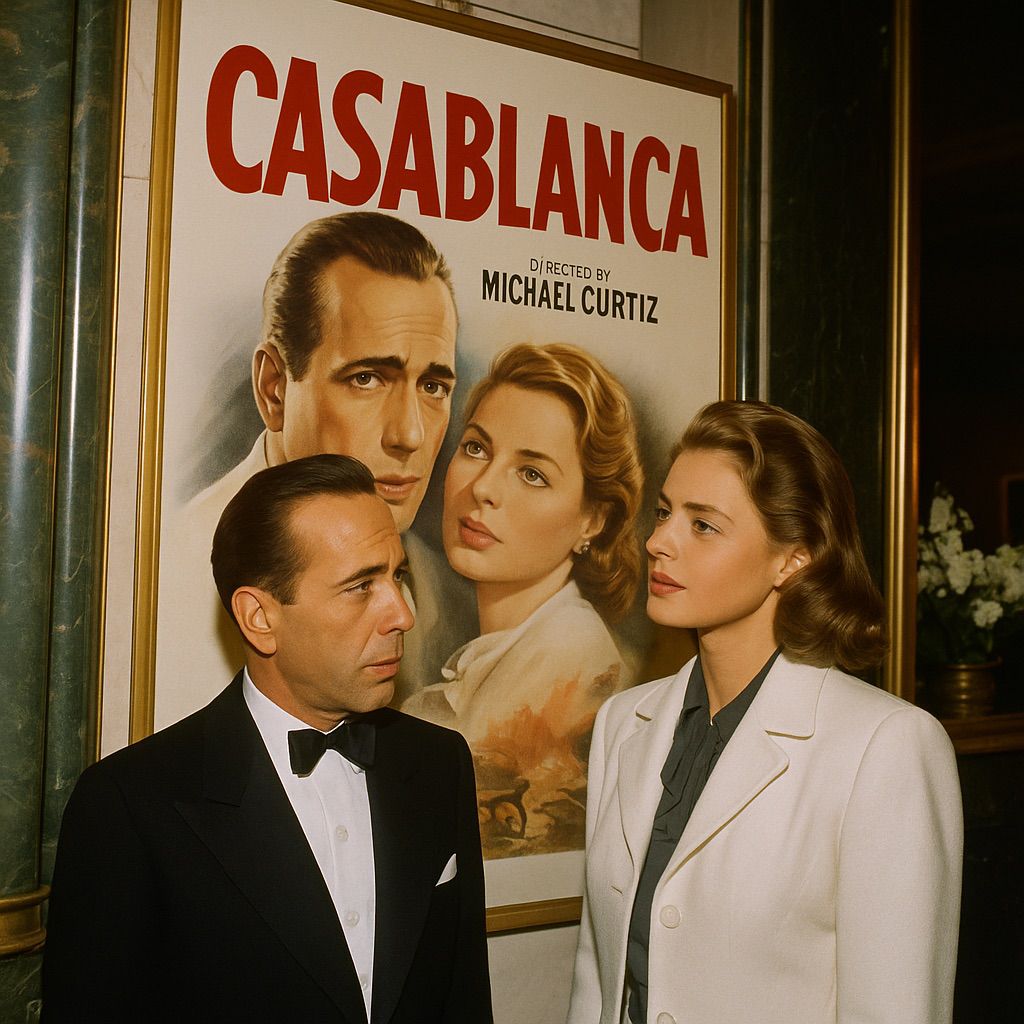
On November 26, 1942, in the middle of a global war that was reshaping the world map, rewriting destinies, and redefining what humanity thought it understood about itself, something quietly remarkable happened in New York City. It didn’t happen on a battlefield or in a strategy room or in the smoke-filled offices of wartime diplomats. It happened in a movie theater—the Hollywood Theatre on Broadway—where the lights dimmed, the projector clicked to life, and a film called Casablanca flickered onto the screen for the first time. No one in the room that night could have known they were witnessing the birth of one of the most iconic films in cinematic history, a film whose lines, characters, and atmosphere would eventually carve themselves so deeply into global culture that even people who have never watched it can quote its dialogue. The premiere of Casablanca was not just an entertainment event—it was an emotional moment wrapped inside a historical turning point, a piece of art arriving at precisely the right time, when the world needed something to hold onto, something that spoke to love, sacrifice, fate, and resilience.
It’s easy today, in an era of giant blockbusters and billion-dollar film franchises, to underestimate how profoundly movies once shaped the emotional landscape of society. During the 1940s, cinema was not just entertainment; it was an escape, a cultural compass, a collective heartbeat. With millions of Americans consumed by wartime uncertainty—sons fighting overseas, families rationing resources, news arriving in painful waves—the movie theater became a place where people could breathe again, even if only for 90 minutes. Casablanca arrived into this world like a kind of elegant thunderstorm, bringing with it all the romantic longing, moral struggle, melancholy, and unexpected hopefulness that people were feeling but could not fully articulate.
Its premiere was strategically timed. Originally planned for early 1943, Warner Bros. moved up the release to align with the Allied invasion of North Africa, a moment when Morocco—a key setting of the film—was suddenly in the headlines. It was a brilliant marketing decision, but it was also more than that. It meant the film would land not as a nostalgic look backward but as a reflection of the present, a mirror held up to a world in which moral choices were no longer academic, love often demanded sacrifice, and the future hung in a fragile balance.
The theater itself buzzed with the kind of pre-show energy unique to the premieres of the era. Men in sharp suits and women in glamorous dresses filled the lobby, the warm glow of chandeliers reflecting off polished marble floors. Cigarette smoke curled in the air. Conversations drifted between gossip about Hollywood stars and whispered speculation about the war overseas. Reporters lingered by the entrance, hoping to capture a quote or glimpse from executives, actors, or anyone with a hint of insider information. The film’s stars—Humphrey Bogart and Ingrid Bergman—were not major red-carpet personalities yet, at least not in the way later Hollywood icons would be. Bergman was still rising, and Bogart, though well known, had not yet ascended to mythic stature. That transformation would come later, in large part because of this very film.
When the house lights dimmed and the first notes of Max Steiner’s haunting score filled the theater, the crowd settled in with a kind of nervous anticipation. They didn’t know what they were about to watch—no one did, not even many of the actors, who had filmed the movie without knowing how the story would end. The magic of Casablanca is that it never announces itself. It unfolds with the confidence of a film that trusts its audience to feel its meaning rather than be told. It begins not with bombast but with mood: a city where refugees drift like ghosts, where danger is constant and invisible, where hopes and dreams become currency. Rick’s Café Américain emerges as a microcosm of the world at war—a place where spies mingle with lovers, where deals are made in shadows, where music softens the edges of fear, and where the past hangs over every character like smoke in the air.
For the audience watching in New York, this world felt both exotic and familiar. They understood wartime dislocation. They understood the ache of separation, the uncertainty of waiting for news, the tension between survival and integrity. And when Humphrey Bogart’s Rick Blaine appeared on the screen—cool, guarded, cynical in a way that looked effortless—they saw not just a character but a reflection of their own unresolved emotions. Rick is a man who used to believe, who used to love, who used to hope, but who now hides behind toughness because it hurts too much to remember anything else. Bogart played him not as a smoldering romantic hero, but as a wounded soul trying—and failing—to outrun his past. That vulnerability resonated deeply in 1942, and it resonates still.
When Ingrid Bergman’s Ilsa Lund enters the café, luminous and conflicted, the emotional center of the film shifts. Her presence is a reminder of everything Rick has tried to bury: passion, idealism, and the pain of unfinished stories. For the audience at the premiere, watching Rick see Ilsa again was not merely cinematic drama—it was a moment that tapped into their own buried memories of people they had loved and lost to time, distance, or war. There is a reason the line “Here’s looking at you, kid” became immortal. It wasn’t just charm; it was a moment of surrender. It was the sound of a man lowering his emotional armor, if only for a heartbeat.
What makes Casablanca so powerful is that its love story isn’t just romantic—it’s philosophical. It’s a reminder that love sometimes demands sacrifice, that doing what is right can be more painful than doing what is easy, and that the greatest acts of heroism often happen in quiet, personal moments rather than on the battlefield. When Rick ultimately chooses principle over passion, helping Ilsa and Laszlo escape so they can continue fighting for a cause bigger than themselves, the audience at the premiere understood the gravity of that choice. They were living in a moment when personal sacrifice was a daily reality, when millions were making decisions shaped not by desire but by duty.
The film’s political message was subtle but unmistakable. Released at a time when America was still adjusting to its role in the war, Casablanca insisted that neutrality—emotional or political—was no longer sustainable. Rick’s evolution from a man who declares, “I stick my neck out for nobody,” to a figure willing to give up everything for the greater good mirrored the broader transformation of a nation that had entered the war reluctantly but now fought with full conviction. Audiences didn’t simply watch the change happen—they felt it, because it was happening in real life.
But beyond the politics, beyond the wartime context, beyond even the beautifully tragic love story, what stunned the premiere audience most was the film’s atmosphere. The smoky café, the intermingling of languages and loyalties, the piano playing “As Time Goes By,” the desperate whispers of people trying to obtain exit visas—it all felt alive, textured, and irresistibly real. Even viewers who had never traveled abroad could feel the weight of longing and danger in every frame. The cinematography, the performances, and the music fused into something that felt both immediate and timeless.
Max Steiner’s score alone could have carried the film into cinematic immortality. His ability to weave emotional themes into the narrative elevated each moment, creating a soundtrack that felt like a heartbeat. And of course, “As Time Goes By,” a song that predates the movie by nearly a decade, became forever linked with Casablanca’s sense of longing, nostalgia, and inevitability.
When the lights came up at the Hollywood Theatre after the premiere screening, something unusual happened. The applause wasn’t the typical polite reaction given to new films. It was warmer, more emotional, more reverent. People lingered, talking softly among themselves long after the credits rolled. Critics took notes in a daze. Reporters pressed forward. There was a sense—not fully formed, but alive—that something extraordinary had just taken place.
The days following the premiere confirmed it. Word spread quickly through New York and across the country. Reviews praised the screenplay, the performances, the direction, and the emotional weight of the film. Audiences returned for repeat viewings. Soldiers on leave saw it and wrote home about it. Couples associated it with the fragility and intensity of wartime romance. The studio, initially uncertain about the film, now recognized they had a sensation on their hands.
But what no one expected—not the studio, not the cast, not the critics, not even the premiere audience—was that Casablanca would become one of the most enduring films in cinematic history. Its lines became quotations. Its characters became archetypes. Its themes became universal emotional landmarks. Decades passed, yet the film never faded. It lived on through generations, through film courses, through cultural references, through late-night broadcasts, through DVD shelves, streaming menus, and curated collections. It is the film that film lovers recommend to non-film lovers. It is the film that writers reference when they want to evoke the beauty of melancholy. It is the film that continues to feel relevant no matter how much the world changes.
Part of its longevity lies in its humanity. Casablanca is not a movie about heroes and villains—it is a movie about people trying to survive morally in a world that doesn’t always reward integrity. It’s about longing, loyalty, loss, resilience, memory, and the bittersweet truth that love does not always lead to happy endings. These are themes that never grow old, because they are part of what it means to be human.
Standing outside the Hollywood Theatre in 1942, as the cold November air swept down Broadway and moviegoers spilled onto the sidewalks buzzing with emotion, no one could have predicted the film’s legacy. They only knew they had experienced something unusual—something that moved them deeply and left them changed in ways they couldn’t quite describe. In that sense, the premiere of Casablanca perfectly reflected the film itself: subtle, profound, emotionally resonant, and destined to matter far more than anyone realized in the moment.
Eighty years later, we can look back at that night and see it for what it truly was: not just a movie premiere, but the beginning of a legend. A night when art transcended its medium, when fiction captured truth, and when a film stepped quietly into the world and never left.