
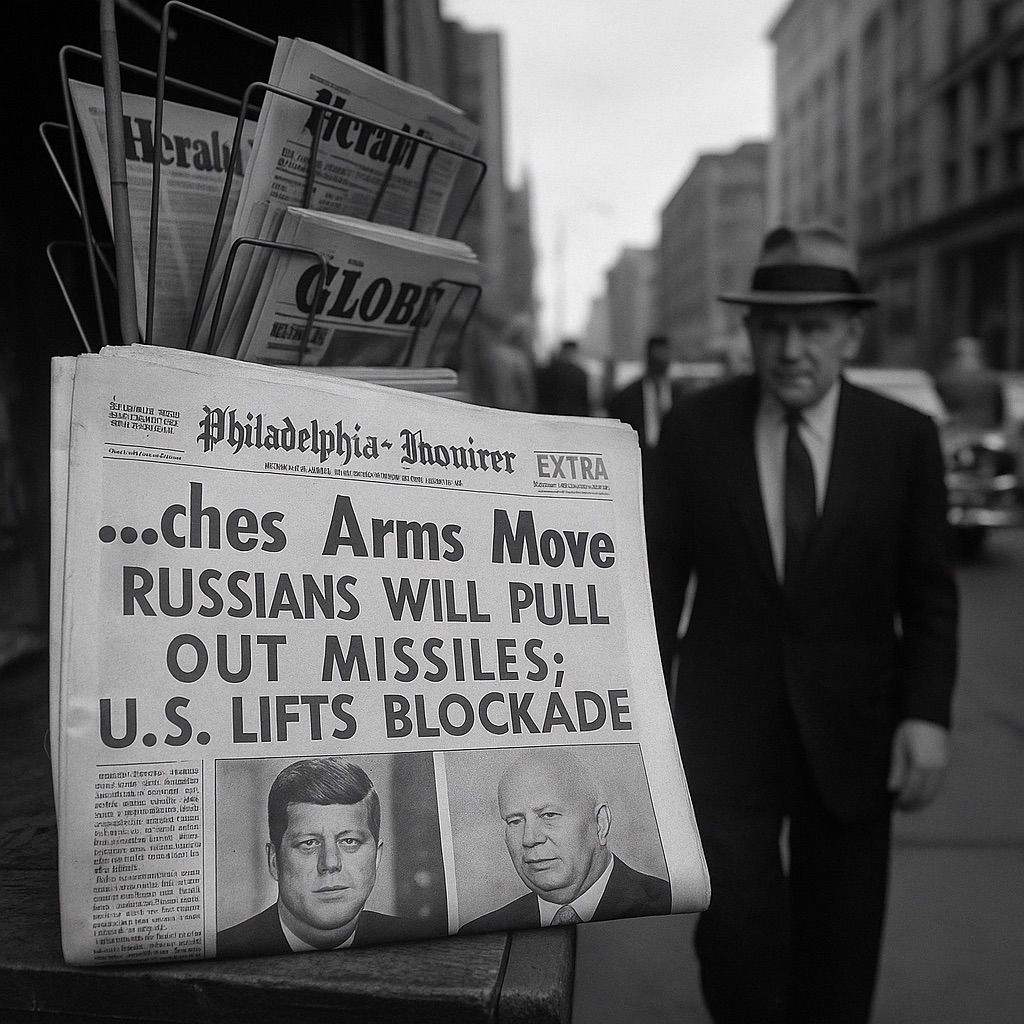
On October 28, 1962, after thirteen days of fear that wrapped around the world like a tightening wire, the Cuban Missile Crisis formally came to an end. It was a quiet ending—no parades, no applause, no triumphant speeches echoing from balconies or podiums. Just a few careful statements, diplomatic signals, and tense, weary exhalations from leaders who had spent nearly two weeks peering into the abyss of nuclear war. For most people alive at the time, the end came not as a shout but as a sigh. The crisis, which had pushed the United States and the Soviet Union to the edge of annihilation, had finally eased. The world had stepped back from the brink.
To understand the relief that swept across nations that day, one must imagine the haunting uncertainty of those thirteen preceding days. The crisis began when American reconnaissance flights revealed Soviet nuclear missiles being installed in Cuba—missiles capable of striking nearly every major American city with only minutes of warning. It was not just the existence of missiles that terrified the world, but their proximity and the suddenness with which they appeared. The U.S. had always feared an attack from afar, an ICBM streaking overhead in a dramatic arc. But missiles just ninety miles off the Florida coast felt like a noose tightening around the neck of an entire nation.
The days that followed were marked by a kind of surreal dread. In Washington, President John F. Kennedy weighed options that ranged from diplomatic pressure to a full-scale invasion of Cuba, each one carrying terrible risks. In Moscow, Premier Nikita Khrushchev wrestled with the realization that his bold gambit to protect Cuba and shift the nuclear balance had instead triggered a confrontation neither side could afford. And in Havana, Fidel Castro braced for an American attack he believed was imminent, preparing his people for a fight he was fully willing to die in.
Across the globe, ordinary people lived with the heavy awareness that their lives depended on men making decisions behind sealed doors. Schools in the United States quietly prepared evacuation procedures that everyone knew wouldn’t matter. Families argued about whether they should flee cities, build shelters, or simply pray. Newspaper headlines screamed of threats and ultimatums. Radio hosts speculated grimly about whether this was how civilization would end—not in decades, but in days.
But then, on that tense October morning, everything changed. The crisis dissolved not with bombs or battles but through a rare act of diplomatic clarity. Messages passed between Washington and Moscow—some formal, others desperate and emotionally raw—had begun carving a path out of conflict. Kennedy agreed to publicly vow not to invade Cuba and to secretly remove U.S. Jupiter missiles from Turkey. Khrushchev agreed to remove the Soviet missiles from Cuba. Castro, though angered by the Soviet negotiations that occurred without him, was forced to accept the terms.
When Khrushchev’s acceptance of the deal was broadcast over Radio Moscow, the world seemed to pause. People stopped in their kitchens, on sidewalks, in offices, listening to the crackling words that meant the threat had receded. Kennedy, informed of the message in the White House, felt the crushing weight of the past thirteen days lift. He did not celebrate; there was no victory to celebrate. But he did allow himself a rare sense of quiet relief. For the first time in nearly two weeks, both superpowers had chosen restraint over destruction.
But even as the crisis formally ended, its emotional and political effects lingered. In the United States, many officials felt uneasy about the secret missile trade, worrying it made the country look weak. In the Soviet Union, Khrushchev endured sharp criticism from hardliners who believed he had retreated too quickly. And in Cuba, Castro raged at being excluded from negotiations that determined the fate of his country’s defense. Peace had been restored, but not without bruises—some internal, some diplomatic, some carved deep within the psyches of the men who had narrowly avoided the worst war in human history.
Still, the world had survived. And in surviving, it learned lessons that would shape decades of policy. The fear sparked by those thirteen days led to the creation of the Moscow-Washington “hotline,” an effort to prevent future misunderstandings from spiraling out of control. It helped accelerate nuclear arms control agreements. It shifted the global balance of power and ushered in a new, complicated phase of Cold War diplomacy. The crisis became a painful reminder that nuclear weapons were not abstract symbols but very real threats capable of wiping out humanity in minutes.
But perhaps the most human part of the crisis’s end lies not in the geopolitical consequences but in the personal reflections of those who lived through it. Kennedy confided privately to advisors that he believed there had been a one-in-three chance of nuclear war. Khrushchev, years later, would say that the crisis convinced him that nuclear weapons must never be used under any circumstances. American families, who had spent nights gathered around their televisions in fear, allowed themselves to breathe again, to turn their thoughts back to everyday life. Soldiers stationed in Florida or Guantánamo Bay, who had spent days in combat readiness, wrote letters home explaining that they were safe after all. Across the Atlantic, Europeans—who lived closer to the nuclear frontlines than anyone—looked out over their cities and felt, for the first time in days, that the sky above them no longer carried an unspoken threat.
As the decades passed, the Cuban Missile Crisis came to represent a moment when the world truly understood the fragility of civilization. Politicians spoke about it, students studied it, military strategists pored over it, and survivors recounted the way it had reshaped their understanding of life, leadership, and peril. The crisis became an anchor point for discussions about risk, diplomacy, and global peace. Its resolution was hailed not as a triumph of power but as a triumph of restraint.
What makes the formal end of the crisis so remarkable—so hauntingly unique in the tapestry of twentieth-century events—is that it marked a moment when humanity collectively glimpsed its own extinction and consciously stepped back. This wasn’t a victory won through force. It wasn’t an inevitable result of historical momentum. It was a choice made by fallible leaders who, in their own ways, realized they could not allow pride or ideology to condemn millions to death.
When the last Soviet missile was removed from Cuba, and when the United States quietly dismantled its missiles in Turkey months later, the crisis fully resolved. But the emotional resolution—the deep breath humanity took—happened on October 28. That was the day parents hugged their children more tightly. The day soldiers loosened their grips on their rifles. The day the White House and the Kremlin allowed themselves to imagine a tomorrow. It was the day the world stepped off the edge of a cliff it had been staring at for thirteen days.
Even now, more than sixty years later, the end of the Cuban Missile Crisis stands as one of the most important moments in modern history. It is a reminder that even in times of great tension, dialogue can prevail over devastation. That caution can triumph over belligerence. That humans—flawed as we are—are sometimes capable of pulling back from disaster at the very last second.
The world breathed again on October 28, 1962. The breath was shaky, uncertain, and exhausted—but it was life. And life, especially after nearly being lost, is always worth remembering.