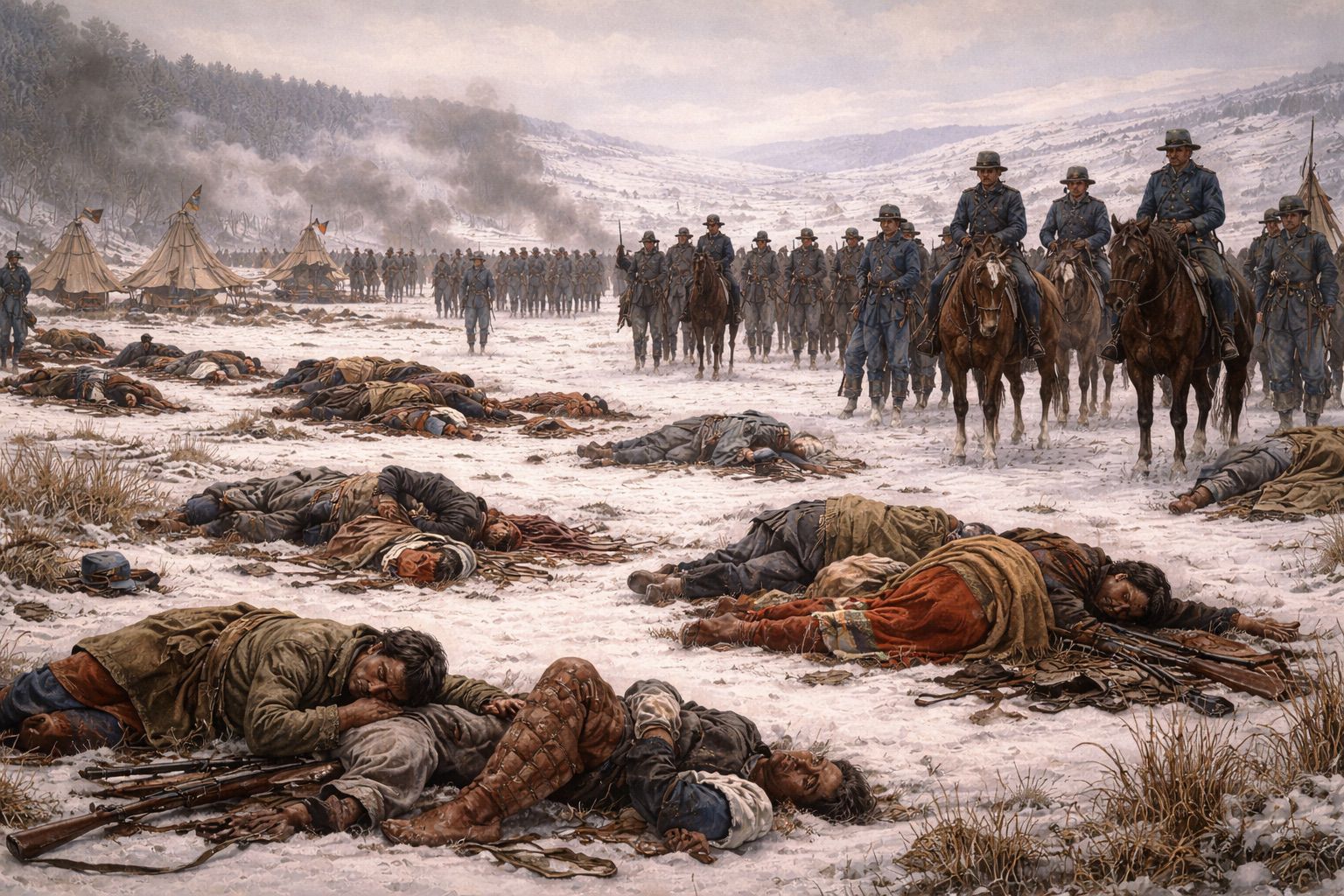
The Wounded Knee Massacre is one of the most infamous events in American history, a brutal and devastating confrontation between the US Army’s 7th Cavalry Regiment and a band of Lakota Sioux that resulted in the slaughter of over 150 unarmed men, women, and children. Taking place on December 29, 1890, at Wounded Knee Creek in South Dakota, this event marked the final major confrontation between the US military and the Native American tribes of the Great Plains.
The years leading up to the massacre were marked by a growing sense of desperation among the Lakota Sioux. The discovery of gold in the Black Hills had led to a surge in white settlement, and the government’s refusal to recognize Native American land rights had forced many families to leave their ancestral homes. President Ulysses S. Grant’s signing of the Fort Laramie Treaty in 1868, which granted the Great Sioux Reservation to the Lakota, was later revoked by Congress without consultation or compensation, leading to widespread anger and resentment among the Native American population.
The Ghost Dance movement, a spiritual revival led by the Paiute prophet Wovoka, had also spread rapidly across the Plains, offering hope to desperate tribes of a return to their ancestral lands and a chance to live free from white domination. The US government viewed this movement with suspicion, fearing it could lead to widespread resistance against its authority. As tensions mounted, federal authorities took steps to quell the rising unrest, including deploying troops to the area.
On December 15, 1890, Sitting Bull, the legendary Hunkpapa Lakota chief and spiritual leader, was killed in a confrontation with Indian Agency police on his reservation near Grand River, North Dakota. This event sparked widespread panic among the Native American population, leading many families to flee their homes in search of safety. A band of approximately 350 Lakota Sioux, led by Chief Big Foot, attempted to make its way to the Pine Ridge Reservation in South Dakota, where they hoped to find refuge.
However, as they approached Wounded Knee Creek on December 29, 1890, they were intercepted by a unit of the US Army’s 7th Cavalry Regiment under the command of Major Samuel M. Whitside. The troopers had been tracking Big Foot’s band for several days and were determined to bring them in for questioning. As tensions mounted, a scuffle broke out between a soldier and one of Big Foot’s warriors, resulting in the accidental shooting of an elderly woman, Crow Dog.
The situation rapidly spiralled out of control as panicked soldiers opened fire on the Lakota Sioux, who were largely unarmed and attempting to flee. The subsequent slaughter was brutal and unrelenting, with reports suggesting that some soldiers even shot fleeing women and children. Over 150 Native Americans perished in the massacre, while only one US soldier died.
The Wounded Knee Massacre marked a dark chapter in American history, symbolizing the brutal suppression of Native American resistance to white encroachment. The event led to a re-evaluation of the government’s treatment of its indigenous population and sparked calls for greater understanding and reconciliation between the two cultures. However, the legacy of Wounded Knee continues to haunt America today, serving as a painful reminder of the ongoing struggle for justice and equality faced by Native American communities.
As news of the massacre spread, outrage erupted across the country, with many questioning the actions of the US military. Congress established an investigation into the event, which concluded that the soldiers had acted in self-defense, but also acknowledged widespread mistakes in judgment and execution. The official report downplayed the severity of the incident, stating only 29 casualties among the Lakota Sioux.
However, estimates of the death toll varied widely, with some accounts suggesting as many as 300 Native Americans perished in the massacre. In reality, the true number lies somewhere between these extremes, but is likely to be closer to the higher estimate given the brutality and scope of the incident.
The Wounded Knee Massacre also had significant long-term consequences for the Lakota Sioux people. The event marked a turning point in their struggle against white encroachment, leading to widespread despair and disillusionment among Native American communities. Many families were forced to flee their ancestral lands once again, while others were confined to reservations where they struggled to survive.
The massacre also served as a catalyst for greater activism among Native American leaders, who began to organize resistance movements in response to the event. In 1973, a group of AIM (American Indian Movement) activists took over Wounded Knee village, occupying it for 71 days and sparking a renewed wave of protests against government policy.
Today, the legacy of Wounded Knee continues to be felt across America. Efforts have been made to recognize the tragedy as a national monument, with many pushing for greater understanding and reconciliation between Native American communities and the wider population.
The struggle for justice and equality faced by Native Americans remains an ongoing challenge, but one that is slowly gaining recognition and momentum. As the US government continues to grapple with its troubled past, it’s clear that the Wounded Knee Massacre will remain a painful reminder of the brutal suppression of indigenous cultures and the need for greater understanding and respect between all communities.
Wounded Knee 1890, Native American rights movement, Indigenous people’s struggles, American Indian Movement, US government accountability, historical injustice #WoundedKneeMassacre #NativeAmericanRights #IndigenousPeoplesStruggles #AIMMovement #USGovernmentAccountability #HistoricalInjustice
The Wounded Knee Massacre was a culmination of decades of violence and dispossession inflicted upon the Native American population by the United States government. The discovery of gold in the Black Hills had set off a chain reaction of events that would ultimately lead to one of the most infamous massacres in American history.
In the 1850s, the US government began to exert pressure on the Lakota Sioux to cede their land, promising them protection and compensation in return. However, these promises were repeatedly broken, and the Native Americans were left with nothing but shattered dreams and broken treaties. The Fort Laramie Treaty of 1868, which granted the Great Sioux Reservation to the Lakota, was a brief respite from the violence, but it ultimately proved to be a hollow promise.
The treaty was signed by President Ulysses S. Grant in 1868, but Congress soon began to revoke its provisions, allowing for the construction of roads and railroads across Native American lands without their consent. The government’s actions were facilitated by the discovery of gold in the Black Hills, which led to a surge in white settlement and further displacement of the Lakota Sioux.
As the years went by, tensions between the US military and the Native American tribes continued to escalate. The Ghost Dance movement, a spiritual revival led by the Paiute prophet Wovoka, offered hope to desperate tribes of a return to their ancestral lands and a chance to live free from white domination. However, the US government viewed this movement with suspicion, fearing it could lead to widespread resistance against its authority.
The killing of Sitting Bull on December 15, 1890, was a devastating blow to the Lakota Sioux. A legendary Hunkpapa chief and spiritual leader, Sitting Bull had been a thorn in the side of the US government for years, refusing to surrender his people’s land or accept the reservation system. His death sparked widespread panic among Native American communities, leading many families to flee their homes in search of safety.
A band of approximately 350 Lakota Sioux, led by Chief Big Foot, attempted to make its way to the Pine Ridge Reservation in South Dakota, where they hoped to find refuge. However, as they approached Wounded Knee Creek on December 29, 1890, they were intercepted by a unit of the US Army’s 7th Cavalry Regiment under the command of Major Samuel M. Whitside.
The troopers had been tracking Big Foot’s band for several days and were determined to bring them in for questioning. As tensions mounted, a scuffle broke out between a soldier and one of Big Foot’s warriors, resulting in the accidental shooting of an elderly woman, Crow Dog. The situation rapidly spiralled out of control as panicked soldiers opened fire on the Lakota Sioux, who were largely unarmed and attempting to flee.
The subsequent slaughter was brutal and unrelenting, with reports suggesting that some soldiers even shot fleeing women and children. Over 150 Native Americans perished in the massacre, while only one US soldier died. The event marked a dark chapter in American history, symbolizing the brutal suppression of Native American resistance to white encroachment.
In the aftermath of the massacre, outrage erupted across the country, with many questioning the actions of the US military. Congress established an investigation into the event, which concluded that the soldiers had acted in self-defense, but also acknowledged widespread mistakes in judgment and execution. The official report downplayed the severity of the incident, stating only 29 casualties among the Lakota Sioux.
However, estimates of the death toll varied widely, with some accounts suggesting as many as 300 Native Americans perished in the massacre. In reality, the true number lies somewhere between these extremes, but is likely to be closer to the higher estimate given the brutality and scope of the incident.
The Wounded Knee Massacre had significant long-term consequences for the Lakota Sioux people. The event marked a turning point in their struggle against white encroachment, leading to widespread despair and disillusionment among Native American communities. Many families were forced to flee their ancestral lands once again, while others were confined to reservations where they struggled to survive.
The massacre also served as a catalyst for greater activism among Native American leaders, who began to organize resistance movements in response to the event. In 1973, a group of AIM (American Indian Movement) activists took over Wounded Knee village, occupying it for 71 days and sparking a renewed wave of protests against government policy.
Today, the legacy of Wounded Knee continues to be felt across America. Efforts have been made to recognize the tragedy as a national monument, with many pushing for greater understanding and reconciliation between Native American communities and the wider population.
However, the struggle for justice and equality faced by Native Americans remains an ongoing challenge. The US government has continued to grapple with its troubled past, but progress has been slow. In 1990, Congress passed the Native American Graves Protection and Repatriation Act (NAGPRA), which required federal agencies to return ancestral human remains and cultural artifacts to their respective tribes.
In 2017, President Donald Trump signed an executive order aimed at expanding oil drilling on Native American reservations, sparking widespread outrage among tribal leaders. The order was seen as a betrayal of the trust relationship between the US government and Native American communities, and it sparked renewed calls for greater accountability and transparency in federal policy-making.
The Wounded Knee Massacre will forever be remembered as a symbol of the brutal suppression of indigenous cultures and the need for greater understanding and respect between all communities. As we continue to grapple with our troubled past, it is essential that we acknowledge the injustices committed against Native American populations and work towards a more just and equitable future.
In recent years, there has been a growing movement among Native American communities to reclaim their histories and cultures. Efforts have been made to preserve traditional languages and cultural practices, while also promoting greater understanding and awareness of Native American experiences through education and media initiatives.
However, much work remains to be done. The struggle for justice and equality faced by Native Americans is complex and multifaceted, requiring sustained efforts from government agencies, tribal leaders, and the wider community. It will take time, patience, and a commitment to understanding and respect for the long-term healing of the wounds inflicted upon Native American communities.
As we reflect on the legacy of Wounded Knee, it is essential that we remember the bravery and resilience of the Lakota Sioux people who suffered so greatly at the hands of the US military. We must also acknowledge the ongoing struggles faced by Native American communities today, from poverty and poor living conditions to inadequate access to healthcare and education.
Ultimately, the story of Wounded Knee serves as a powerful reminder of the importance of understanding and respect between cultures. As we move forward towards a more just and equitable future, it is essential that we honor the memories of those who suffered at Wounded Knee by working towards greater reconciliation and healing between Native American communities and the wider population.
The US government’s treatment of its indigenous populations has left deep scars on the collective psyche of Native America. However, with continued efforts towards greater understanding and respect, there is hope for a brighter future where Native Americans can live in dignity and equality with their fellow citizens.
In 2019, the US House of Representatives passed the Wounded Knee Massacre Commemoration Act, which recognized the tragedy as a national monument and encouraged greater awareness and education about the event. The bill also provided funding for the preservation of tribal lands and cultural resources, marking an important step towards reconciliation and healing.
However, much work remains to be done. The struggle for justice and equality faced by Native Americans is ongoing, requiring sustained efforts from government agencies, tribal leaders, and the wider community. As we continue to grapple with our troubled past, it is essential that we acknowledge the injustices committed against Native American populations and work towards a more just and equitable future.
In conclusion, the Wounded Knee Massacre was a brutal and devastating event that left deep scars on the collective psyche of Native America. However, it also serves as a powerful reminder of the importance of understanding and respect between cultures. As we move forward towards a more just and equitable future, it is essential that we honor the memories of those who suffered at Wounded Knee by working towards greater reconciliation and healing between Native American communities and the wider population.
The legacy of Wounded Knee continues to haunt America today, serving as a painful reminder of the ongoing struggle for justice and equality faced by Native American communities. However, with continued efforts towards greater understanding and respect, there is hope for a brighter future where Native Americans can live in dignity and equality with their fellow citizens.