📥 Click here to download the full text (PDF)
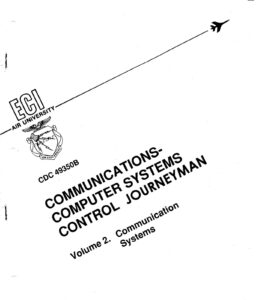
The 3C251 Career Development Course (CDC) Volume 2: Communications Systems was one of the cornerstone texts for Airmen training in the field of communications during their time in the United States Air Force. Every career field had its technical manuals, but for those of us who worked in the world of circuits, switches, and global networks, this volume was the roadmap. It provided a foundation that transformed raw recruits into skilled technicians, bridging the gap between theory in the classroom and the demands of real-world operations.
What made this course unique was its balance of detail and accessibility. On one hand, it introduced Airmen to highly technical concepts—everything from transmission paths and multiplexing to signal flow and system security. On the other, it broke these concepts down into lessons that could be absorbed even by someone encountering them for the first time. The structure of the CDC ensured that as you progressed through the chapters, you weren’t just memorizing acronyms and diagrams—you were building a mental model of how Air Force communication systems fit into the larger mission.
For many, the study of CDC Volume 2 wasn’t just about passing tests. It was about proving ourselves capable of mastering the technology that connected bases across the Pacific, the United States, and the globe. The Air Force couldn’t function without reliable communication systems, and that meant every line we studied, every diagram we memorized, had a direct impact on the mission. There was pride in being the invisible backbone of operations—the ones who ensured the right message got through at the right time, whether it was a routine report or a command at a critical moment.
I remember carrying this volume with me everywhere, its cover becoming scuffed from use, its pages filled with notes and highlights. It wasn’t unusual to see Airmen huddled in dorm lounges late at night, quizzing each other on multiplexing schemes, DSN protocols, or troubleshooting steps. There was a shared camaraderie in tackling the dense material together, knowing that our success in the field depended on mastering these lessons. For many of us, it was the first true test of our technical aptitude after basic training.
Beyond the academics, the CDC symbolized something larger. It was a reminder that while jets, tanks, and satellites captured headlines, none of them could function effectively without the quiet strength of communications. We weren’t always the most visible career field, but we were essential. This volume, dry and technical though it may have seemed at first glance, held within it the knowledge that kept the Air Force connected, efficient, and effective. In that sense, it wasn’t just a study guide—it was a piece of Air Force history, one that trained generation after generation of Airmen who carried forward the responsibility of maintaining the lines of communication.
Looking back, I realize that CDC Volume 2 didn’t just teach systems and circuits—it shaped the way I approached problem-solving. It taught me to break down complex challenges into manageable parts, to respect the importance of precision, and to never underestimate the value of reliability. These lessons stretched far beyond the classroom and the base. They became habits of mind that carried into deployments, civilian careers, and even everyday life.