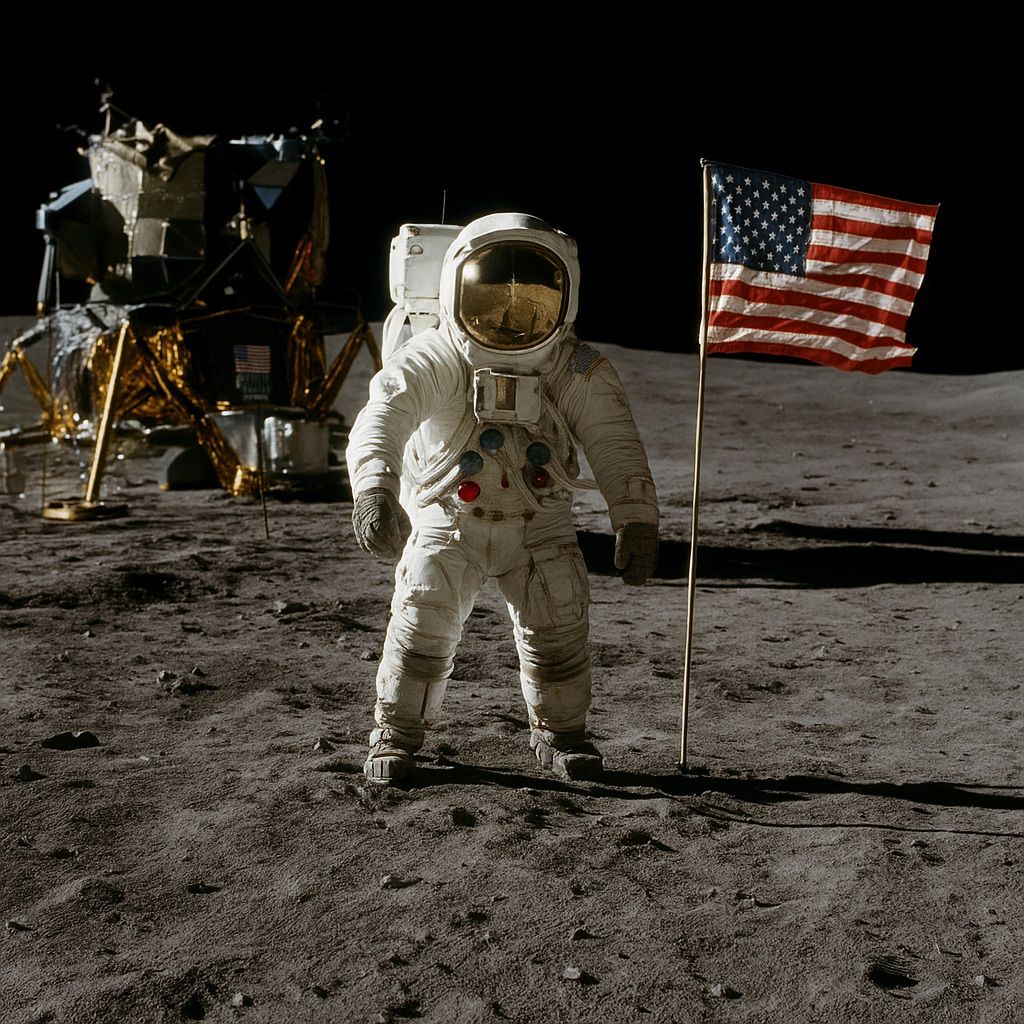
The world held its breath on July 20, 1969. In living rooms across the globe, people huddled around black-and-white television sets, tuning in to a moment that would transcend borders, ideologies, and languages. The grainy images beamed from the Sea of Tranquility on the Moon were not just scientific or technological milestones—they were deeply human. When Neil Armstrong took that first step and spoke the immortal words, “That’s one small step for man, one giant leap for mankind,” it felt like all of humanity had taken that step with him. The Apollo 11 moon landing wasn’t just an American triumph—it was a planetary awakening, the climax of centuries of curiosity, ambition, and imagination.
At the height of the Cold War, space exploration had become a symbolic battlefield. The Soviet Union had stunned the world in 1957 by launching Sputnik, the first artificial satellite, and again in 1961 with Yuri Gagarin’s orbital flight. The United States, determined to catch up and surpass, galvanized its resources in response. In 1961, President John F. Kennedy boldly challenged America to land a man on the Moon and return him safely to Earth before the end of the decade. At the time, it seemed almost impossible. The U.S. had just begun launching astronauts into space, and the Moon was a quarter of a million miles away. Yet, within eight short years, an incredible collaboration of scientists, engineers, and astronauts achieved exactly that.
Apollo 11 was the culmination of Project Apollo, NASA’s ambitious lunar program. The spacecraft consisted of three modules: the Command Module Columbia, where astronauts Neil Armstrong, Edwin “Buzz” Aldrin, and Michael Collins would spend most of their journey; the Service Module, which housed propulsion and life-support systems; and the Lunar Module Eagle, which would carry two of the men to the Moon’s surface. On July 16, 1969, Apollo 11 lifted off from Kennedy Space Center atop the Saturn V rocket, the most powerful machine ever built at the time. As the rocket roared skyward, it carried with it not just three men, but the hopes and dreams of generations.
Four days later, after navigating the cold void of space, Armstrong and Aldrin boarded Eagle and began their descent to the Moon. Collins remained in orbit aboard Columbia, performing critical systems checks and preparing for their return. The descent was anything but smooth. Alarms blared inside the Lunar Module—computer errors due to data overload. Armstrong, calm and composed, took manual control to steer Eagle away from a boulder-strewn area, touching down with only seconds of fuel remaining. “Houston, Tranquility Base here. The Eagle has landed,” Armstrong radioed. Applause erupted at Mission Control in Houston. On Earth, it was as though time had stopped.
Nearly seven hours later, Armstrong emerged from the Lunar Module, descending the ladder in deliberate steps. As he stepped onto the surface, his boot pressed into the fine lunar dust, leaving an imprint that would last millennia. “That’s one small step for man, one giant leap for mankind,” he declared—a phrase etched forever into the collective memory of humanity. Aldrin followed soon after, describing the view as “magnificent desolation.” Together, they planted the American flag, deployed scientific instruments, and collected lunar samples, all while moving with the awkward grace of low gravity.
For 21 hours and 36 minutes, Armstrong and Aldrin explored the Moon, while Collins circled above in solitary silence, the loneliest man in the universe. Though unseen, his role was crucial—he ensured that Columbia was ready to bring them all home. On July 21, Eagle lifted off from the lunar surface, docked with Columbia, and the crew began their journey back to Earth. On July 24, 1969, they splashed down in the Pacific Ocean, greeted by recovery teams and a jubilant world.
But what did it all mean? In the immediate aftermath, the Apollo 11 mission was hailed as a triumph of American ingenuity and perseverance. Yet its impact went far beyond national pride or geopolitical victory. It sparked a philosophical and existential shift. Seeing Earth from the Moon as a fragile blue marble floating in the vastness of space prompted a new awareness of our planet’s fragility and unity. Environmentalism gained momentum. So did the recognition that despite our differences, we are one species, sharing a single home.
The Apollo 11 mission also ushered in a new era of science and technology. The innovations developed for space travel trickled down into everyday life—advancements in computing, telecommunications, materials science, and medical technology. The integrated circuit, for instance, was propelled forward by the demands of the space race and laid the groundwork for modern computers. The mission became a catalyst for STEM education, inspiring countless young people to pursue careers in science and engineering.
Yet, as with all great achievements, Apollo 11 also carried contradictions and critiques. Some questioned the staggering costs—over $25 billion in 1960s dollars—arguing that the money could have been better spent on poverty, education, or civil rights. Others lamented the rapid decline in public interest that followed. After the initial flurry of moon landings, enthusiasm waned. By 1972, the Apollo program was shut down. No human has walked on the Moon since.
Still, the legacy endures. Armstrong, Aldrin, and Collins became global icons, though each bore the weight of fame differently. Armstrong, famously private, shied away from the limelight. Aldrin struggled with depression and alcoholism but later became a vocal advocate for Mars exploration. Collins, the quiet pilot who never set foot on the Moon, wrote eloquently about the loneliness and majesty of space. They were not superheroes, but ordinary men doing extraordinary things, which made their feat all the more inspiring.
In the decades since Apollo 11, our understanding of space has continued to grow. Robotic missions have explored distant planets, telescopes have peered into the origins of the universe, and the International Space Station has become a model of global cooperation. Yet the Moon remains the most tangible symbol of humanity’s reach beyond Earth. In recent years, there has been renewed interest in returning. NASA’s Artemis program aims to land the first woman and next man on the Moon. Private companies like SpaceX are developing technologies to make space travel more accessible. The dream of Mars looms on the horizon.
But perhaps the most enduring impact of Apollo 11 is emotional and symbolic. It represents what we can achieve when we dream big, when we invest in knowledge, when we work together toward a common goal. It reminds us that exploration is a fundamental part of who we are. Long before rockets, humans looked up at the Moon with wonder. Poets wrote about it, sailors navigated by it, lovers gazed at it. On July 20, 1969, we didn’t just look—we went. And in doing so, we redefined what was possible.
The moment Armstrong stepped onto the Moon, it became not just a celestial body, but a place where humans had stood, worked, and returned. It became part of our story, our mythos. That dusty footprint said: we are capable of greatness. In an age marked by division and uncertainty, the Apollo 11 mission remains a beacon. It shows that even when challenges seem insurmountable, even when odds are long, we can still reach for the stars—and sometimes, we get there.
That July night in 1969, as the world watched in awe, there was a rare sense of unity. Strangers on the street smiled at one another. Children imagined themselves as astronauts. Scientists cried. Political leaders paused. It was one of those moments when history doesn’t just unfold—it soars. And though decades have passed, the echoes of that leap still resonate. They remind us not only of where we’ve been, but of how far we still might go.
As we look toward future missions—back to the Moon, on to Mars, and perhaps beyond—it is worth remembering that Apollo 11 wasn’t just about conquering space. It was about discovering ourselves. It was about proving that with courage, vision, and persistence, we can transcend limitations. The Moon landing wasn’t the end of the journey—it was the beginning of a new chapter in the human story. And what a magnificent chapter it was.