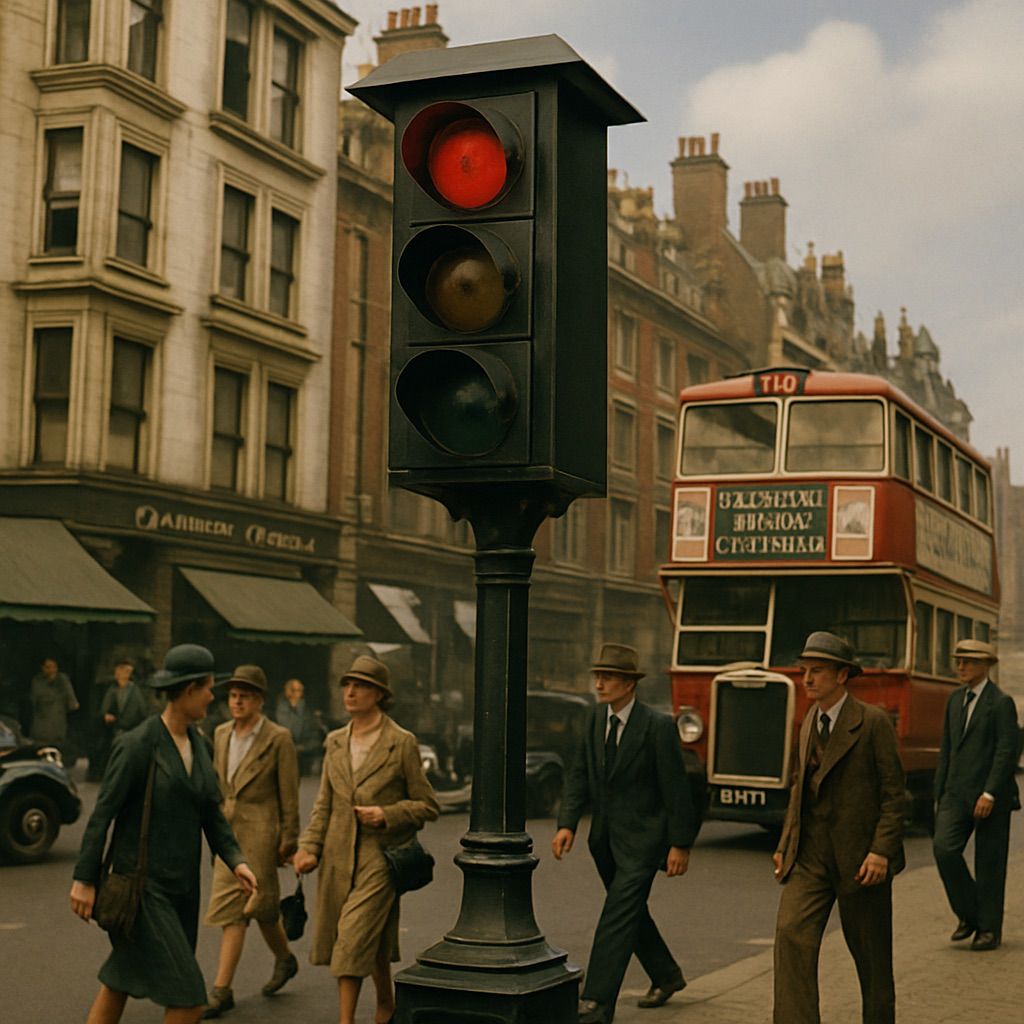
The history of a city is often told through its architecture, wars, and politics—but sometimes, its most transformative moments appear in the smallest of innovations. On August 3, 1926, the bustling streets of London bore witness to a curious sight that would go on to change the rhythm of modern life: the installation of Britain’s first electric traffic lights. What might seem like a routine civic improvement was, in truth, a powerful milestone in the evolution of urban infrastructure—one that fundamentally redefined how people moved, interacted, and envisioned the future of their cities. The flicker of colored bulbs on a metal pole signaled far more than just “stop” or “go.” It symbolized order in chaos, safety amidst uncertainty, and a quiet leap into the mechanized age of modern urbanity.
Before the advent of traffic lights, city streets were loud, lawless arteries of transportation chaos. Horse-drawn carriages, bicycles, early motorcars, and pedestrians all jostled for the right of way. There were no clear rules, and accidents were frequent. London, one of the busiest cities in the world at the time, was plagued with collisions and congestion, particularly at major intersections like Piccadilly Circus or Parliament Square. Policemen stationed on pedestals did their best to direct traffic, often using elaborate hand signals that varied from one intersection to another. It was an exhausting, inefficient, and dangerous system—made worse by the growing popularity of the automobile.
The motorcar had become a symbol of modern progress and personal freedom, but it brought with it a new set of challenges. The streets, once designed for pedestrians and carriages, were suddenly choked with speeding metal machines. Something had to be done. While the United States had already experimented with electric signals—the first of which were installed in Cleveland, Ohio in 1914—Britain was hesitant. There were fears about reliability, power failures, and how the public might react to taking orders from a machine instead of a policeman. But eventually, practicality triumphed over skepticism.
The pivotal moment came on that summer day in 1926, when London’s first electric traffic signal was installed at the intersection of Piccadilly and St James’s Street. The signal, mounted on a tall black post with a pair of colored lights—red for stop, green for go—and an amber warning, stood like a lighthouse of logic amid the swirling tides of urban confusion. A small control box operated the lights manually at first, and a police officer was still present to supervise the system and reassure skeptical citizens. But there it was: a quiet, blinking revolution.
The public’s response was a mix of fascination and bewilderment. Children gawked at the strange device, and newspaper headlines hailed the dawn of a “New Age in Traffic Control.” Motorists—some of them unsure whether to obey the new lights or wait for a policeman’s whistle—gradually adapted. Pedestrians were slower to trust the lights, often hesitating in the street until coaxed by officers. Yet within days, the system proved its worth. Traffic flowed more smoothly. Accidents at the intersection dropped. And most importantly, people began to feel a new sense of predictability and safety.
What the installation represented went beyond mere traffic management. It was a symbol of a changing society—one that was beginning to prioritize efficiency, automation, and forward-thinking urban planning. The traffic light was not just a tool for controlling cars; it was a signal that cities were evolving into systems, machines in themselves, governed by rules, signals, and structures designed to harmonize the movement of millions. It marked a shift in the relationship between people and their cities—from chaos to coordination.
The success of London’s electric signals sparked rapid adoption across the city. Soon, other intersections received their own lights, and a standardized system of red, yellow, and green became the norm. Over time, the controls were automated, then computerized, allowing for dynamic changes based on traffic flow. The transformation of London’s traffic infrastructure reflected broader shifts occurring globally in the 20th century. As cities swelled with cars, buses, and bikes, the humble traffic light became a universal symbol—instantly recognizable in every country and culture.
But beyond its functionality, the electric traffic light also had a psychological impact. It introduced the concept of shared responsibility in public space. No longer was movement dictated by dominance or aggression; it was coordinated through mutual agreement. Red meant everyone stopped. Green meant everyone could go. The simplicity of this system bred a kind of civic order, a shared language of movement that transcended class, language, and identity.
The traffic light also opened the door to broader urban innovations. Once cities could control vehicle flow at intersections, they began reimagining public transit, pedestrian pathways, and even the very design of streets. Crosswalks, bike lanes, roundabouts, and zoning regulations all emerged as part of a larger vision of organized, human-centered cities. In this way, the electric signal served as the catalyst for a century of planning innovations that sought to balance mobility, safety, and accessibility.
Of course, the history of traffic lights isn’t without irony or complexity. While they brought order to the streets, they also signaled the growing dominance of the automobile—a mode of transport that would later be linked to air pollution, suburban sprawl, and climate change. In many cities, pedestrians were gradually sidelined in favor of cars. Urban design began to prioritize vehicles, often at the expense of human interaction and community life. And yet, even within this critique, the role of the traffic signal remains crucial. It didn’t cause these shifts; it simply mediated them, attempting to manage a rapidly changing world.
In more recent years, traffic signals have themselves evolved to reflect the changing values of society. Smart traffic systems now use sensors and artificial intelligence to optimize flow and reduce emissions. Pedestrian signals have become more inclusive, featuring audible cues for the visually impaired and extended crossing times for seniors. Some cities are even experimenting with “shared spaces” where traffic lights are removed entirely—encouraging eye contact and negotiation between drivers and pedestrians. Yet even in these places, the legacy of that first electric signal in London is deeply felt. It laid the groundwork for all the innovation that followed.
There’s something poetic about the way a machine designed to direct vehicles has become such a fixture in our visual and emotional landscape. We associate the red light with patience, the green light with permission, the amber with caution. These colors have become metaphors, shorthand for choices and consequences. Artists, poets, and filmmakers have used traffic lights as symbols of transition, decision, and fate. Children learn their meanings before they learn to read. Travelers see them and feel instantly oriented, no matter how far from home they may be. Few inventions have so seamlessly blended into our lives while maintaining such clear purpose.
Human stories surround every light. A young couple holding hands, waiting for green before crossing a bustling street. A cab driver tapping his steering wheel in rhythm with the blinking yellow. A cyclist darting through a late red. The hum of city life pulses around these signals—never acknowledged, rarely admired, but always obeyed. The traffic light may seem mundane, but it is deeply human. It reflects our need for order, our willingness to cooperate, and our desire to move forward—together.
Looking back at August 3, 1926, we might marvel at how such a small act—raising a signal post on a busy London street—could resonate through history. But progress often begins this way: quietly, incrementally, with one small change that alters the flow of life. The traffic light didn’t just manage traffic; it made city life bearable, livable, and eventually beautiful. It gave rhythm to the dance of machines and humans. And for that, it deserves its place among the great milestones of modern civilization.
As we move further into the 21st century—with autonomous cars, hyperloops, and smart cities—it’s worth remembering the humble beginnings of traffic control. It began not with a grand proclamation, but with a blinking light and a cautious public. It succeeded because people trusted it, obeyed it, and built upon it. The traffic light is, in a way, a contract: a quiet agreement between strangers to share space, to take turns, to yield when needed. It is a reminder that even in our busiest moments, we are all part of something larger—connected not by wires or lights, but by shared understanding.
So the next time you’re stuck at a red light, take a moment. Look around. You’re not just waiting. You’re participating in a tradition of cooperation that stretches back nearly a century. You are part of a story that began on the streets of London, with the flick of a switch and the glow of a promise: that cities can work, people can coexist, and progress—like traffic—moves best when everyone knows when to stop, when to go, and when to pause.