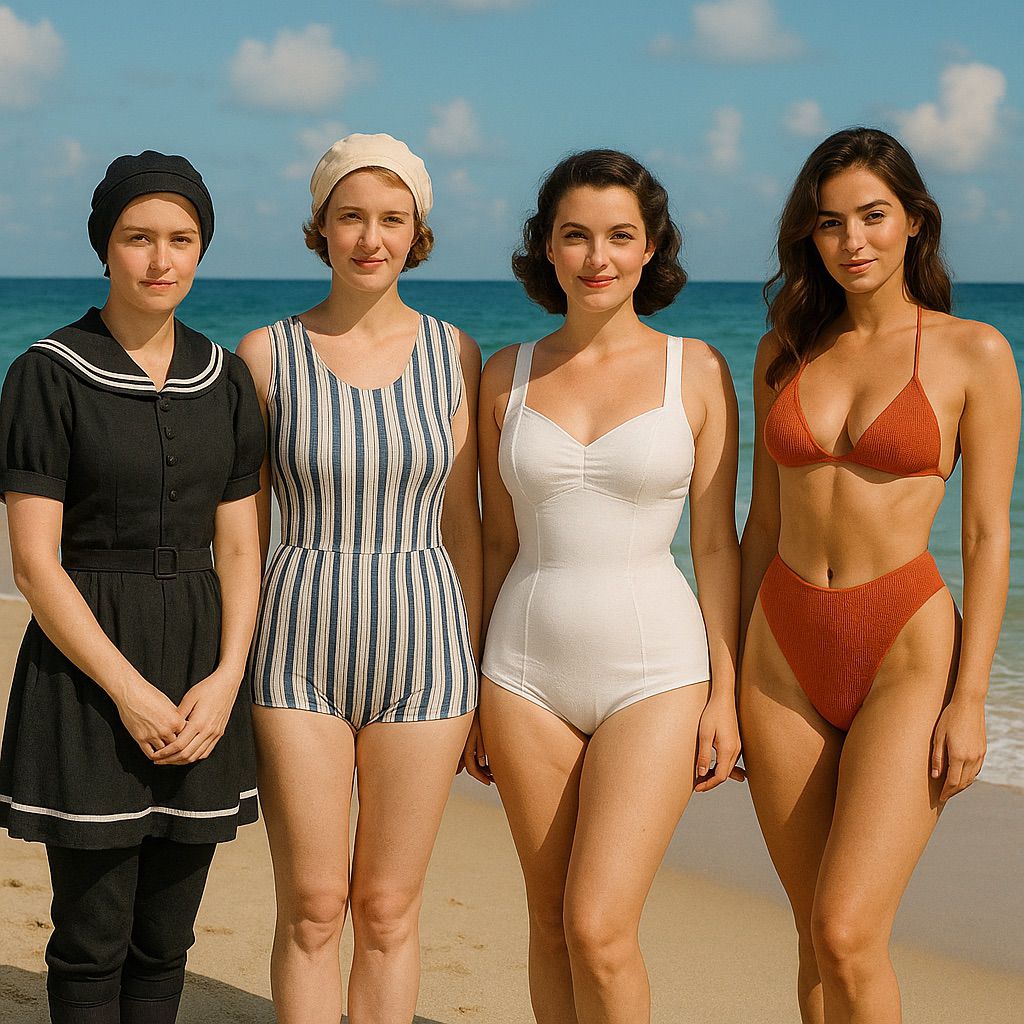
Oh, darling, let’s slip into something more comfortable—preferably made of quick-dry fabric—and take a long, lingering stroll through the steamy, sun-dappled history of the swimsuit. It’s a story that’s part fashion evolution, part cultural rebellion, and part unabashed flirtation with the limits of what’s “decent.” And like any great romance, it began with a little bit of shyness, grew bold with time, and eventually decided that modesty was optional when the beach beckoned.
Our tale begins in the prim and proper 1800s, when the mere thought of a woman’s ankle flashing in public could spark a scandal worthy of gossip columns. Back then, “swimwear” was less about sun-soaked seduction and more about… well, not drowning under the weight of your own clothes. Women wore bathing dresses made of heavy wool—yes, wool, the least sexy and most suffocating fabric known to humankind—paired with stockings, bloomers, and even full-on corsets. Imagine wading into the water swaddled in something that could double as an overcoat, while the men sported striped one-piece suits that looked suspiciously like prison uniforms. The only thing these ensembles revealed was that the Victorians had a serious aversion to tan lines.
But the early 20th century was feeling cheeky. The flirty spirit of the Roaring Twenties shook off the dust of propriety and introduced the world to swimsuits that showed—gasp!—knees. It was scandalous enough to cause fainting spells among the more fragile sensibilities, but it also sparked an intoxicating taste for freedom. Swimmers like Annette Kellerman, a daring Australian who famously wore a fitted one-piece in public, challenged the rules and even got herself arrested for indecency. But my, oh my, she also set a precedent that the swimsuit could be not only functional but alluring. Think of her as the pin-up girl of the swimming pool before pin-ups were even a thing.
By the 1930s, swimsuits had shed a few more inches of fabric, and the beaches were looking more like a flirtation zone than a moral battleground. Materials like Lastex (a rubber-yarn blend) made suits cling in all the right places, and sweetheart necklines, ruching, and halter straps turned seaside attire into something tantalizing. Men, meanwhile, ditched their modesty panels and started showing more thigh, perhaps realizing that a little skin in the sun could work wonders for their appeal.
And then came 1946. Ah, the year the world fell head over heels for the bikini. Invented by French designer Louis Réard, the bikini was a two-piece that dared to bare the midriff, and its debut caused a sensation akin to fireworks on Bastille Day. Réard named it after Bikini Atoll, the site of atomic bomb testing, claiming it would have the same explosive impact on the public. He wasn’t wrong. The first bikini model was a Parisian nude dancer, because, as Réard cheekily put it, no “respectable” model would wear such a revealing garment. But society has always had a soft spot for the bold, and soon enough, Hollywood bombshells like Brigitte Bardot and Ursula Andress turned the bikini into an object of mass desire.
The 1960s and ’70s rode that wave hard. The bikini got smaller, sexier, and more diverse in design—triangle tops, string ties, bandeaus—while the cultural revolution gave everyone permission to flaunt it. The sexual liberation movement turned the swimsuit into a political statement: “My body, my choice, my swimsuit.” Suddenly, the beach became a catwalk of liberation, where minimal coverage equaled maximum confidence.
Of course, the 1980s had to go and turn up the drama. Think neon colors, high-cut legs, and one-pieces that could make your hips look like they went on for miles. The Baywatch era brought the iconic red lifeguard suit, which was less about saving lives and more about making hearts stop. Lycra and spandex clung to every curve, creating silhouettes so sharp they could cut glass. It was bold, it was sexy, and it was unapologetically over the top.
By the 1990s and 2000s, swimsuits had gone global in style influence. Brazilian cuts sashayed into the mainstream, cheeky bottoms made waves, and tankinis offered a middle ground for those flirting with the idea of baring it all but not quite ready to commit. The Y2K era brought metallic fabrics, embellishments, and designs that looked just as good lounging poolside with a cocktail as they did in the surf.
And here we are in the 2020s, where the swimsuit is more than a garment—it’s a declaration. Designers are blending sensuality with sustainability, proving you can make hearts race without making the planet sweat. Recycled nylon, eco-friendly dyes, and ethically made swimwear are the new sexy. And inclusivity is finally stealing the spotlight: brands are embracing every body type, skin tone, and gender expression, because desire is as diverse as humanity itself. Swimsuits today aren’t just about seduction—they’re about celebrating the whole spectrum of beauty, unapologetically and with a wink.
What’s delicious about this journey is how the swimsuit has always reflected our collective flirtation with the idea of freedom. From wool-covered ankles to barely-there microkinis, each stage has been a little tease, a little dare, a little whisper that maybe, just maybe, we’re ready to show the world exactly who we are—sun-kissed, salt-water tousled, and utterly irresistible. The beach has never been just about swimming; it’s a stage for performance, a playground for the bold, and a canvas where desire and style paint together under the sun.
So the next time you slip into your swimwear—whether it’s a retro-inspired one-piece or a barely-there bikini—remember, you’re not just putting on fabric. You’re stepping into over a century of evolution, rebellion, and romance. You’re part of a love affair between body and water, style and skin, modesty and mischief. And sweetheart, that’s one relationship that will never go out of style.