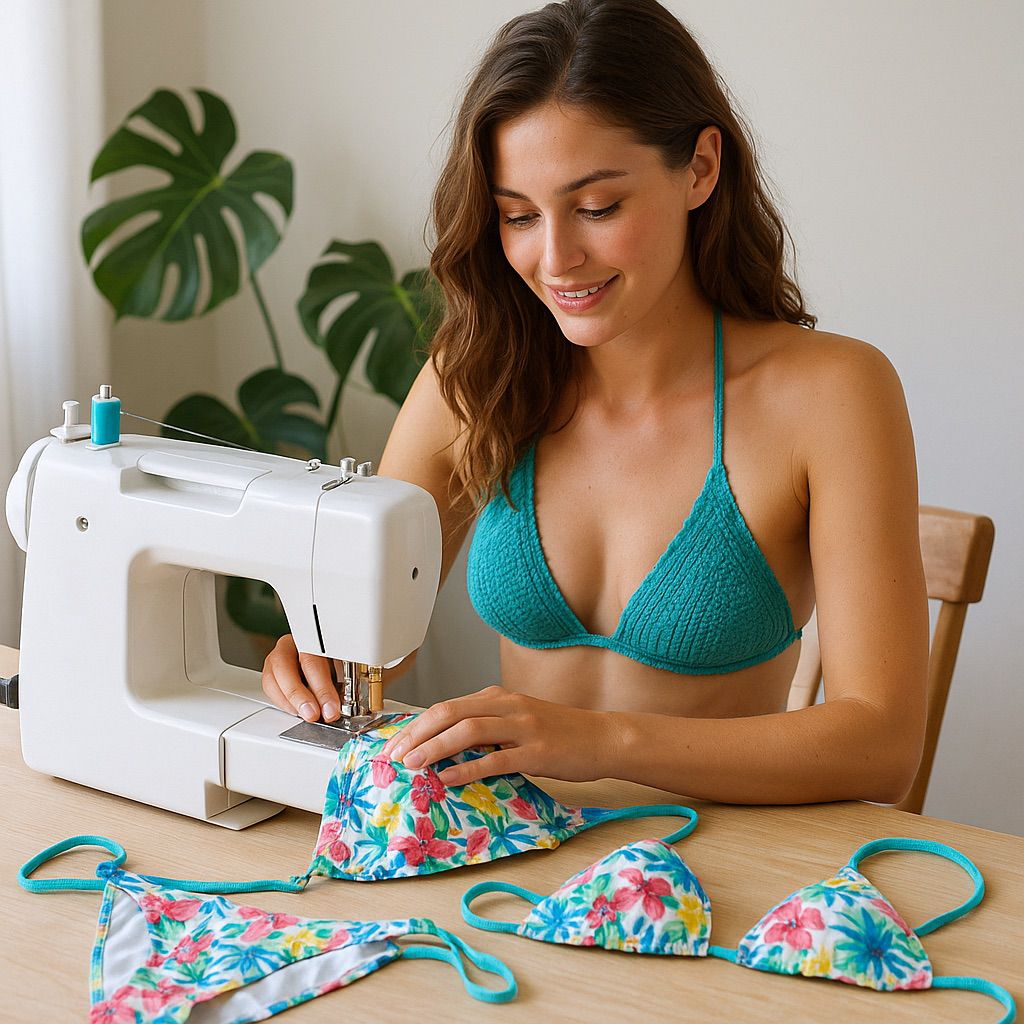
The idea probably begins with a late-night scroll—one too many cute swimsuits in your feed, each tagged with a price that makes your debit card wince. Or maybe it starts in a thrift store, your fingers trailing over a bolt of fabric that feels like summer under your palm. Whatever the spark, the thought lands with the same mix of thrill and trepidation: Could I make my own bikini? A question equal parts craft project and personal dare. And beneath it, something deeper—a tug toward control, toward creativity, toward wearing something that carries the fingerprint of your patience and personality instead of a brand logo. In a world where bikinis are churned out by the millions in glossy factories, the idea of making your own is like deciding to bake bread in an era of drive-throughs. It’s slower, messier, and infinitely more satisfying.
For the uninitiated, the prospect can feel absurd. Isn’t swimwear some arcane alchemy of elastic and magic stitches, perfected only by those with industrial machines and years of apprenticeship? The truth is more democratic. Yes, bikinis are a little technical—stretch fabrics have their quirks, and there are tricks to making something that will survive both the surf and the sun. But the barrier to entry is not nearly as high as most people think. A basic home sewing machine, a handful of notions, some patience, and a willingness to practice on scraps before you cut into your dream fabric are your main tickets in. The rest? Well, that’s style and spirit, and you’ve already got those.
Step one in your DIY bikini odyssey is a choice that feels deceptively simple but will set the tone for the whole project: fabric. Swimwear calls for materials with both stretch and recovery, meaning they need to stretch to fit your body snugly and then snap back to shape after you take them off. The classics are nylon-spandex or polyester-spandex blends, sometimes with a lining for modesty or structure. In your hands, they feel slick and slightly cool, like the surface of a pond just before you dive in. Prints open up an entire gallery of personality—tropical florals for the escapist, nautical stripes for the retro romantic, solid black for the minimalist with secrets. There’s something intoxicating about standing in a fabric store, bolts fanned out before you, knowing this will be more than just cloth; it will be a second skin you made yourself.
Once you’ve got your fabric, you’ll meet the next big fork in the road: pattern. You can draft your own (ambitious, but not impossible if you’ve dabbled in garment making) or buy one online from the many indie designers who cater to home sewists. Patterns range from modest high-waisted bottoms and supportive tops to daring string bikinis that would barely pass muster in a game of beach volleyball. Here’s where you confront a small but liberating truth—your bikini doesn’t have to please anyone’s idea of “on-trend” but yours. Want a top with wide straps for comfort? Do it. Want a reversible design so you pack light for vacation? Totally doable. Want to engineer a suit that actually fits your bust and hips without compromise? Welcome to the revolution.
If fabric and pattern are the canvas and sketch, then notions are the paints—elastic for leg openings and waistbands, closures for halter straps or back bands, optional padding for tops. Swimwear elastic is different from the garden-variety elastic you might use in pajamas; it’s resistant to chlorine and saltwater, ensuring your masterpiece doesn’t sag after its first encounter with the deep end. Choosing notions is like choosing jewelry—you’re thinking not just about function but about how the little details finish the whole look. A gold clasp at the back can elevate a simple design into something that looks plucked from a boutique rack. And don’t underestimate the psychological lift of good tools—sharp shears, a fresh stretch needle in your machine, and a walking foot that coaxes slippery fabric into submission.
Then comes the cutting, which is as much about courage as it is about precision. There’s a quiet drama in laying your pattern pieces on the fabric, making sure the stretch runs in the right direction, pinning them in place. Once you make the first cut, you’re committed, and the sound of scissors through spandex is oddly thrilling—like the first bite into something you baked yourself. This is where mistakes are born and, thankfully, where they can often be rescued. Stretch fabric is forgiving; seams can be unpicked, straps reattached, lines altered. Perfection is overrated; progress is the real prize.
Sewing swimwear is where the magic—and the learning curve—really kicks in. The stitches that hold bikinis together have to stretch without breaking, which means you’ll lean on zigzag stitches or specialized stretch stitches your machine might offer. Seams need to be smooth and strong, and hemming the elastic into the edges without puckering the fabric is a skill you’ll get better at with practice. The first time you manage to sew a clean, even edge on a stretchy bikini bottom feels like a small miracle. And yes, there will be moments of frustration—a seam that twists, a strap that comes out uneven, elastic that refuses to sit flat—but those are the moments that teach you more than any YouTube tutorial ever could.
The fitting stage is both exciting and, let’s be honest, humbling. Trying on something you’ve made yourself can be a bit like hearing your own voice on a recording: it’s familiar but also strangely revealing. A waistband might sit differently than you pictured, a top might gape a little. But here’s the beauty of DIY: you can change it. Add darts, adjust elastic tension, swap straps. Every tweak makes the bikini more yours, and every fitting session teaches you more about what makes swimwear comfortable and flattering for you. And there’s a quiet satisfaction in realizing you’re tailoring something not for a generic size chart but for your own living, breathing form.
And then, one day—or rather, one late night, if you’re the sort who sews with coffee and playlists—you finish it. The last stitch is tied off, the last loose thread snipped. You hold it up, this small, bright thing that once was just a sketch in your head. There’s pride in the symmetry, in the neat seams, but more than that, there’s the electric knowledge that you could do it again. You could make ten more, each one different, each one an evolution of your style. In that moment, the question “Can you make your own bikini?” has shifted into something quieter but more potent: “What else can I make?”
Wearing it for the first time is the real test, of course. The beach or pool becomes your runway, though not in the stiff, self-conscious way of a fashion show. It’s subtler than that—you feel it in the way you stand, in the ease with which you move. People might compliment the color or the cut, and you’ll smile, knowing they’re seeing only the final chapter of a story that began with a roll of fabric and a hunch that you could figure it out. The best part isn’t even the compliments; it’s the intimacy of knowing your bikini has no twin in the world, that it’s as one-of-a-kind as your tan lines.
Over time, you might start seeing possibilities everywhere. That old maxi dress you don’t wear anymore? Enough fabric for a color-blocked bikini. The remnant bin at the fabric store? A treasure chest for bold prints you’d never commit to in a $120 retail suit. Friends might drop hints about wanting their own custom swimwear, and if you’re generous—or entrepreneurial—you might start sewing for others. It’s a slippery slope from personal project to small business, and many indie swimwear brands have started exactly this way: at a kitchen table, with a borrowed machine and the nerve to think “Why not?”
Making your own bikini isn’t just about thrift or even style; it’s a quiet rebellion against disposability. Fast fashion has trained us to think of clothes as temporary, interchangeable, even forgettable. But when you sew something yourself, you invest not just money but hours and focus, and that investment changes how you treat it. You mend instead of discard. You store it carefully instead of letting it fade in the backseat of your car. And, maybe most importantly, you notice—how fabric behaves, how seams age, how salt and sun alter colors over time. The relationship becomes reciprocal: you take care of it, and it takes care of you.
There’s also a kind of empowerment in swimwear-making that goes beyond craft. Bikinis are loaded garments in our culture, carrying more than just the weight of fabric and elastic. They are tied to body image, to confidence, to all the stories we tell ourselves about what is “beach ready.” Making your own is a way of editing those stories. You choose cuts and colors that make you feel ready, without waiting for some arbitrary green light from fashion magazines or fitness influencers. You realize that “ready” isn’t about the body changing for the bikini but about the bikini being made for the body you have right now.
This is not to say every attempt will be a masterpiece. There will be duds. The top that looks great on the hanger but sags in the surf. The bottoms that ride up in ways that are unprintable. But even the flops have value; they teach you about fit, about tension, about patience. They also give you a better appreciation for the skill in well-made commercial swimwear—not to intimidate you out of trying again, but to inspire you. And with each attempt, your hands grow more confident, your stitches straighter, your eye sharper.
In the end, the question of whether you can make your own bikini transforms into whether you want to keep making them. For some, one suit is enough—a fun experiment, a badge of accomplishment. For others, it’s the beginning of a new way of dressing, of engaging with clothing as something you participate in creating rather than simply consuming. And once you’ve crossed that threshold, you may find yourself looking at all your clothes differently, wondering how they came to be and whether you could recreate them, too.
DIY bikinis may not change the world, but they can change your summer. They can shift the way you see your body, your creativity, and your relationship to the clothes you wear in your most unguarded moments. They can turn a beach day into a celebration of something you made with your own two hands. And maybe, just maybe, they can spark the realization that self-reliance and self-expression are a pretty unbeatable combination—on the shore and everywhere else.