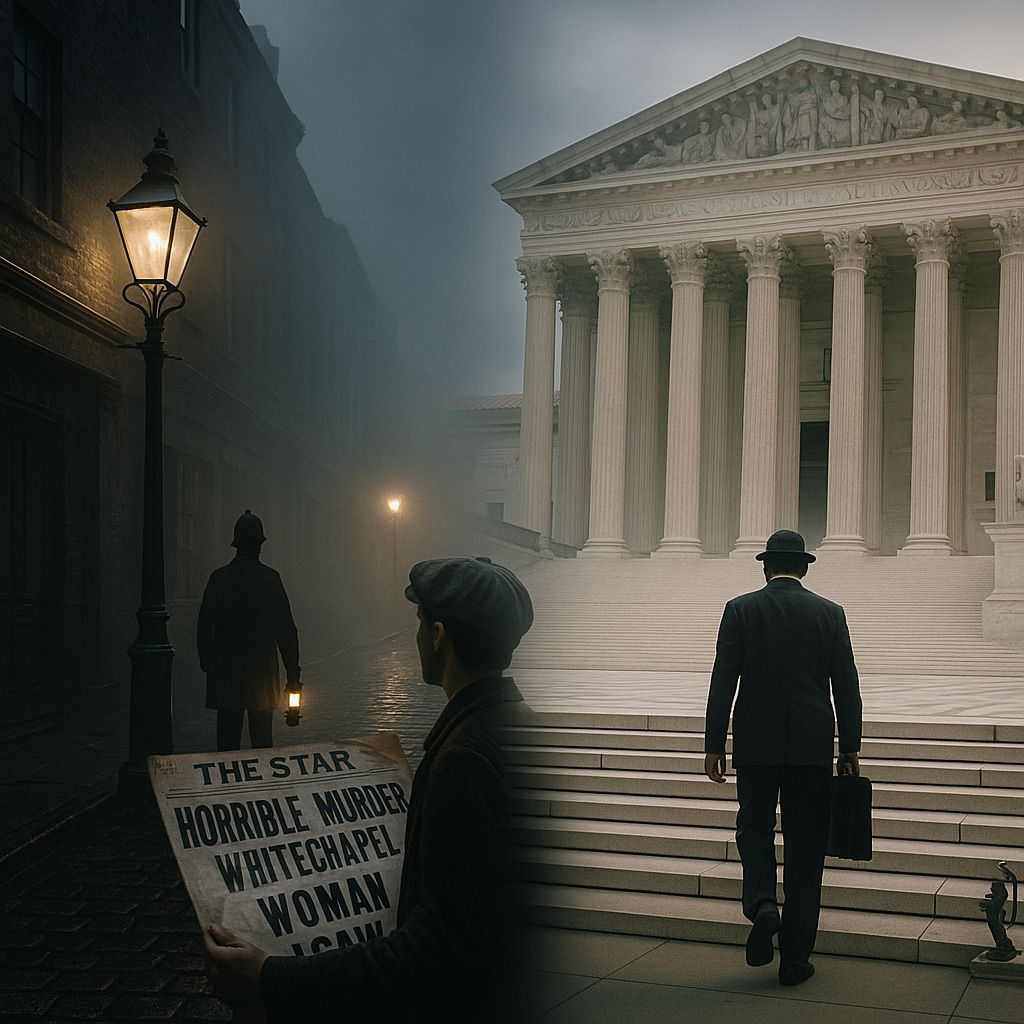
The calendar is supposed to be tidy: boxes, numbers, moon phases, holidays, a kind of paper metronome that keeps life on beat. But some dates hum with a stranger rhythm, a low chord that vibrates through streets and courtrooms alike. August 31 is one of those dates. In the pre-dawn hush of 1888, a carman on his way to work in London’s East End found a woman lying near a gated yard on Buck’s Row. Her name was Mary Ann Nichols—“Polly” to those who knew her—and within minutes she was transformed from person to headline, from a complicated life of laughter, hardship, and stubborn hope into the unliving symbol of a mystery that would metastasize into folklore. The man who likely killed her would be handed a nickname that sounded like theatre but felt like terror: Jack the Ripper. Nearly a century later, on another August 31 and far across the Atlantic, a very different kind of headline threaded itself into American life: landmark legal milestones that re-anchored the promise of equal justice under law. Over time, August 31 became a hinge where a gaslit alley meets a marble portico, where a constable’s lantern meets the cool gaze of a blindfolded statue. One day, two stories: the oldest unsolved serial-murder case to still spark arguments in pubs and seminars, and the living, evolving story of U.S. legal breakthroughs that try to make the country truer than its mistakes. If that juxtaposition feels jarring, good—it should. It’s the distance between fear and the systems meant to answer it, between the shadow of a crime and the scaffolding of a society that learns how to protect the vulnerable not just by catching monsters, but by changing the rules that let monsters thrive. What follows is a walk through fog and into the courtroom—an essay that insists on remembering a victim by name, locates the myth where it belongs, and then uses that memory to talk about how justice actually gets built, case by case, statute by statute, precedent by precedent, until the law’s promise sounds less like a lullaby and more like instructions.
History will tell you that Polly Nichols’ story begins the night she was murdered, but that is the historian’s economy, not the human truth. She was born in 1845, grew up in the bustle of London’s working-class neighborhoods, married a printer’s machinist, had children, and wrestled with poverty that behaved like a tide—sometimes receding enough to let a tiny beach of hope appear, sometimes swallowing every plan. Victorian London had two kinds of light: the shining newness of empire’s boulevards and the rancid glow of alleys where the poor rented not rooms but corners of air. Whitechapel was a neighborhood of laborers, hawkers, seasonal trades, and those whom the language of the day, with its chilly blend of pity and disdain, called “unfortunates.” Police rosters and charitable society ledgers reveal a world of hand-to-mouth hustle. There were workhouses whose rules punished the poor for needing them, lodging houses that charged by the night for beds that still smelled of the last occupant’s fear, and streets that carried a thousand finger-smudge stories no one wrote down. Against this life, Polly laughed when she could, argued when she needed to, borrowed when she had to, and—on the worst nights—sold what men had taught the world could be bought. If you want to do right by her memory, start there: with a person who had friends, a father who worried, a frayed dignity she kept trying to sew back together. Then put her back on Buck’s Row. Imagine the hour before dawn, when cities shiver and the mind feels both foggy and too sharp. Imagine a lamplighter’s residue in the air, a constable’s boots making their own metronome, and a quiet so complete that any sound—footsteps, a cart’s squeak, a door, a voice—feels like a decision arriving. Polly’s murder was swift and deliberate; I refuse to narrate it in gory detail because her dignity does not require it. What matters is what followed: shouts in the street, men running, a doctor’s hurried assessment by lamplight, a police investigation that stumbled through the limits of its time, and a set of newspaper editors who understood that fear sells even faster than scandal.
Jack the Ripper is as much an invention of typography as a person of flesh and bad choices. The name itself arrived via letters whose authenticity is still disputed, punctuation bleeding drama into broadsides. There is an undeniable, unsettling giftedness in how the Ripper legend learned to market itself: the taunting letterhead, the red ink, the cadence of terror serialized. But every time we get caught in that theatre, we let the culprit hijack the narrative of the people he harmed and the community he scarred. Better to keep the camera wide. The Whitechapel of 1888 was a social pressure cooker: immigration, unemployment cycles, religious friction, and the Victorian habit of treating poverty as a moral failure rather than a civic responsibility. Police were stretched thin and trained for a different kind of crime; forensics, as we now understand it, barely existed; neighborhoods bristled at authority while relying on it in emergencies. Newspapers pounced. They coined phrases, drew alarming maps, and tested the moral intermittently; their coverage served a purpose—attention can force resources into a crisis—but it also sipped from the same sensationalism that would later turn true crime into a spectator sport. The case cracked open a century-long argument about privacy and publicity, ethics and appetite. How do you tell the truth about violence without teaching it to itself? How do you warn without exploiting? How do you mourn without mythologizing wickedness? Try this: keep the victims’ names a litany (Mary Ann Nichols, Annie Chapman, Elizabeth Stride, Catherine Eddowes, Mary Jane Kelly) and keep the criminal’s name as a label of the system’s failure rather than as a brand.
If you walk Whitechapel’s streets today, you can buy a tour with shudders baked into the price. The guides are often kind, knowledgeable people doing their best to balance education and entertainment. Still, the city hums with a dissonance they cannot always resolve. For on those same streets, modern Londoners go to work, wait for buses, share chips on the curb, talk on phones that put the whole world in a pocket. The gap between 1888 and now seems huge—DNA in crime labs, databases in the cloud, cameras that call witnesses back from their scrolling. Yet the old questions remain stubborn: Who gets protected? Who is credible when they speak? Who gets the benefit of the doubt and who gets the blame? If the Ripper killings keep their long lease in our imagination, it’s partly because they sit at the intersection of these questions. They force us to watch a society improvising an answer and getting it only half-right. Yes, police opened investigations; yes, citizens organized watch patrols; yes, the Home Office stirred. But no, the city did not fix the poverty that made women more vulnerable after midnight. No, the nation did not learn fast enough how to listen to the voices closest to the danger. When we retell the story with accuracy and humility, we learn that safety is not just patrol routes and whistles; it is housing policy, it is wages that can stand up to hunger, it is public lighting budgets prioritized where fear lives, it is lodging houses inspected because dignity is a right even when money is a rumor.
The evolution of criminology since 1888 looks, from the twenty-first century, like a miracle we should not take for granted. Consider fingerprints: a curiosity when the Whitechapel case erupted, a cornerstone of identification a generation later. Consider blood typing, then DNA swabbing: molecules learning to raise their hands in court to say, “I was there.” Consider behavioral analysis: flawed when used as prophecy, but sometimes clarifying when used as context. Consider the creation of centralized databases and cross-jurisdictional task forces; violence does not respect postal codes, so the people who fight it needed to become more fluent in collaboration. These advances are more than gadgets and acronyms; they are the civic decision to let truth have better tools than rumor. Even so, the case remains unsolved. That fact has been as productive of cheap fascination as it has been of scholarship. Every few years a new theory appears with the confidence of a salesman and the staying power of a fogbank. Perhaps the most honest thing we can say is that the mystery belongs as much to the city’s history of inequality as to the murderer’s technique. He used darkness; the city supplied it. He used anonymity; the city’s neglect crowded his victims into it. He used fear; editors gave him ink and a megaphone. The lesson for us is sharper than a whodunit answer could ever be: if we want fewer monsters, we must starve the ecosystems that feed them.
This is where the essay pivots, not out of indifference to the dead but out of allegiance to the living. Because the second half of August 31’s strange double bill asks a different question: How does a society teach itself to be more just than the sum of its terrors? The United States has answered imperfectly, and also magnificently, through a chain of legal milestones that turned grief, courage, and rage into rules. Think first of cases that changed the water temperature of American life. In Brown v. Board of Education, the Supreme Court acknowledged what parents and children already knew in their bones: that separate is never equal, that segregation was not simply a social habit but a constitutional insult. The case did not desegregate America in a single splash—resistance stood up snarling and the work took decades—but it recalibrated the law’s compass, gave a legal grammar to the moral demand. In Gideon v. Wainwright, the Court admitted that the right to counsel means nothing if it can be priced out of reach; a poor defendant facing the machinery of the state must be given a lawyer, not as charity, but as a matter of fairness. In Miranda v. Arizona, the justices translated the Fifth Amendment’s protection against compelled self-incrimination into everyday language, instructing police to advise suspects of their rights; that small speech, now baked into television scripts and teenagers’ imaginations, is a civic ritual that says: power must talk to you as if you were a citizen, not a trophy. In Loving v. Virginia, the Court struck down bans on interracial marriage and reminded legislatures that intimacy is not theirs to ration. In New York Times v. Sullivan, the Court gave the press breathing room to criticize officials without being bankrupted by thin skins, ensuring that the Ripper-era synergy of news and fear could be balanced, when we do it right, by a press liberated to investigate the powerful. In Obergefell v. Hodges, the Court listened to decades of gay and lesbian Americans insisting that the architecture of marriage should not be a museum of someone else’s values and said, with constitutional clarity, that equal protection is not a synonym for “maybe later.”
These cases are not trophies on a shelf; they are bridges that require inspection and repainting. For every Miranda, there is a case that tries to carve an exception; for every Gideon, a county that underfunds public defenders until the promise thins to a whisper; for every Brown, a district line gerrymandered to reassemble what the law knocked down; for every Obergefell, a state-level stratagem to delay dignity. You do not fix a country once. You keep fixing it. The milestones are instructions as much as they are victories. They tell you where to stand when the weather turns mean. They teach the difference between vengeance—hot, quick, and almost always aimed at the wrong target—and justice, which is slow, careful, and interested in everyone’s tomorrow.
From Whitechapel’s fog to the appellate record, the through-line is not as strange as it first looks. Both halves of August 31 insist that fear is a poor architect unless you teach it math. After Polly Nichols’ death, London learned, slowly, to count better—counting the ways lighting, housing, and patrol habits could starve a predator of his favorite conditions. After each American case I mentioned, the country learned to count differently too—counting voices equally in classrooms, counting rights at the moment of arrest rather than after, counting love as a public good rather than a private embarrassment, counting the press as a watchdog that must be free to bark. None of this rescues us from tragedy. People will still harm. Institutions will still err. But it changes what we do next. It replaces superstition with procedure, rumor with record, panic with process. It makes the city and the nation less hospitable to the kinds of silence that violence prefers.
There is an ethics to how we remember August 31, and it begins with refusing to make the Ripper the protagonist of anyone’s story. The protagonist is always the person whose life was taken. Say Mary Ann Nichols’ name with the pacing of respect. Imagine her children’s questions. Imagine her laughter before the world decided to hear only the echo of a man’s footsteps. Then widen the circle to include the women who survived that era’s nightly gamble, the neighbors who left extra coal by a door they did not knock on, the constables who walked a little slower past lodging house steps after that night because it felt indecent to hurry. In the same breath, remember the plaintiffs whose names became verbs: to mirandize, to gideonize the courtroom so that no one is forced to stand alone before the state, to brown a schoolhouse into something more like a community, to loving a marriage until the law recognizes what love already knows. These are the heroes of a quieter kind of story—the one in which a society decides to stop improvising compassion and start standardizing it.
Humanizing an essay that begins in an alley can feel like a dare, but people live entire lives in alleys and on courthouse steps. So here is a way to practice the memory this date demands. If you are ever tempted by a lurid headline, pause and ask yourself what the victim loved the day before the headline. If you are ever tempted to treat a Supreme Court case as an abstraction, find the face: Clarence Gideon with his petition written in pencil; Mildred and Richard Loving with their daughters on a front porch; Ernesto Miranda signing a confession he did not fully understand; plaintiffs in Brown walking their kids to school under the friendly surveillance of a community that had finally decided to share. If you are ever tempted to celebrate a verdict as an ending, throw a party and then calendar the next hearing; justice is less a destination than a schedule of maintenance, like the inspection of a long causeway that keeps a region together.
What, finally, does August 31 want from us? Vigilance softened by empathy. Curiosity disciplined by ethics. Policies informed by the people who will live under them at midnight, not just those who design them at noon. It wants us to build laws that arrive before the monster does, to fund services that make the streets less lonely for the poor, to train police and prosecutors to consider dignity as a form of evidence. It wants journalists to write in a way that never forgets who the main character is. It wants citizens who understand that rights are habits, not souvenirs. It wants the next frightened person in a dark place to meet a city that has bothered to light the way.