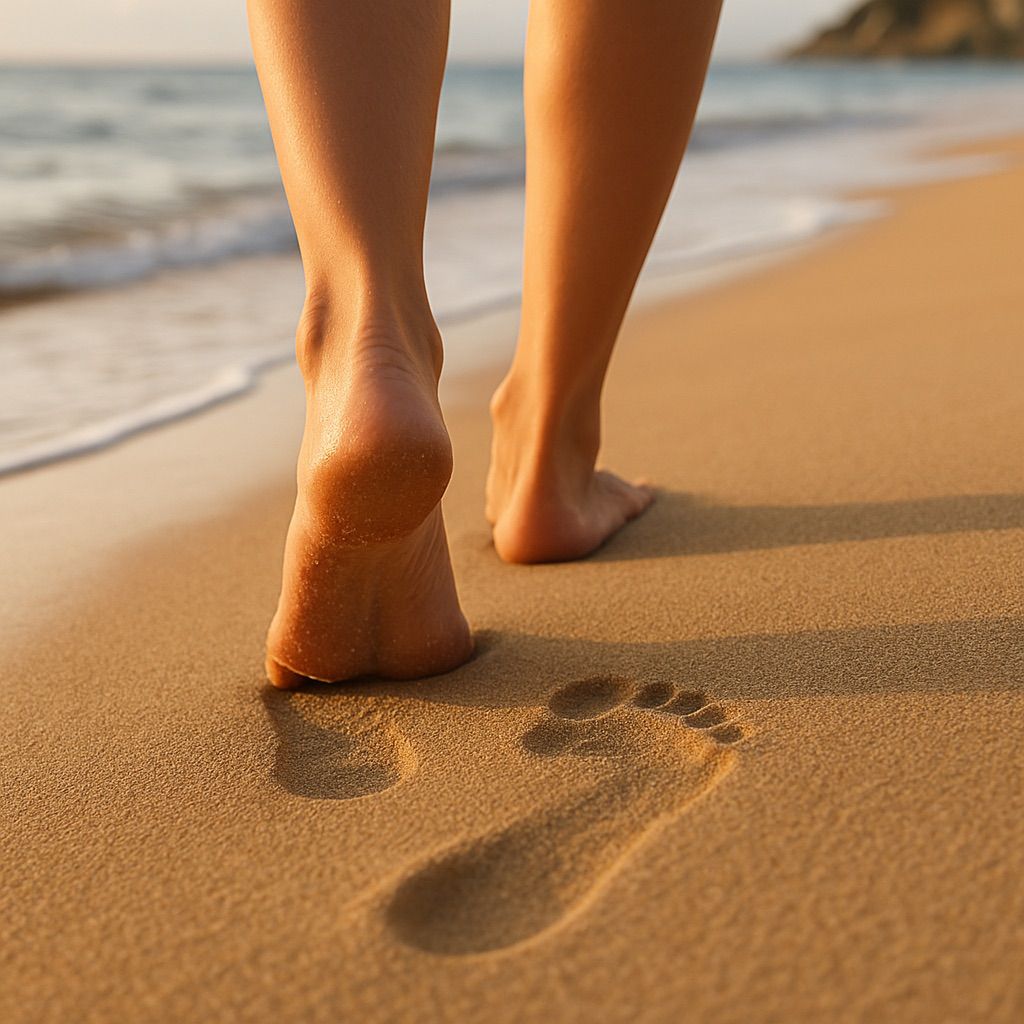
There’s a small, almost rebellious kind of joy in stepping out of your shoes and letting your feet meet the sand. The first touch is a flicker of temperature—the sun-warmed grains greeting your soles—then a slow, yielding sink as your weight presses down and the earth rearranges itself to fit you. It’s not just a pleasant sensation; it’s a full-body memo that says, “You’re here. You’re alive. Pay attention.” Barefoot walking on sand is one of those simple acts that hides a surprising amount of science and soul. It strengthens things you didn’t know were weak. It calms parts of you that forgot how to be quiet. It reminds you that your body, for all its complexity, was designed to move with the world, not against it. And that’s the secret many of us miss: the most powerful reset often looks like a gentle walk along the shore.
If you’ve ever taken that first step and felt your ankle wobble, you’ve met one of sand’s great teachers: instability. Unlike sidewalks, sand doesn’t demand a single, repetitive pattern. It shifts, so you adapt. Every micro-adjustment your foot makes—curling your toes, flaring your heel, tightening your arch—is a tiny strength exercise. The muscles of your feet wake up like a crowd at sunrise. The smaller stabilizers in your ankles, calves, and hips join the chorus, coordinating to keep you upright. Think of sand as a quiet, forgiving gym—no mirrors, no clanging metal—just an ever-changing surface that asks you to be present. Over time, this unpredictability builds foot strength, improves balance, and teaches your nervous system to communicate more efficiently with your muscles. It’s functional fitness in the oldest sense of the term: training your body to respond gracefully to the world it actually lives in.
There’s also the matter of pace. Most of us move too fast, even when we’re technically standing still. Sand slows you down—not because you’re lazy, but because the medium makes you honest. You can’t sprint mindlessly across a soft beach without paying attention; the surface won’t let you. Your stride shortens. Your knees bend. Your hips start to move more fluidly. Your spine becomes a mast that steadies the ship. In that slowness is an opportunity to breathe deeply, to open your chest to the sea, to let your arms fall with your steps. A few minutes in, you’re not just walking; you’re unspooling a thread of tension that’s been wrapped tight around your day. And as your breath finds rhythm with your steps, your mind often follows—the to-do list quiets, the sense of urgency thins, and you begin to feel that spaciousness in your head that you forgot existed.
Then there’s the sensory orchestra. Bare feet mean full access to the world: cool patches of damp sand hiding under warm top layers, the contour of a shell under your arch, the faint fizz of foam as it reaches for your toes and retreats. Your skin is your largest organ, a master receiver of information, and on the beach you’re tuning it to high fidelity. The texture of sand provides rich, varied input to thousands of nerve endings in your soles, sending a stream of data to your brain about pressure, temperature, and terrain. That feedback can improve proprioception—the body’s sense of where it is in space—like turning up the brightness on your internal GPS. Better proprioception often means better movement: more confident steps, quicker reactions, and a reduced risk of missteps that become injuries. The beauty is that your brain loves novelty, and a beach is novelty in endless supply—no two steps are the same, and because of that, your nervous system keeps learning.
But let’s be honest about something: our feet have a story, and for many people that story includes aches, stiffness, and a lifetime of shoes that turned them into passengers rather than drivers. Barefoot walking on sand is a gentle invitation back to agency. The arch—so frequently misunderstood as either too high or too flat—relearns its job as an elastic bridge. The toes get a chance to spread and stabilize instead of cramming into a narrow toe box. The calf muscles, perpetually shortened by heeled shoes and hard surfaces, lengthen a little with each sink and push. Over time, that can translate into better alignment up the chain: when your feet work, your ankles stabilize; when your ankles stabilize, your knees track more cleanly; when your knees track, your hips and lower back carry less strain. It’s not magic; it’s mechanics favored by a forgiving surface.
Of course, the ocean gives you more than physics. There’s something about a shoreline that resets perspective, even if you’re not sure why. Maybe it’s the horizon: a literal line of possibility that stretches beyond whatever you’ve been carrying. Maybe it’s the soundscape—the slow thunder of waves—masking the mental noise that chews through your attention inland. For many people, the beach flips on what marine biologist Wallace J. Nichols calls the “blue mind,” a calmer mental mode associated with water settings. You don’t have to be a poet to feel it; just a person willing to stand there long enough to let your senses catch up. When you walk barefoot in that setting, your brain gets two signals at once: the grounding from your feet, and the spaciousness from your eyes and ears. The result is an unusually effective formula for dropping stress in real time.
Let’s talk about “grounding,” a concept that quickly gets tangled in big claims. You don’t need to buy into anything mystical to appreciate the clear, lived experience: connecting skin to earth can feel steadier than being insulated by rubber soles. At minimum, it’s a habit that encourages time outdoors, slower walking, and full-body attention—three things modern life notoriously under-delivers. If you find the practice soothing, that feeling itself is the benefit worth chasing. If you’re skeptical, you can still enjoy the measurable perks: stronger feet, better balance, fresh air, and a calmer nervous system that comes from moving in a rhythmic, sensory-rich environment.
The hidden cardio is another quiet win. Sand demands more from your muscles with every step. Even a leisurely, 10- to 20-minute beach walk can elevate your heart rate in a low-impact way. Because the surface absorbs some of the force you generate, your joints deal with less sharp impact than on concrete. Many people find they can go a little longer on sand without the same post-walk soreness in knees or lower back. It’s like nature’s elliptical—more work, less strain—wrapped in sunlight and salt air. If you crave a challenge, walk closer to the dry, softer sand; if you want more stability, stay near the water’s edge where the surface is firmer. You get to tune the difficulty without changing the location.
And then there’s temperature, a quiet physiotherapist. Warm sand coaxes blood flow to the soles, which often spend their days chilled and under-stimulated in air-conditioned rooms. In the cooler hours—sunrise and sunset—the sand’s warmth feels like a natural heat pad. That comfort alone can relax the muscles in your feet and calves, making each step more fluid. When a wave rolls over your ankles, the brief cool contrast wakes tired tissues like a splash of water on a sleepy face. It’s hot-and-cold hydrotherapy, delivered by the planet for free.
But what about the practicalities—the small obstacles that keep a beautiful idea from becoming a real habit? Start with duration. Ten minutes counts. You don’t need to schedule an epic trek or “close all your rings.” A dozen mindful, barefoot minutes can do more for your nervous system than an hour you don’t enjoy. To make it stick, anchor the walk to something you already do: after your morning coffee, after school drop-off, while dinner’s simmering. If you’re carrying stress (and who isn’t), try treating the first five minutes as a decompression lane. Feel the sand. Count your exhale to four. Let your arms dangle and your jaw unclench. Imagine dropping questions into the tide: What can wait? What do I want the next hour to feel like? How little force can I use and still move forward?
If foot strength is new for you, think micro-progress. The first week, aim for softer, damp sand near the water and short intervals—five to ten minutes—even if you’re eager. In week two, add a minute or two and venture to a slightly softer patch. A simple pattern that works: three steps slow, three steps normal, repeat. Slow steps keep you honest about form—quiet landings, even weight, toes spreading—while normal steps let you settle into a natural rhythm. If your arches feel tired, that’s okay; tired is a signal to stop for the day, not a reason to quit the practice. Over a few weeks, many people notice their arches feel springier, their toes more articulate, and their balance better on everyday surfaces.
Use your eyes like a second set of feet. Scan the ground ahead for shells, stones, or debris. The goal isn’t to tiptoe nervously—it’s to walk with awareness, like a surfer reading a wave. If you do step on something sharp, pause. Shake out the sting, check the skin, and carry on if it’s superficial. If you have diabetes, neuropathy, or foot wounds, talk to a clinician first—barefoot walking may still be possible, but you’ll want personalized guidance. Sand can also be hot enough to burn later in the day; prefer morning and late afternoon, and test the temperature with your hand before committing.
What you do with your arms matters more than most people realize. Let them swing. That movement counter-rotates your torso and hips, easing your lower back and helping your feet place more naturally. Keep your gaze about ten meters ahead rather than down at your toes; your neck will thank you. And breathe like you’re walking through a long exhale—because you are. A simple pattern: inhale for three steps, exhale for four. The longer exhale nudges your nervous system toward calm, leveraging the vagus nerve’s role in relaxation. When your thoughts drift (and they will), bring your attention to the sensation of your heel sinking, your arch loading, your toes pressing, your body rising. That’s one barefoot step, start to finish. Repeat it a few hundred times and you’ve built a moving meditation without ever trying to meditate.
There’s also a quiet emotional repair that happens when your feet meet the shore. The beach is a shapeshifter: a place for sprinting, for ambling, for grieving, for joy. If you’re carrying anger, the sand absorbs the excess like an old friend who doesn’t need you to explain. If you’re tired, the rhythm of the waves will keep time while you borrow a little calm. If you’re excited, you’ll find room to celebrate without worrying how loud you are—nature has already turned the volume up. Walking barefoot in that environment becomes a way to metabolize feelings that never quite get processed in the daily grind. It’s not therapy, but it is therapeutic.
Parents discover another perk quickly: kids are natural barefoot philosophers. Give a child a strip of beach and they will invent a world—races with the waves, treasure hunts for shells, obstacle courses over tide lines. Walking alongside them barefoot creates an easy, shared sensory language. You notice where the sand is warmest; they show you the smoothest skipping stones. You point out a pelican’s shadow; they teach you how to sprint away from the foamy edge like it’s a playful monster. These are the tiny, healthy memories families are built on: ordinary wonder, repeated often.
If you like a plan, here’s a simple one you can start the next time you meet a shoreline, written like a friendly whisper rather than a command. Day one: walk for ten minutes at low tide near the waterline, barefoot, slow enough to feel your heels sink. Day two: repeat, adding a minute and a few slow-motion steps where you pause on the mid-stance and notice your arch. Day three: shift five minutes to slightly softer sand, then finish on firmer ground; pay attention to the difference in muscle effort. Day four: after your walk, stand facing the water and roll slowly from heels to toes for one minute as if the ground is a gentle rocking chair. Day five: keep the walk casual, but finish with five “quiet steps”—place your feet so softly you can hardly hear them. Day six: let it be social; bring a friend, walk, talk, and laugh—because joy sticks better in groups. Day seven: take a photo of your footprints and then watch the tide erase them; let it remind you that stress, too, is temporary.
As your relationship with sand deepens, you may notice subtle payoffs landing elsewhere. Your balance on stairs feels easier. Your posture in line at the café is looser, your shoulders lower. Your calves don’t bark after a day on your feet. That’s what happens when small muscles resume their jobs: the big ones stop overworking. Walking barefoot on sand also nudges your gait toward a softer landing. Without the buffer of thick soles, most people naturally shorten their stride and place the foot more underneath the body rather than far in front. That alignment spreads the load through the whole kinetic chain, reducing the braking forces that accumulate during long, heel-striking strides on hard ground. It’s not that shoes are bad; it’s that variety is good, and your feet thrive on it.
You’ll also learn a surprising amount about timing. Beaches change character throughout the day—the sand is cooler at sunrise, busier after lunch, smoother after a receding tide, sculpted into ridges by wind overnight. When you begin to read those patterns, your walk becomes a conversation with the landscape. On a breezy morning, head into the wind for the first half and let it push you back on the return. On a cloudless evening, walk west and gather gold from the setting sun, then turn around and walk into a violet-blue that softens your eyes. On a drizzly day, watch how the wet sand tightens beneath your steps and doubles as a mirror.
There will be days you don’t want to go—too hot, too humid, too busy. Try this trick: tell yourself you only have to step onto the sand. That’s all. Nine times out of ten, momentum will carry you forward. On the tenth, you still touched the earth and reminded your nervous system how to settle. Another trick: end each walk with one small gratitude you wouldn’t have had without showing up. The cool patch under the dry sand. The far laughter of strangers. The way your feet look dusted with gold. Gratitude turns a single walk into the first line of a habit.
Let’s keep it real with a few cautions, folded gently into the invitation. Hot sand can burn—choose morning or late afternoon, aim for shade breaks, and test the surface with your hand. Be mindful of glass, hooks, or sharp shells; a quick visual scan saves a lot of drama. If you have circulatory issues, neuropathy, or a history of foot ulcers, consult a medical professional before you go barefoot on natural terrain; safety is part of strength. If you tend toward plantar fascia irritation, ease in slowly, favor firmer sand at first, and stop if pain—not just fatigue—shows up. And sunscreen isn’t optional on the tops of your feet; they’re closer to the sun than your calendar is to empty.
When all is said and walked, the hidden benefits of barefoot time on sand are not rare or exotic. They’re ordinary, which is why they’re so powerful. Your feet get stronger because you use them for what they were made to do. Your balance improves because your brain is fed a richer signal. Your joints learn generosity from a surface that yields. Your breath slows to match the sea’s patient metronome. Your mind steps out of the hot circle of worry and remembers the long horizon. None of this requires the “perfect” beach or the “perfect” body or the “perfect” schedule. It asks only that you show up, set your soles free, and let the shore reshape not just the ground beneath you but the way you carry yourself through the rest of your life.
And that might be the real, shining secret in the sand: you don’t have to push to become better. You can soften. You can let the world help. You can trust that something as small as a barefoot step can ripple outward into your posture, your mood, your sleep, your relationships. A beach walk doesn’t fix everything, but it doesn’t have to. It just needs to be the part of your day where you remember how to be a human animal in a living world—equal parts muscle and breath, purpose and play. Tomorrow, the tide will tidy away the marks you left. But you’ll take the changes with you: stronger feet, a clearer head, a little more room inside your chest. That’s a good trade for ten quiet minutes and a handful of sand.