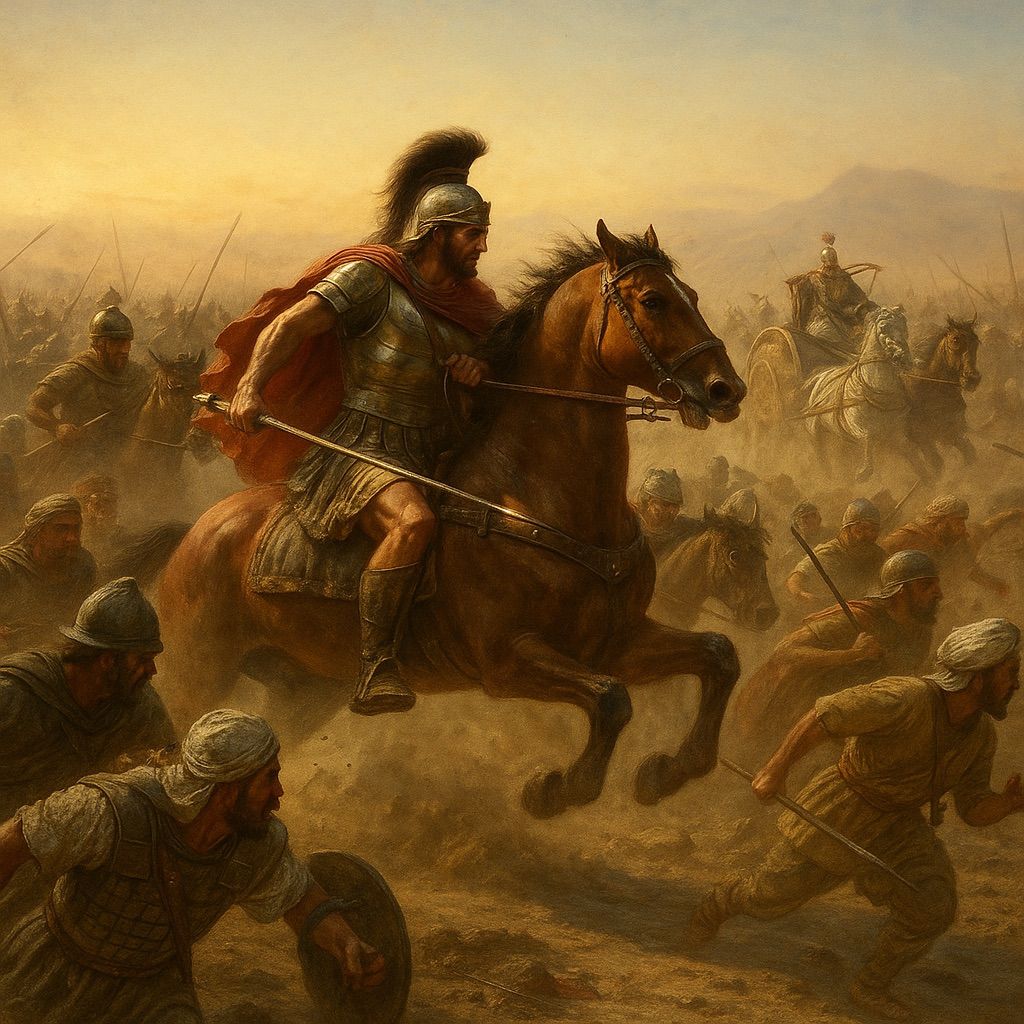
History is littered with moments that feel like the turning of a page in a book, but the Battle of Gaugamela was more than just a page—it was a whole new chapter. On October 1st, 331 BC, the fate of empires and the course of civilizations shifted in the dusty plains of northern Mesopotamia. The encounter between Alexander the Great and Darius III was not merely a clash of armies; it was the collision of two worlds, two visions of power, and two destinies written in blood, sweat, and ambition. To understand why this battle still resonates today, one must step into the chaos of that battlefield, breathe in the dust, hear the thunder of hooves, and feel the raw humanity of men standing on the edge of history.
The Persian Empire had stood for centuries as the colossus of the ancient world. From the Aegean Sea to the Indus River, it stretched across cultures, languages, and landscapes. Its rulers, the Achaemenid kings, commanded wealth and armies that seemed insurmountable. Yet by the 4th century BC, Persia faced an adversary it had not anticipated: a 25-year-old Macedonian king with unshakable confidence and a vision that the world could belong to him. Alexander was not just another ambitious monarch. He had been tutored by Aristotle, hardened by campaigns in Greece, and driven by an insatiable hunger for glory. He wasn’t content to rule Macedon—he wanted to redefine the boundaries of the known world.
When Darius III gathered his massive forces at Gaugamela, he believed sheer numbers would be enough. Ancient accounts claim he assembled perhaps 200,000 men, though historians debate the accuracy. The exact figure matters less than the psychological weight of it: a sea of soldiers, chariots with scythed wheels, and cavalry drawn from every corner of the empire. Against them, Alexander brought roughly 47,000 men—disciplined, battle-tested, and fiercely loyal to their king. They had followed him across mountains, rivers, and deserts, and they trusted that his audacity could turn even the bleakest odds into triumph.
The night before the battle tells us everything about the two leaders. Darius, restless and anxious, kept his men awake, moving, preparing, fearing what was to come. Alexander, in stark contrast, slept deeply. When his officers woke him at dawn, he appeared refreshed, almost casual, as if destiny itself had whispered into his dreams: Tomorrow, the empire is yours. That calm confidence would set the tone for the day.
As dawn broke, the plain near Gaugamela became an amphitheater of war. Dust shimmered in the early light, the sound of thousands of hooves and marching feet vibrating through the ground. Darius positioned himself at the center, elevated on a chariot, a visible symbol of royal majesty. Alexander, by contrast, placed himself at the right flank with his Companion Cavalry, ready to lead from the front. It wasn’t just strategy—it was theater. Both men understood that their presence would inspire or terrify their armies.
The Persians opened with a thunderous advance. Scythed chariots, designed to tear through enemy lines with their spinning blades, raced forward. Yet Alexander’s men, calm and disciplined, parted their ranks to let the chariots pass harmlessly, then cut down the drivers. What was meant to inspire terror became a spectacle of futility. Darius’ great advantage was blunted in a matter of moments.
But the true genius of Alexander lay not in defense but in audacious offense. He recognized the weakness in Darius’ position—the Persian king’s tendency to stay fixed at the center, relying on numbers to envelop his opponent. Alexander feigned retreat on his right flank, luring Persian cavalry into pursuit. At the precise moment, he pivoted and led a wedge formation directly toward the heart of the Persian line. With the ferocity of a thunderbolt, he charged toward Darius himself.
Imagine that moment: the dust choking the air, the clash of steel echoing, Alexander’s Companions slicing through the Persian ranks with terrifying precision. Darius, staring at the young Macedonian king barreling toward him, lost his nerve. He fled. The king of kings, ruler of the largest empire on earth, abandoned his army and his dignity in a single act of fear. The Persian lines, seeing their leader vanish, dissolved into chaos. What had begun as overwhelming might crumbled into disarray.
The battle did not end in minutes, but the result was sealed once Darius fled. Alexander’s forces pursued, cutting down stragglers, capturing treasures, and scattering the remnants of Persia’s proud army. In the aftermath, Alexander showed a mixture of pragmatism and cruelty. He proclaimed victory not only through conquest but also through narrative. To his men, he framed the triumph as destiny fulfilled. To the Persians, he presented himself not merely as a conqueror but as the legitimate heir to their empire. He even honored fallen Persian nobles, a shrewd gesture to win support among his new subjects.
The significance of Gaugamela cannot be overstated. This was not just another battlefield victory; it was the moment the ancient balance of power shifted forever. The Persian Empire, which had dominated for centuries, was effectively broken. Alexander’s star blazed brighter than ever, and his dream of a world united under his banner seemed within reach. He would march on Babylon, Susa, and Persepolis, each step fueled by the momentum born on that dusty plain in 331 BC.
Yet behind the grand narrative lies the human element. Imagine the fear of a Persian soldier, standing shoulder to shoulder with comrades, watching the invincible image of Darius dissolve into dust. Imagine the exhilaration of a Macedonian infantryman, weary from years of campaigning, realizing that in this moment, his sacrifices had carved out a new empire. Imagine Alexander himself, bloodied but unbowed, pausing amid the chaos, realizing that he had done what no Greek had dreamed possible: he had toppled the might of Persia.
The story of Gaugamela is not just about tactics or numbers. It’s about the power of vision, the force of will, and the fragile psychology of leadership. Darius had everything—numbers, resources, and tradition. Alexander had less of everything except one thing: unshakable belief in himself. That belief, magnified through the loyalty of his men, changed history.
And perhaps that is why Gaugamela still matters. It reminds us that history often pivots not on the many but on the few—the leaders who seize the moment, the soldiers who follow despite the odds, and the decisions made in the heartbeat of chaos. On October 1st, 331 BC, the dust of Mesopotamia bore witness to one of those moments. The echo of that clash still reverberates through time, reminding us that destiny often favors the bold.