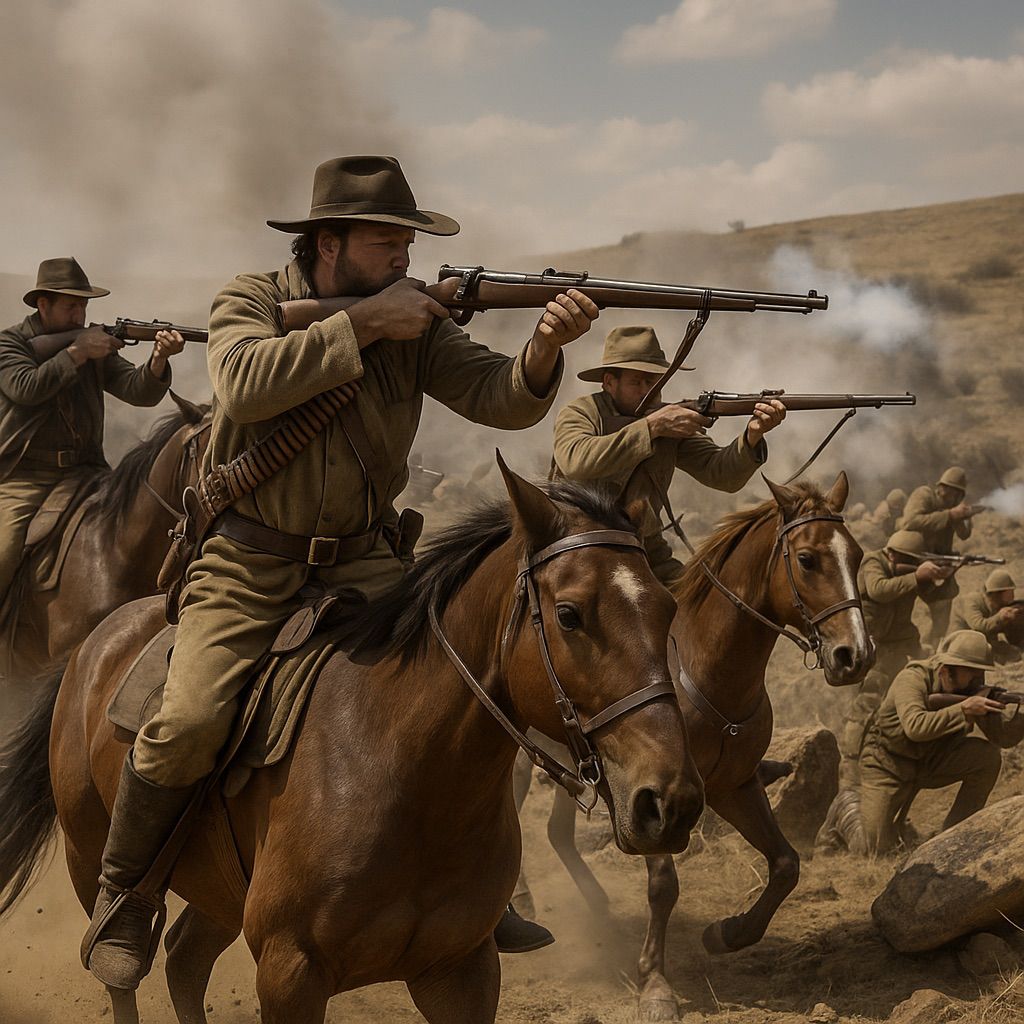
On October 11, 1899, a war erupted on the sun-scorched plains of southern Africa that would test the might of the British Empire, redefine guerrilla warfare, and foreshadow the bloody conflicts of the twentieth century. It was the beginning of the Second Boer War, a clash between the world’s greatest imperial power and two small but defiant republics—the South African Republic (Transvaal) and the Orange Free State. To the British, it was a campaign to assert authority over the resource-rich territories of the region. To the Boers, it was a desperate fight to preserve their independence, their farms, and their way of life. What followed was not the quick victory Britain expected, but a brutal, drawn-out struggle marked by sieges, scorched earth, concentration camps, and extraordinary resilience.
At the end of the 19th century, the map of Africa was colored by European empires. Britain’s possessions stretched from the Cape to Cairo, and its pride was its dominance of trade and industry. Yet nestled within southern Africa lay the Boer republics, established by Dutch-descended settlers who had trekked away from British rule decades earlier. These republics might have remained marginal—small farming communities resisting modernity—were it not for the discovery of gold and diamonds in their soil. Suddenly, the Transvaal and Orange Free State became prizes of immense value. Britain, unwilling to let independent states sit atop such wealth, turned its eyes to conquest.
The Boers, however, were not passive. Hardened by generations of frontier life, skilled in marksmanship, and fiercely independent, they were prepared to defend their republics. Led by men such as Paul Kruger, they saw the British as invaders threatening not just their land but their identity. By October 1899, after years of tension, ultimatums, and failed negotiations, the fuse was lit. When the Boers launched preemptive strikes into British territory, the war began.
The early months shocked Britain. Boer commandos, mounted on sturdy ponies and armed with modern Mauser rifles, proved deadly opponents. They laid siege to British garrisons in Ladysmith, Mafeking, and Kimberley, cutting off supplies and communications. Their knowledge of the land, their mobility, and their guerrilla tactics outmatched the slow, rigid British forces. International observers mocked the empire: how could the greatest power in the world be humbled by farmers?
The sieges became symbols of endurance. In Mafeking, Colonel Robert Baden-Powell (later founder of the Boy Scouts) held out for over 200 days, using ingenuity and bluff to keep Boer forces at bay. In Ladysmith, citizens endured shelling, hunger, and disease. Relief efforts became desperate races against time, and when British forces finally broke the sieges in 1900, the empire celebrated—but the war was far from over.
Britain responded with overwhelming force. Reinforcements poured in, and generals like Lord Roberts and Lord Kitchener led massive campaigns. The British captured the Boer capitals—Bloemfontein, Pretoria, Johannesburg—and declared the republics annexed. London cheered victory. But in the veld, the war was only beginning.
The Boers adapted. No longer fighting in formal battles, they dissolved into small, mobile commando units. They struck railways, ambushed supply lines, and vanished into the vast countryside before British troops could respond. They became shadows in the grasslands, impossible to pin down. Britain, frustrated, escalated its tactics.
This escalation was brutal. Kitchener launched a scorched-earth campaign, burning farms, slaughtering livestock, and salting the earth to deny the Boers food and shelter. Families of suspected fighters were rounded up and placed in concentration camps—the first of their kind in modern warfare. Conditions were horrific: disease, hunger, and exposure claimed the lives of over 26,000 Boer women and children, along with thousands of Black Africans who were also imprisoned. The camps shocked the conscience of the world, sparking outrage and tarnishing Britain’s reputation as a “civilized” empire.
And yet, despite suffering and loss, the Boers fought on. Their resilience was legendary. In villages, women carried messages, smuggled supplies, and held families together. Fighters slept under the stars, carried rifles across endless plains, and fought battles that seemed unwinnable. Their struggle turned them into symbols of defiance against imperial power.
By 1902, however, exhaustion and devastation forced a reckoning. With their land destroyed, their families suffering in camps, and resources depleted, the Boer leaders sued for peace. On May 31, 1902, the Treaty of Vereeniging was signed. The Boer republics were annexed into the British Empire, but Britain promised eventual self-government and granted funds for rebuilding. Though defeated, the Boers had earned concessions that ensured their survival as a people.
The Second Boer War was more than a colonial conflict—it was a harbinger of the modern age of warfare. It showed how guerrilla tactics could frustrate even the mightiest armies. It introduced concentration camps as tools of war. It demonstrated that public opinion, stirred by journalism and outrage, could shape international perception. And it left deep scars in South Africa, sowing tensions that would influence the nation’s politics for generations.
But beyond strategy and politics lies the human story. Imagine the Boer farmer watching his homestead burn, clutching his rifle, knowing his family is being marched to a camp. Picture the British soldier, shipped from Manchester or Glasgow, bewildered by the endless veld, terrified of ambushes in the night. Picture the children in the camps, their hollow eyes staring at a world they did not understand, paying the price for battles fought by men. These are the ghosts of the war—ordinary lives consumed by the fire of empire and resistance.
October 11, 1899, was the day the war began. It was a war born of pride, greed, and survival. It was the war that reminded the British Empire of its limits and revealed the Boers’ indomitable spirit. And it was a war that forces us, even today, to ask hard questions about power, resistance, and the cost of conquest.