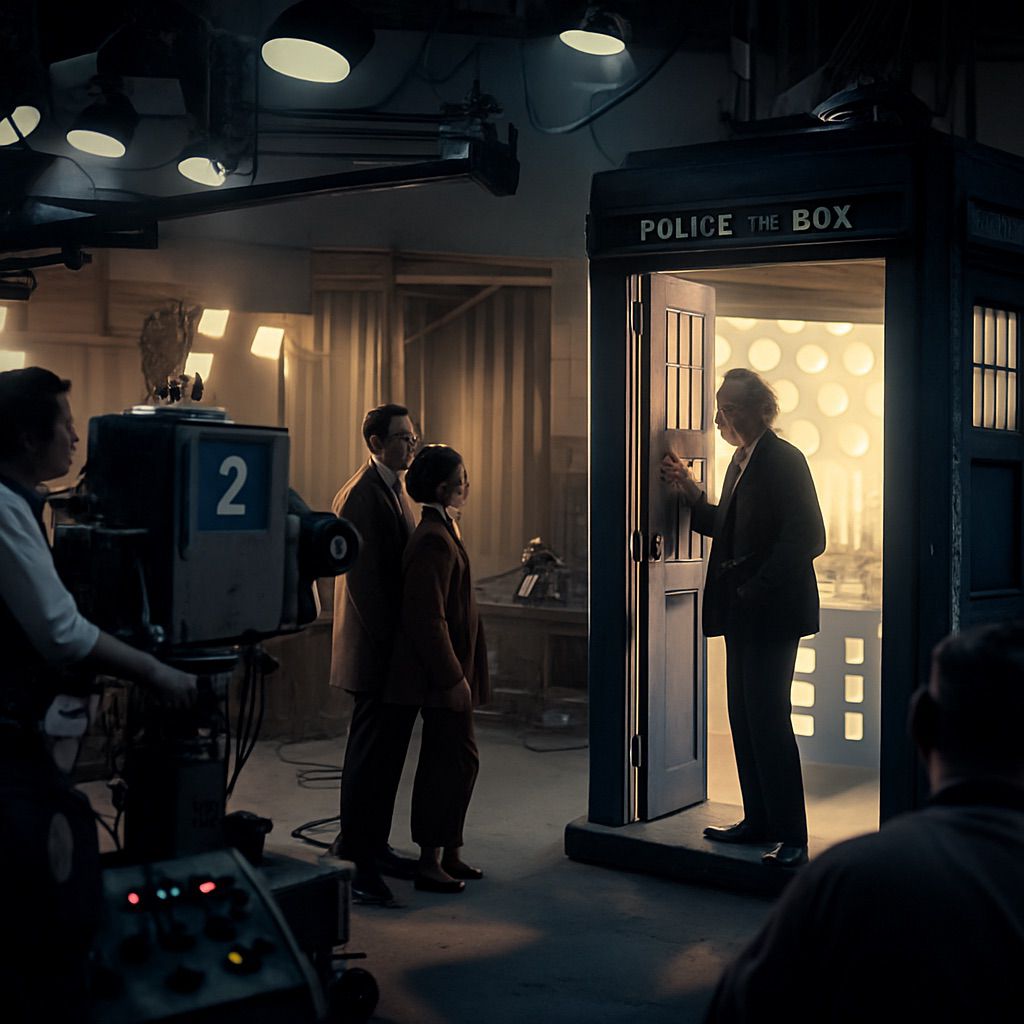
On a fog-filled November evening in 1963, British television quietly changed forever. The moment itself didn’t arrive with fireworks or prestige or any of the pomp that would later surround the cultural phenomenon it became. Instead, it slipped into the BBC’s broadcast lineup nestled between educational programming and the tail end of children’s shows, a modest science-fiction series meant to fill a late Saturday afternoon slot. But what premiered that night—an unassuming episode titled “An Unearthly Child”—was something far more enduring. It was the birth cry of Doctor Who, a series that would go on to become one of the longest-running and most beloved institutions in television history. To understand why this first episode mattered, and why it continues to ripple across generations, it’s worth traveling back to that exact night, when Britain itself was a country navigating uncertainty, and when a strange blue box and an even stranger traveler offered a glimmer of possibility.
November 23, 1963 had already seared itself into public consciousness for far more tragic reasons. Just the day before, President John F. Kennedy had been assassinated in Dallas, an event that sent shockwaves around the world and overshadowed nearly everything else in the news cycle. The BBC knew full well that launching a brand-new program less than 24 hours later meant attention would be scattered and public mood somber. Yet despite the circumstances—and perhaps in a quiet way because of them—Doctor Who aired as planned, its premiere broadcast slipping into living rooms with a kind of understated resilience. And for those who tuned in, the experience was unlike anything they had seen before.
The episode began not with aliens or explosions, but with an eerie simplicity: a junkyard, a fog, a police telephone box humming with a mystery of its own. Within minutes, the show introduced audiences to two schoolteachers investigating a peculiar student, Susan Foreman, whose uncanny knowledge and odd behavior sparked their curiosity. Their search led them to 76 Totter’s Lane, where they encountered Susan’s grandfather—or guardian—or something more complicated entirely: The Doctor. Played by William Hartnell, the Doctor was immediately puzzling, enigmatic, irritable, brilliant, and absolutely magnetic. His refusal to explain himself combined with the series’ stripped-down visuals created an atmosphere that was more unsettling than flashy, more psychological than sensational. When the teachers finally forced their way inside the police box, the moment of revelation was both iconic and deeply disorienting. The tiny box was impossibly vast inside, filled with futuristic technology, glowing panels, and a humming console that suggested immense capability. It was the first time the audience stepped into the TARDIS, and even through the limitations of 1960s production, that reveal landed with breathtaking imagination.
If you watch that episode today, you can still feel that moment—the sudden shift from the ordinary to the extraordinary, the spark of discovery that would come to define the series. The TARDIS interior did not rely on the polished special effects of modern science fiction; instead, it leaned into creativity, abstraction, and suggestion. Its very roughness created a sense of mystery, a feeling that this world stretched far beyond what the camera captured. And at the center of it all stood Hartnell’s Doctor, not yet the whimsical hero audiences would come to adore, but a far more abrasive and alien figure. He wasn’t cuddly, he wasn’t particularly warm, and he certainly wasn’t safe. But he was fascinating—because he was different.
What makes the first episode of Doctor Who so compelling is that it didn’t try to be the epic, galaxy-spanning adventure the franchise would later become. Instead, it built itself on curiosity. The show was conceived as an educational program as much as an entertainment one, meant to teach children about science, history, and logic through the framing of time travel. It was grounded, almost quiet in its ambition. No one involved—not the producers, not the writers, not the actors—could have predicted that Doctor Who would endure for decades, reinventing itself again and again, becoming a fixture of British identity and a global fandom that crosses languages, cultures, and generations. In that first episode, Doctor Who was just… interesting. Strange. Charming. And, for reasons no one could fully articulate, it drew people in.
Part of what made the episode so mesmerizing was its atmosphere. The production was filmed in stark black and white, giving it a dreamlike, almost noir quality. Shadows stretched against junkyard walls. Fog curled in alleys. The TARDIS interior glowed with softness and mystery. The pacing was slower than modern television but hypnotic in its own way, allowing viewers to linger on details, to absorb the eerie tension that pulsed through each scene. Even the smallest moments—a tilt of Hartnell’s head, a flicker of the console lights—felt intentional, crafted to pull you deeper into the story.
The Doctor himself, as portrayed in this first incarnation, was absolutely unlike the versions most modern fans know. Hartnell’s Doctor was prickly, defensive, and at times almost sinister. But beneath that tough exterior was a complexity and vulnerability that emerged in subtle ways. His interactions with Susan hinted at a tenderness and protectiveness that he struggled to show directly. His bewilderment at the teachers’ intrusion masked a deeper fear of being discovered or misunderstood. Hartnell’s performance created a character who was larger than life yet deeply human—flawed, frightened, brilliant, and unpredictable. It’s the core of what the Doctor would always remain, even as different actors put their own spins on the role.
One detail worth remembering about this first episode is how innovative it was for its time. In 1963, science fiction in television was still viewed with skepticism. Many executives worried that aliens, time travel, and advanced machines would be too outlandish or silly for serious audiences. Budgets were small, sets were flimsy, and the very idea of constructing a long-term narrative around time travel was considered a risk. Yet Doctor Who leaned directly into those risks. It imagined a universe where history, science, mystery, and morality crashed against each other in ways no one had attempted on British television. The series dared to take young viewers seriously, trusting them to follow complex concepts, to think beyond the familiar, and to embrace imagination as a tool rather than an escape.
That spirit of innovation was evident from the earliest frame of the premiere, and it only grew stronger as the episode built toward its conclusion. When the Doctor, panicked by the teachers’ insistence, abruptly launched the TARDIS into the vortex and hurtled them all back in time, Doctor Who took its first bold leap. The characters landed in prehistoric Earth, setting the stage for a story about survival, tribal politics, and the origins of human society. It wasn’t glamorous. It wasn’t shiny. It wasn’t even particularly fast-paced. But it was daring. It was weird. And it was unforgettable.
The journey of that first episode didn’t become legendary overnight. Ratings on premiere night were modest, in part because of competing news coverage about the assassination. The BBC even re-aired the episode the following week to ensure viewers had another chance to catch it. Slowly, steadily, audiences began to grow. Children were enthralled by the eerie atmosphere and strange new worlds. Adults were drawn to the intelligence of the storytelling. The show’s popularity would skyrocket months later with the introduction of the Daleks, but the foundation had been laid in that single, daring hour: a story about curiosity, about stepping into the unknown, and about the remarkable things that happen when ordinary people encounter the extraordinary.
Over the following decades, Doctor Who evolved dramatically. New Doctors emerged with new personalities, new companions came and went, and new monsters filled viewers with both terror and delight. The show survived budget cuts, production hurdles, cancellations, reboots, and the changing tastes of several generations. But through all its transformations, the DNA of the show—the spirit first introduced in “An Unearthly Child”—remained intact. It was a show about exploration. About asking questions. About pushing against the boundaries of knowledge and imagination. About finding bravery in unexpected places.
Perhaps most importantly, that first episode introduced the idea that change itself is not a flaw but a feature. The Doctor’s ability to regenerate into new forms—one of the most iconic aspects of the series—was not yet part of the canon in 1963. But the seeds were there. The Doctor was strange, unpredictable, and constantly evolving. The show felt alive, as though it could shift shape whenever needed. And over time, that flexibility would become its secret weapon. Doctor Who could adapt to cultural shifts, emerging technologies, and new audiences because the show itself was built on reinvention.
Watching “An Unearthly Child” now, with modern television as saturated and polished as it is, you can still feel the spark of something special. You can sense that the creators weren’t just producing another program—they were experimenting, pushing boundaries, and imagining things far beyond their budget or time period. The episode is a testament to what creativity can achieve even with limited resources. And in an era where massive franchises dominate screens with multimillion-dollar effects, the handcrafted charm and raw ingenuity of that early Doctor Who story stand out all the more.
It is impossible to count how many people were inspired by this single episode. Writers, directors, actors, scientists, engineers, teachers, dreamers—countless individuals cite Doctor Who as the spark that ignited their imagination. The show taught audiences that curiosity mattered. That knowledge mattered. That compassion mattered. That time and space were not barriers but invitations. And all of that began on one chilly Saturday afternoon when a mysterious man, his curious granddaughter, and two ordinary teachers stepped into an impossible blue box and disappeared into the swirling unknown.
Sixty years later, the legacy of that moment continues to grow. Fans gather at conventions across the world, cosplaying their favorite Doctors and companions. New audio dramas, comics, novels, spin-offs, and television seasons continue to extend the timeline. Children still hide behind couches at frightening scenes, just as their parents and grandparents once did. The TARDIS sound—the rising and falling groan of the engines—remains instantly recognizable. And the themes introduced in that very first episode resonate more than ever. Exploration. Curiosity. Equality. Bravery. Change.
It’s remarkable to think that none of it would have existed without the creative risks taken on November 23, 1963. That first episode wasn’t just a pilot for a new show—it was an opening door. A promise. A spark of wonder that lit a fire lasting generations. Some shows entertain. Some shows inform. But very few shows become cultural landmarks, shaping the imaginations of entire populations and expanding the boundaries of storytelling. Doctor Who managed that from its very first breath.
And perhaps that is the greatest magic of all: the premiere wasn’t trying to create a legacy. It wasn’t trying to become a phenomenon. It was simply trying to tell a good story. A story about a girl who didn’t fit in, about teachers who cared enough to investigate, about a strange old man guarding secrets bigger than the world itself. A story about stepping beyond fear into discovery. A story that whispered to viewers: What if there’s more out there? What if the universe is waiting for you?
That whisper turned into a roar. And all these decades later, the echo of that very first episode still rings out—timeless, hopeful, endlessly imaginative.
Because on that night in 1963, time didn’t just move forward. It unfolded. It opened. It invited. And millions of people have been traveling with the Doctor ever since.