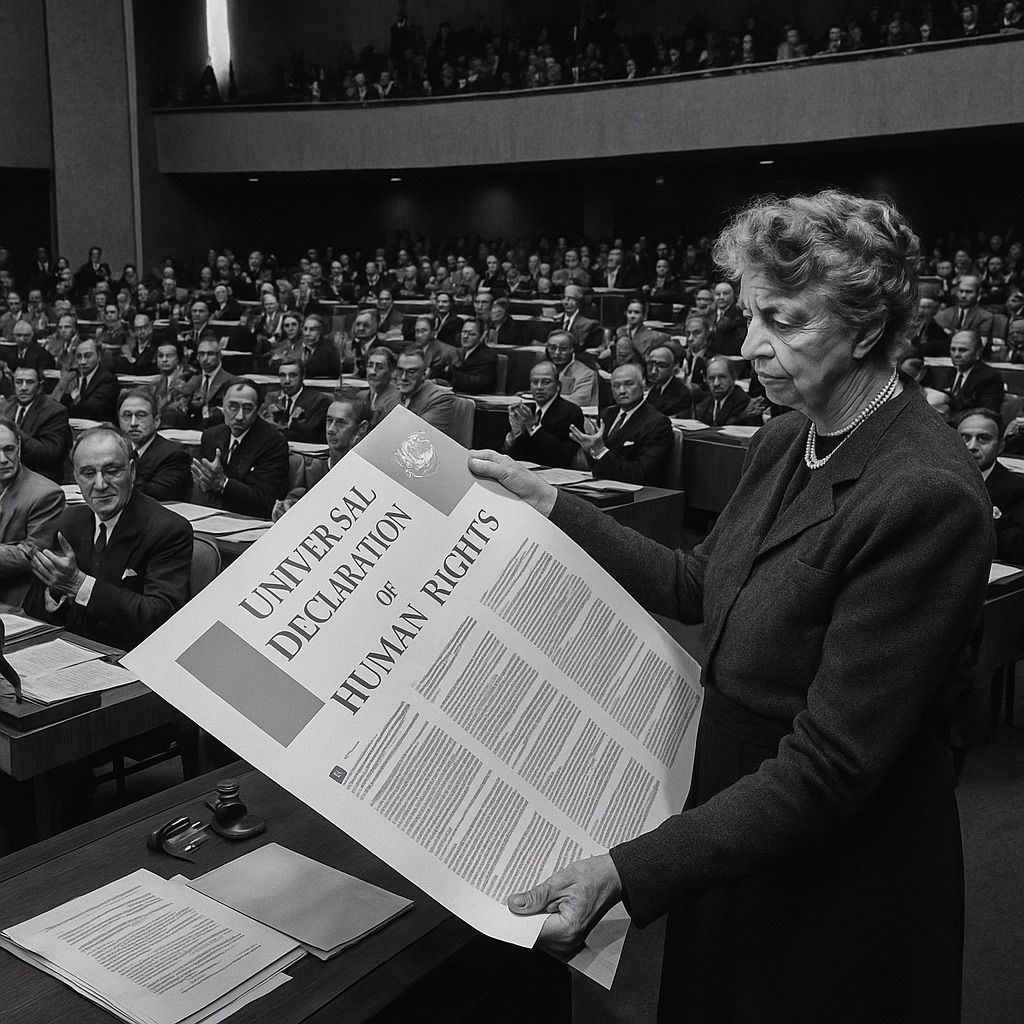
In the cold December air of 1948, as the world continued to patch its wounds from a war more devastating than anything humanity had ever endured, a different kind of battle was unfolding inside the United Nations General Assembly in Lake Success, New York. Delegates from dozens of nations, many still reeling from the trauma of occupation, genocide, and political collapse, gathered to discuss a document that dared to do something unprecedented: declare, openly and unflinchingly, that every human being on earth possessed inherent dignity and rights, regardless of nationality, religion, class, or ideology. In a century defined by unimaginable cruelty and division, the Universal Declaration of Human Rights emerged as a beacon of hope—a promise that humanity could rise above its darkest moments and attempt to define, at last, what it meant to treat all people with fairness and respect. This declaration, which years earlier had seemed almost impossible to imagine, was now on the verge of becoming reality, carried forward by leaders who refused to allow the atrocities of the past to become the blueprint for the future.
The momentum behind the declaration began long before delegates took their seats in 1948. In the immediate aftermath of World War II, the world’s horror at Nazi concentration camps, mass executions, forced labor systems, and the systematic dehumanization of entire populations forced global leaders into a stark confrontation with their own failures. Never before had the world seen such destruction inflicted with such calculated efficiency, and the question of how humanity could prevent such tragedies from recurring became a moral imperative. When representatives gathered in San Francisco in 1945 to establish the United Nations, they knew the organization had to stand for something greater than political alliances and peacekeeping mandates. Yet the resulting UN Charter was cautious, gesturing toward human rights without explicitly defining what those rights should be. This omission left many dissatisfied, especially activists and nations emerging from colonial rule who felt that without a clear, universal standard, the world risked repeating its most catastrophic mistakes.
Among the voices pushing the hardest for a global framework was Eleanor Roosevelt, who had stepped into the role of U.S. delegate to the new Commission on Human Rights not out of any formal diplomatic training but out of a deeply ingrained conviction that moral leadership was necessary for global stability. Eleanor carried with her the legacy of her late husband, Franklin D. Roosevelt, who had championed the “Four Freedoms”—freedom of speech, freedom of worship, freedom from want, and freedom from fear—as essential pillars of a peaceful world. But she also brought her own lived experience: the empathy she had cultivated while traveling through war-torn cities, refugee camps, mining towns, and segregated American communities. Her work on the Commission would require her to navigate a labyrinth of clashing ideologies, national interests, and cultural norms, yet her calm persistence would ultimately become one of the most defining forces behind the Universal Declaration.
The first draft of the document was prepared by John Humphrey, a Canadian lawyer whose encyclopedic knowledge of legal systems gave him the foundation to craft something truly global in scope. Humphrey approached his task like a historian, a lawyer, and an idealist all at once. On his desk sat an enormous collection of world constitutions, philosophical treatises, religious texts, and political charters. He drew inspiration from the American Bill of Rights, the French Declaration of the Rights of Man and of the Citizen, the writings of Confucius, the teachings of the Quran, and the democratic ideals of newly independent nations. His goal was not to impose one culture’s values upon another but to find the overlapping principles that all human societies, at their best, aspired to uphold. The result was a sweeping statement of rights spanning civil liberties, political freedoms, economic security, and social equality—all expressed in language that the average person could understand.
Yet drafting the document was only the beginning. The real struggle emerged during months of debate inside the Commission on Human Rights and later in the UN’s Third Committee, where delegates from vastly different systems of governance attempted to reconcile their conflicting views. The Soviet Union argued forcefully for economic and social equality, insisting that the right to food, work, and shelter was as essential as the right to vote or speak freely. Western democracies prioritized political freedoms and warned that states must not be given excessive power over the individual. Meanwhile, newly decolonizing nations pressed for recognition that human rights must apply not only within nations but also in the context of imperialism, where powerful countries continued to control the destinies of millions without representation or consent. These conversations grew heated, occasionally erupting into ideological clashes that reflected the early tension of the Cold War. But despite fierce disagreements, a shared acknowledgment persisted beneath the rhetoric: the world needed this document, and failure to adopt it would be a betrayal of the millions who had suffered through war, oppression, and genocide.
Eleanor Roosevelt became the crucial bridge between competing worldviews. She used personal charm where diplomacy stalled, moral clarity where politics muddied the waters, and unwavering conviction where others hesitated. Late into the night she studied revised drafts, scribbled notes in the margins, wrote letters to world leaders, and reassured smaller nations that their voices mattered. Her insistence that the declaration had to be accessible to the ordinary person—not just lawyers or politicians—reshaped the language into something almost poetic in its simplicity: “All human beings are born free and equal in dignity and rights.” That opening line, elegant and courageous, would become one of the most quoted sentences in the history of international law.
By December 1948, the debates had reached their final stage. Delegates gathered once again in the General Assembly, each carrying the weight of their nation’s hopes and anxieties. Some worried the declaration would be impossible to enforce; others feared it would interfere with domestic sovereignty. Yet, as speeches echoed through the chamber, a quiet sense of unity began to take hold. Representatives who had once clashed over ideology now found themselves acknowledging a shared truth—that humanity had reached a crossroads, and failing to act would leave the door open for future atrocities. As the final vote was cast, the room held its breath. Forty-eight nations voted in favor. Eight abstained. None voted against. The Universal Declaration of Human Rights had passed.
The moment was met with applause, relief, and an unmistakable sense that history had shifted. Though the declaration had no legal force, its moral authority was undeniable. Newspapers around the world hailed it as a triumph of the human spirit. In Paris, London, and New York, crowds gathered outside consulates and universities to discuss the newly adopted principles. Survivors of war wrote letters expressing hope that future generations might be spared the suffering they had endured. Civil rights activists in the United States, anti-colonial leaders in Africa and Asia, and reformers in Latin America all saw the declaration as validation for their struggles. At a time when humanity felt fragile and fractured, the UDHR offered something rare: a shared vision of dignity, equality, and justice that transcended borders and ideologies.
In the decades that followed, the declaration became the blueprint for a new generation of international treaties, including the International Covenant on Civil and Political Rights and the International Covenant on Economic, Social, and Cultural Rights. It influenced new constitutions in nations emerging from colonial rule. It inspired social movements, from the fight against apartheid in South Africa to campaigns for gender equality, children’s rights, LGBTQ+ rights, and protections for people with disabilities. Its principles appeared in classrooms, courtrooms, refugee camps, and grassroots campaigns around the world. Even authoritarian governments, when accused of violating human rights, found themselves forced to respond—not because the UDHR had legal teeth, but because it had become the moral compass against which nations were judged.
Yet the legacy of the UDHR is not one of unbroken progress. The world continues to struggle with human rights abuses, discrimination, and violence. Genocides have occurred long after the declaration’s adoption. Governments still silence dissent, restrict movement, and violate basic freedoms. Economic inequality persists, disproportionately affecting the most vulnerable. Cultural and political differences still challenge the dream of universal application. But the enduring power of the declaration lies not in the perfection of its implementation but in its ability to remind humanity of what is possible. It remains a guidepost—a vision of the world we continue striving to build, even when we fall short.
Today, as the Universal Declaration approaches its eighth decade, its words remain as urgent as ever. New technologies raise questions about privacy, surveillance, and digital rights. Migration crises challenge our understanding of borders and belonging. Climate change threatens the stability and well-being of millions, testing our commitment to Article 25’s promise of a standard of living adequate for health and well-being. But through all of these challenges, the declaration endures, offering a framework grounded in the simple but revolutionary idea that every person matters.
The story of the Universal Declaration of Human Rights is ultimately a story of hope. It is the story of how, in the wake of unimaginable devastation, the world chose not bitterness but aspiration—not vengeance but empathy. It is the story of people like Eleanor Roosevelt, John Humphrey, Charles Malik, René Cassin, and countless unnamed delegates who believed that dignity was not a luxury but a birthright. And it is the story of millions throughout the world who continue to raise their voices in defense of those rights, proving that the declaration was not merely adopted—it was embraced. As long as its principles live in the minds, hearts, and actions of people everywhere, the UDHR remains one of humanity’s greatest achievements: a collective promise to build a world in which every person can live freely, equally, and without fear.