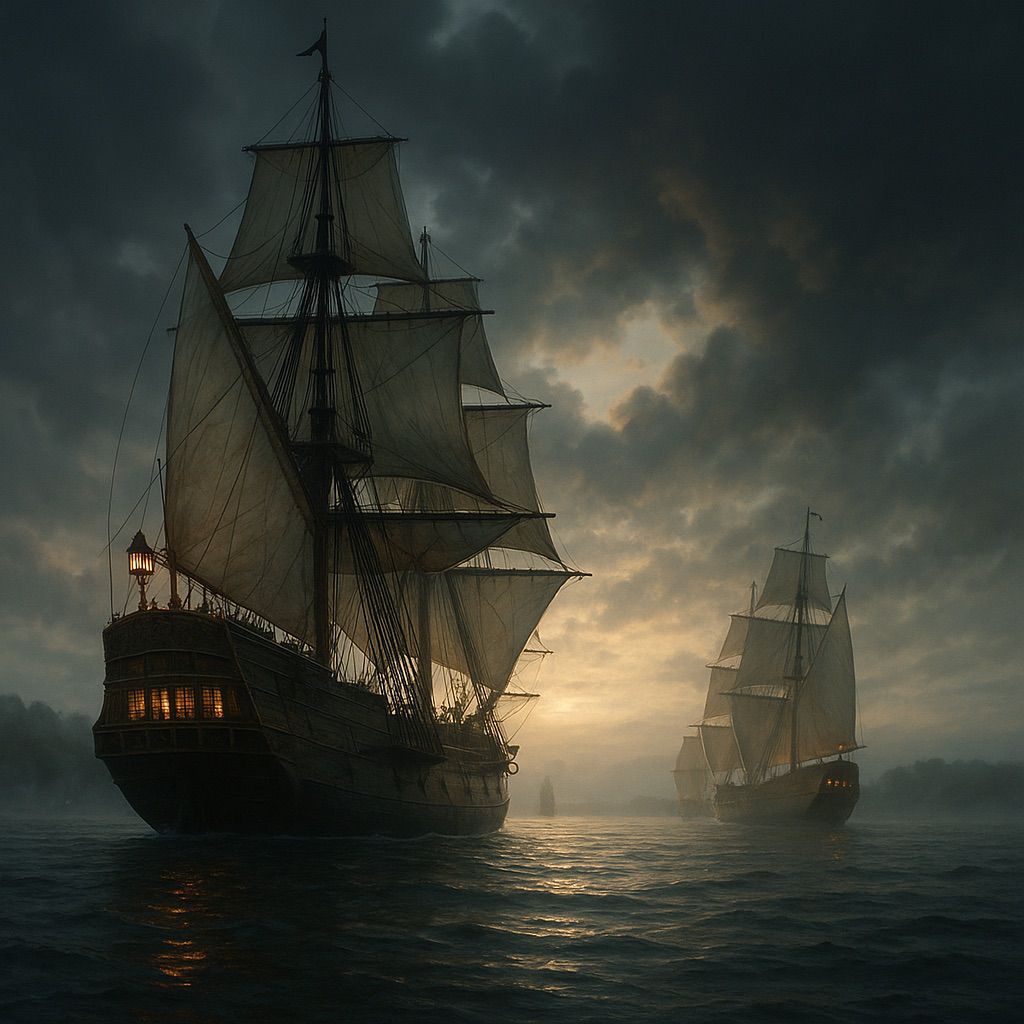
Francis Drake’s departure from Plymouth Sound on November 15, 1577, was the kind of moment that felt suspended between myth and reality. To the people who watched the sparsely lit silhouettes of three small ships push away from the English coast, the sight held more questions than answers. Few knew the mission, fewer still understood its scope, and none could imagine the way this departure would shape England’s future. Behind the secrecy, the whispers, and the brisk autumn wind was a man whose ambition and audacity were about to redirect the winds of empire.
Drake had not simply appeared on the stage of history; he had carved his way onto it. Born into modest circumstances, shaped by hardship, and thrust early into a life at sea, he had grown into a hardened mariner long before commanding his own fleet. His hatred of Spain was not political posturing but personal memory—memories filled with the crackle of burning timber and the screams of English sailors ambushed in Nombre de Dios years earlier. And Queen Elizabeth I, ever the calculating monarch, understood that Drake’s hunger for reprisal could be harnessed into something useful, something that served the crown while allowing her to maintain plausible deniability.
In the dim predawn hours of that November morning, Drake walked the deck of the Pelican, soon to be renamed the Golden Hind, feeling the familiar pitch of his ship beneath him. Around him, men hauled ropes, checked rigging, whispered superstitions, or simply stared out into the dark, wondering whether they would ever see England again. They had been assembled not just for a voyage, but for a purpose—a mission that neither parliament nor public could know about, a mission that required a certain kind of man at its helm.
Drake had spent years preparing for this. The charts, the hidden coves along the Spanish Main, the patrol routes of treasure galleons—he had studied them all. His companions included trusted mariners and questionable allies. Thomas Doughty, intelligent but dangerously ambitious; Richard Hawkins, young but eager; and Nicholas Farrington, a navigator whose steady instincts would save the fleet more than once. Together they had forged a plan to breach the Strait of Magellan, slip into waters Spain claimed as its own, and strike at the very arteries of the Spanish Empire.
The crossing of the Atlantic tested even Drake’s resolve. Weeks of storms slammed relentlessly into the fleet. Water barrels leaked. Rats found their way into provisions. Men whispered that the voyage was cursed. Yet Drake pushed on, using every scrap of knowledge gleaned from earlier expeditions. When they at last reached the coast of Brazil, battered but intact, he allowed the crew a rare respite. Fires burned along the shore as the men dried clothes stiff with salt, repaired torn sails, and exchanged cautious smiles. They were still alive, still together, still moving toward the unknown.
The real test came at the Strait of Magellan, that serpentine, treacherous passage between continents. The sky darkened with sudden storms; icy winds screamed through the narrow channels; visibility dropped to almost nothing. Men clung to ropes with frozen fingers as towering waves smashed against the hulls. More than once Drake feared the Pelican would splinter and be swallowed by the sea. But Farrington’s guidance proved invaluable—his instinct for currents and shifting winds allowed the fleet to thread through waters that had claimed countless lives before them. When they finally emerged into the Pacific, the men erupted into cheers, believing the worst behind them.
They were wrong.
The Pacific had been christened the “peaceful ocean” by explorers who had experienced it on gentler days, but Drake’s fleet encountered a world of storms. A gale scattered the ships, and one was lost entirely. Yet amid this chaos, Drake reinvented himself—not merely a survivor, but a predator. The Spanish Empire had grown complacent, believing its Pacific harbors safe from European reach. Drake shattered that illusion. He raided settlements along the Chilean and Peruvian coasts, seized treasure-laden ships, and liberated enslaved Indigenous captives. With every victory, every captured galleon, his legend grew.
Word of “El Draque” spread across Spanish territories, not merely as a name but as a living terror. He was said to appear out of nowhere, to strike with impossible precision, to vanish back into the horizon as quickly as he came. Spain’s colonial subjects learned to watch the sea not for its beauty, but for the threat it concealed.
Yet Drake’s voyage was not only destruction. He spent months repairing ships on uncharted islands, trading with Indigenous peoples, documenting coastlines unknown to Europeans, and marveling at stars unseen from England’s skies. He began keeping detailed logs that would later reshape navigation itself. In quieter moments, he walked alone along foreign beaches, letting the roar of unfamiliar surf remind him of how far from home he had drifted.
When he finally turned northward, sailing along the California coast and claiming “Nova Albion” for the English crown, he planted more than a flag—he planted the seed of an empire. He could not have known that centuries later, the very land he named would become the backbone of another nation entirely. For Drake, it was simply another strategic victory, a statement to Spain that the Pacific was no longer theirs alone.
The return across the Pacific was a feat almost beyond comprehension. No English ship had ever crossed that vast expanse. The men endured storms, starvation, and the relentless passage of months without sight of land. And yet they persevered, driven by the promise of home and by Drake’s unyielding will.
When the Golden Hind finally sailed back into Plymouth on September 26, 1580, the sight of it caused an uproar. Crowds flooded the harbor. Men shouted. Women cried. The ship was weighed down with treasure so vast it dwarfed anything England had ever seen. Drake himself stepped onto English soil not as a privateer, but as a national hero. Queen Elizabeth knighted him on the deck of his ship, cementing his place in history.
There was criticism, of course—accusations of piracy, questions of morality, disputes over Spain’s rights versus England’s ambitions. But the tide of public sentiment swept all objections aside. Drake had done something no Englishman had ever achieved, something few dared even imagine. He had circumnavigated the globe, struck a crippling blow to Spain’s dominance, and opened the door to England’s future as a world power.
His voyage was not merely an expedition. It was a turning point. It was the moment England stopped being an island nation and started becoming an empire. It was the moment the world got a glimpse of what the next centuries would bring—competition, colonization, conflict, discovery, and the relentless push of nations hungry for influence.
Drake’s legacy remains complicated, forged of both brilliance and brutality. But history rarely honors simplicity. It honors magnitude. And Drake’s voyage, begun in secrecy on a clear November morning, reshaped the world more profoundly than any of those watching from Plymouth’s shores could ever have known.