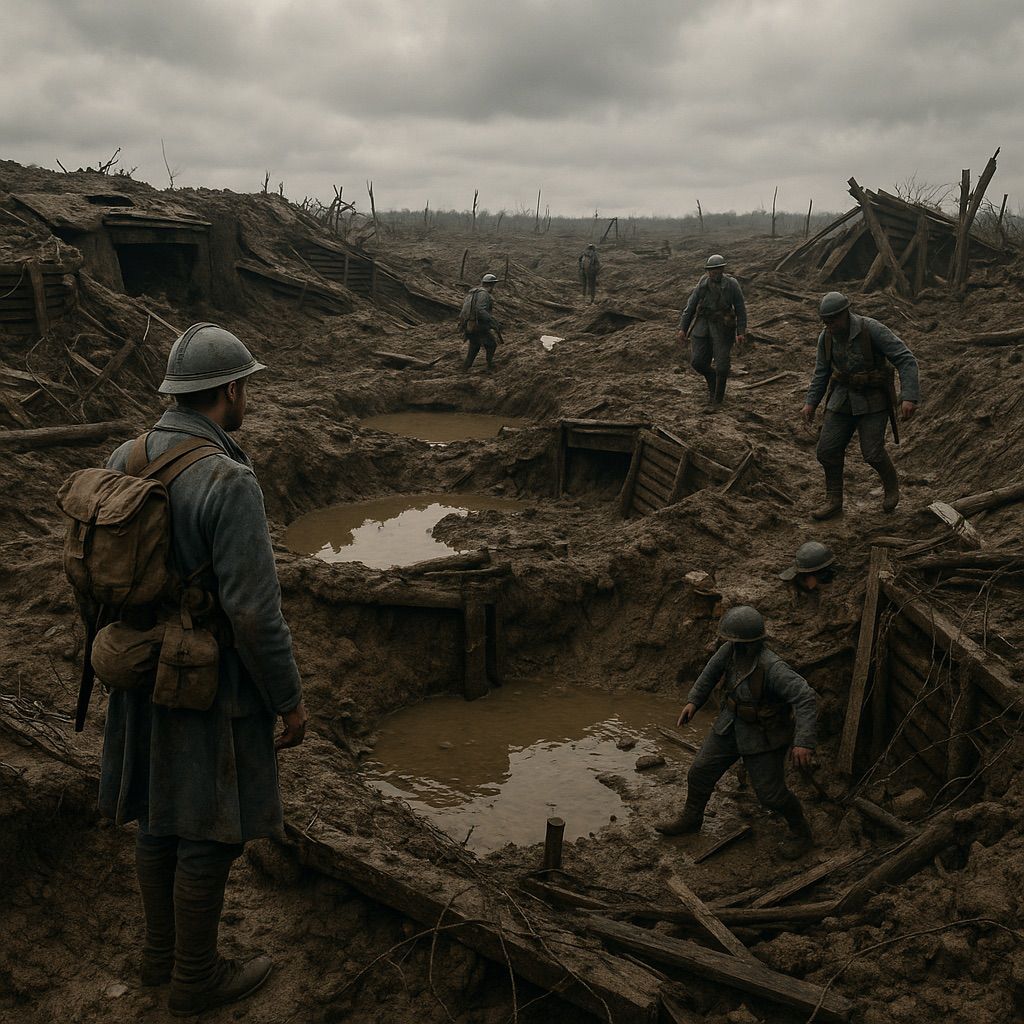
The Battle of Verdun did not begin with a dramatic breakthrough or a swift advance. Instead, it unfolded slowly, deliberately, and mercilessly, grinding human lives into the soil of northeastern France over the course of 303 days. When it finally ended on December 18, 1916, Verdun had become more than a battlefield. It was a symbol of industrialized death, of endurance pushed beyond reason, and of a war that seemed determined to consume an entire generation.
Verdun was never intended to be just another offensive. For the German high command, it was meant to be something far more calculated and devastating. General Erich von Falkenhayn believed that France could be bled white by attacking a position the French could never afford to abandon. Verdun, with its historic fortresses and strategic importance, was the perfect target. Falkenhayn did not necessarily seek to capture the city outright. His aim was attrition—forcing France to pour men into the fight until its army collapsed under the weight of its own losses.
On February 21, 1916, the German assault began with one of the most intense artillery barrages the world had ever seen. Shells rained down relentlessly, tearing apart trenches, forests, and bodies alike. The earth itself seemed to scream under the violence. French soldiers, many of them stunned and buried alive, struggled to regroup as German infantry advanced through a shattered landscape.
Verdun’s defenses were formidable but incomplete. Years of complacency had left some forts under-garrisoned and inadequately supplied. Yet what the French lacked in preparation, they made up for in resolve. Reinforcements were rushed to the front along the “Sacred Way,” a single supply road kept open day and night under constant shellfire. Trucks moved in endless columns, carrying men toward the front and wounded away from it, creating a grim rhythm that would continue for months.
General Philippe Pétain emerged as the battle’s defining figure on the French side. Calm, methodical, and deeply aware of his soldiers’ limits, he reorganized defenses and emphasized artillery coordination. His famous declaration, “They shall not pass,” became both a rallying cry and a grim vow. Verdun would be held, no matter the cost.
The cost was staggering. Attacks and counterattacks turned hills, forts, and villages into names etched in blood—Douaumont, Vaux, Fleury. Ground was gained and lost repeatedly, sometimes measured in meters at the price of thousands of lives. Trenches collapsed under shellfire, forcing soldiers to fight in open craters filled with mud, water, and decomposing bodies. The landscape became unrecognizable, transformed into a lunar wasteland scarred by millions of shell holes.
As spring turned into summer, Verdun became a war within the war. Both sides fed divisions into the furnace, rotating units to prevent complete collapse. Even so, psychological trauma spread rapidly. Soldiers spoke of “shell shock,” of men reduced to silence or hysteria by constant bombardment. Sleep became impossible. Survival felt arbitrary, dependent on chance rather than skill or bravery.
German frustration mounted as the battle dragged on without decisive results. Falkenhayn’s strategy succeeded only in destroying his own army alongside the French. By mid-1916, German resources were strained, and public confidence wavered. Falkenhayn was eventually replaced, but the damage had been done. Verdun had become a trap for both sides.
In the autumn, the French regained momentum. Improved artillery tactics and renewed offensives slowly pushed German forces back from key positions. Fort Douaumont, once a symbol of German success, was retaken. Fort Vaux, defended with almost mythic desperation earlier in the year, stood as a monument to endurance and suffering.
By December, exhaustion defined both armies. When fighting finally ceased on December 18, 1916, neither side could claim real victory. Verdun remained in French hands, but at an almost incomprehensible cost. Roughly 700,000 men had been killed, wounded, or gone missing. Entire regiments ceased to exist. Families across Europe would never recover from the loss.
The physical devastation was matched by moral shock. Verdun exposed the true nature of modern warfare—mechanized, impersonal, and ruthlessly efficient at killing. It shattered illusions of glory and honor, replacing them with images of mud, blood, and endless artillery fire. For France, Verdun became sacred ground, a symbol of national endurance. For Germany, it became a cautionary tale of strategic hubris.
The battle reshaped military thinking. It accelerated the search for alternatives to trench warfare, contributing to the development of tanks, improved artillery coordination, and new infantry tactics. Yet no innovation could erase Verdun’s legacy. It remained a warning etched into history, a reminder of what happens when strategy ignores humanity.
In the years that followed, Verdun became a place of remembrance. Memorials rose where soldiers once fell. Forests regrew over shattered ground, but beneath the soil lay unexploded shells and unmarked graves. Even today, the land bears scars that refuse to disappear.
Verdun endures not because it was decisive, but because it was relentless. It showed how modern war could devour nations without resolution, how victory itself could feel indistinguishable from defeat. It stands as one of the clearest lessons of World War I: that courage alone cannot redeem a war built on attrition and mass sacrifice.
The Battle of Verdun ended in December 1916, but its echoes continue to shape how we understand war, memory, and loss. It remains one of history’s most haunting reminders that survival, not triumph, is sometimes the only possible outcome.