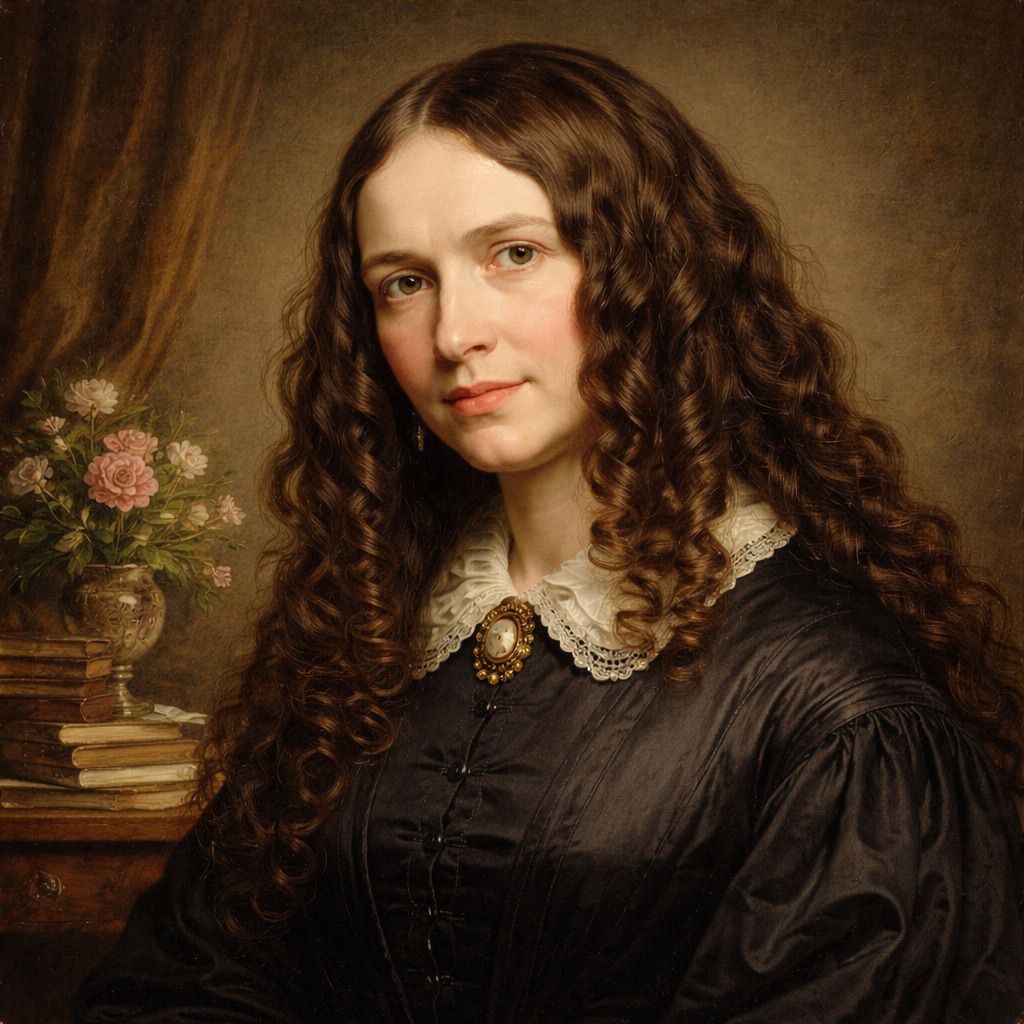
I’ve always been fascinated by Elizabeth Barrett Browning’s life, particularly her relationship with Robert Browning. It’s not just the romance – though that’s certainly a big part of it – but the way she navigated her own desires and ambitions within it.
For me, the most compelling aspect is how Elizabeth, as a poet, struggled to balance her need for creative expression with her expectations of what a wife should be. I can relate to this internal conflict; in college, I often felt like I was caught between pursuing my passion for writing and meeting the more “practical” demands of a career or family.
It’s striking that Elizabeth wrote some of her most famous poetry during her courtship with Robert – specifically, Sonnets from the Portuguese. These sonnets are love letters, but they’re also declarations of identity, power, and autonomy. I wonder if she was using her writing as a way to stake her claim on who she was outside of marriage, or if it was simply an expression of the intensity of their relationship.
The fact that Robert Browning was often seen as the more talented poet in the pair adds another layer of complexity to Elizabeth’s story. Did he enable her creative pursuits, or did he hold her back by being the dominant figure? I think about my own relationships and how they’ve influenced my writing; have I ever used someone else’s validation to justify my own ambitions?
Sometimes I find myself thinking that Elizabeth’s relationship with Robert was a kind of Faustian bargain – she got to pursue her art, but at what cost? She had to sacrifice some level of independence, even though it was still within the bounds of Victorian societal norms. It makes me question whether I’d ever be willing to make similar compromises in my own life.
I’ve read that Elizabeth often used pseudonyms or anonymous submissions for her work, which seems like a way of protecting herself from criticism or judgment. As someone who’s also written under various names and identities online, I can understand the desire for anonymity. But it also makes me uneasy – am I hiding behind my writing, or is it truly an expression of myself?
There are moments when Elizabeth’s relationship with Robert feels suffocating to me; I imagine him exerting pressure on her to conform to certain expectations, and she resisting in subtle but significant ways. It makes me think about how relationships can both empower and constrain us – even the ones we’re deeply invested in.
Sometimes, while reading Elizabeth Barrett Browning’s poetry or letters, I feel like I’m getting glimpses of a woman who was more complex, more multifaceted, than I initially gave her credit for. It’s as if she’s still figuring out who she is, and that uncertainty resonates with me on a deep level.
I suppose what draws me to Elizabeth Barrett Browning is not just the romance or the poetry – it’s the sense of being torn between different selves, of searching for a way to reconcile our desires and expectations. It’s a feeling I’m still navigating in my own life, and seeing her story play out has made me feel less alone in that struggle.
As I delve deeper into Elizabeth Barrett Browning’s life, I find myself increasingly fascinated by the tension between her public and private selves. On one hand, she was a celebrated poet, known for her passionate and expressive verse. But on the other, she was also a wife and daughter, bound by the societal expectations of her time.
I think about how this dichotomy might have played out in my own life if I’d chosen to pursue writing full-time after college. Would I have been able to reconcile my desire for creative expression with the pressure to find a “stable” career? Or would I have felt forced to compartmentalize my passions, hiding them away from the rest of the world?
Elizabeth’s letters and poetry suggest that she struggled with this very same question. In one letter, she writes about feeling like an actress, playing out a role for her husband’s benefit rather than her own. It’s a striking image – Elizabeth, dressed in a mask of propriety, hiding behind a veil of convention.
It makes me wonder if I’m doing something similar with my writing. Do I use it as a way to express myself honestly, or do I tone down my emotions and experiences for fear of being judged or rejected? The thought is unsettling – am I compromising my own truth in order to fit into someone else’s idea of what a writer “should” be?
I also find myself thinking about Elizabeth’s relationship with her family, particularly her father. He was a wealthy and influential man who encouraged her love of poetry, but also expected her to marry well and manage the household. It’s a classic patriarchal dynamic – he enables her creativity, but only as long as she conforms to his expectations.
I’ve had similar experiences with my own family members, who often view writing as a hobby or a pastime rather than a legitimate career path. They mean well, but their words can be hurtful and limiting. It’s hard not to internalize these messages, to feel like I’m somehow less capable or less worthy because I choose to pursue this path.
Reading about Elizabeth Barrett Browning’s life has made me realize just how much I’ve internalized these same messages. There are times when I feel like I’m living in a state of suspended animation – stuck between my desire for creative expression and the pressure to conform to societal expectations. It’s a feeling that’s both familiar and suffocating, like being trapped in a perpetual twilight zone.
And yet, as I continue to read about Elizabeth’s story, I also feel a sense of solidarity. She may have lived in a different time and place, but her struggles are eerily familiar – the tension between desire and duty, the fear of rejection and criticism, the struggle to find one’s own voice amidst the expectations of others.
It’s this sense of connection that keeps me coming back to Elizabeth Barrett Browning’s story. She may have lived a life that was vastly different from my own, but her experiences resonate with me on a deep level – we’re both searching for a way to reconcile our desires and expectations, to find a path forward in the face of uncertainty.
As I delve deeper into Elizabeth Barrett Browning’s story, I’m struck by the ways in which she navigated her own identity amidst the societal expectations placed upon her. She was a woman of privilege, with a wealthy father and a husband who supported her writing, yet she still felt constrained by the roles society assigned to her.
I think about my own life, and how I’ve struggled to reconcile my desire for independence with the need to please others. In college, I often felt like I was walking a tightrope between being seen as smart and capable versus being likable and relatable. It’s a delicate balance that many women are expected to maintain – we’re supposed to be strong and confident on the outside, while still being vulnerable and emotional enough to be attractive.
Elizabeth’s poetry suggests that she felt this same tension. In her sonnets, she often writes about the constraints of marriage and societal expectations, yet at the same time, she celebrates the love and intimacy she shares with Robert Browning. It’s a paradoxical portrayal of womanhood – one that acknowledges both the beauty and the burden of being a wife and poet in a patriarchal society.
As I read her words, I’m reminded of my own experiences with vulnerability and self-expression. In my writing, I often try to tap into my emotions and desires, but it’s hard not to feel like I’m putting myself out there for judgment or rejection. Elizabeth’s bravery in the face of criticism is something that inspires me – she wrote about her feelings, even when they were difficult or unconventional, and she did so with a level of honesty and vulnerability that’s still stunning today.
But what really resonates with me is Elizabeth’s sense of self-doubt. She often writes about feeling uncertain or unsure, not just about her writing but also about her place in the world. It’s a feeling I’m familiar with – the constant questioning of whether I’m good enough, smart enough, or talented enough to pursue my passions.
In many ways, Elizabeth Barrett Browning’s story is a reminder that our struggles are universal, regardless of time period or context. We’re all searching for a way to reconcile our desires and expectations, to find a path forward in the face of uncertainty. And it’s this sense of solidarity that I think draws me to her life – she may have lived in a different era, but her experiences speak directly to my own heart.
As I continue to explore Elizabeth’s story, I’m struck by the ways in which she embodied both strength and fragility. She was a woman who defied convention and followed her heart, yet she also struggled with the weight of societal expectations and personal doubts. It’s a complex portrayal of womanhood that feels both deeply familiar and profoundly inspiring – a reminder that we’re all capable of growth, change, and self-expression, no matter what challenges we face.
One aspect of Elizabeth Barrett Browning’s life that continues to intrigue me is her relationship with her own identity. As I mentioned earlier, she often wrote under pseudonyms or anonymous submissions, which speaks to a desire for anonymity and protection from criticism. But it also makes me wonder if this was a way of disavowing herself, of not fully embracing the complexity of her own experiences.
I think about my own writing and how I’ve used different names and identities online. Sometimes I feel like I’m hiding behind these personas, trying to distance myself from the vulnerability and uncertainty that comes with sharing my true self. But at other times, I see it as a way of claiming ownership over my words, of separating them from the expectations and judgments of others.
It’s a fragile balance, one that Elizabeth Barrett Browning seemed to be constantly negotiating in her own life. She was a woman of privilege, but she also faced societal pressures and expectations that threatened to constrain her creativity and autonomy. And yet, despite these challenges, she continued to write, to express herself honestly and vulnerably.
This is something I struggle with myself – the fear of being seen as too much, too little, or just plain wrong. But reading Elizabeth’s poetry and letters has given me a sense of courage, a reminder that it’s okay to be uncertain, to take risks, and to follow my heart.
One of the most striking aspects of Elizabeth Barrett Browning’s life is her use of language as a form of resistance. In her sonnets and other poems, she often employed imagery and metaphor to subvert societal expectations and challenge patriarchal norms. It’s a powerful way of reclaiming one’s own narrative, of taking control over how you’re perceived and understood.
I think about my own writing and how I’ve used language to explore similar themes – the tension between desire and duty, the struggle for independence and autonomy, the search for identity and self-expression. But seeing Elizabeth Barrett Browning’s work as a model has made me realize just how much more I can do with words, how much more power and agency they hold when wielded in resistance.
It’s this sense of possibility that draws me to Elizabeth’s story – the idea that language can be a tool for liberation, a way of reclaiming one’s own voice and narrative. And it’s something that I’m still grappling with today, as I navigate my own relationships, ambitions, and creative pursuits.
As I continue to explore Elizabeth Barrett Browning’s life, I’m struck by the ways in which she embodied both strength and fragility. She was a woman who defied convention and followed her heart, yet she also struggled with the weight of societal expectations and personal doubts. It’s a complex portrayal of womanhood that feels both deeply familiar and profoundly inspiring – a reminder that we’re all capable of growth, change, and self-expression, no matter what challenges we face.
In many ways, Elizabeth Barrett Browning’s story is a testament to the enduring power of creativity and resistance. Despite the societal constraints and expectations she faced, she continued to write, to express herself honestly and vulnerably. And it’s this same spirit of resilience that I hope to carry with me as I navigate my own path forward – a reminder that language has the power to liberate us, to give voice to our deepest desires and most profound struggles.